Lucky survivors rescued by Fla. turtle hospital
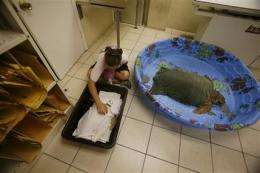
(AP) -- The turtles at this waterfront hospital have been hit by boat propellers, caught in fishing nets, attacked by sharks, stricken with tumors and lost flippers.
Or, as their veterinarian puts it, they've had a heck of a lot of luck.
Most injured turtles are never spotted and die at sea. The fortunate ones are brought to The Turtle Hospital - a converted strip club where workers graft the waterproof fabric Gore-Tex to patch badly injured shells and find other innovative ways to save lives. On this particular day, a 13-pound green sea turtle named Fin is being treated for a potentially debilitating tumor.
"He's got a new life now," says Dr. Doug Mader, the center's chief veterinarian.
---
The seafoam green hospital, halfway through the Florida Keys, offers round-the-clock care to the turtles that call the waters around this ribbon of islands home.
Morning is just beginning, and the hospital's patients are already being prepped on the X-ray room floor. Iain, an 89-pound loggerhead, and Fin are on their backs in plastic kiddie pools, being sprayed with disinfectant. Another green sea turtle on deck for surgery, 37-pound Rocky Thyme, awaits attention.
Iain is eventually lifted onto a steel cart and wheeled into the operating room. A half-dozen hospital staffers gather around the turtle, including Mader, who is wearing blue Wrangler jeans and Teva sandals.
"Ready?" Mader asks.
"Ready," says Richie Moretti, the hospital's founder and director, who assists in surgery but is not a veterinarian. And a morning of surgery begins.
Iain's tumor is removed with the flash of a laser. Fin's surgery is a bit more complex: her flippers flutter against a white towel as a breathing tube is inserted, and a manual respirator causes her shell to lift slightly with her lungs every six to seven seconds as 15 tumors are removed.
Finally the surgeons move on to Rocky Thyme, who has clung to life even though a boat split her spine.
Rocky has external tumors and is weakened by injury. If she has internal tumors, too, she will have to be euthanized.
Mader enters Rocky's body with an endoscope; a crack in her shell glows orange from the light. On a small Sony screen, the black-and-white image shows her insides - lungs, kidneys, intestines.
"Good news," says Mader, a volunteer. Rocky shows no signs of internal tumors. She'll be nursed back to health and eventually have external tumors removed to prevent the fibropapilloma from spreading.
There is a bittersweet side to this: Rocky is still paralyzed and will never fully recover. She can never again live in the wild.
---
This used to be a strip club.
Moretti bought a 21-room motel next door in 1981. He turned a saltwater pool into an aquarium for fish, but children fascinated by the cartoon "Teenage Mutant Ninja Turtles" kept asking where the turtles were.
The only way the state would let him keep endangered animals was to help rehabilitate them. So in 1986, the hospital was born.
At first, it was a makeshift operation. Turtles were mostly sent to local veterinarians for treatment and nursed back to health at the motel. But surgeries were done there, too, and guests could see vets in scrubs carrying turtles into motel rooms for treatment.
In 1991, Moretti bought the shuttered strip club. The motel had to close after Hurricane Wilma in 2005, but the turtle sanctuary has lived on in the converted club.
Out back, a 100,000-gallon pool - and a number of smaller ones - house recuperating turtles. Some can only float, with spinal cord injuries causing paralysis. Some have the bite marks of a shark on their shells. One was attacked by wild dogs.
Along the way, Mader, 51, and others have had little guidance on how to treat these creatures. Other turtle hospitals exist, though treatments can still be tricky - a drug that's effective on humans or even dogs and cats probably has never been tested on a sea turtle.
Mader still can't forget when he used a canine pain medication on two turtles. One died. The other nearly did.
"I still feel like crap almost 12 years later," he said. "You feel so bad."
The staffers try hard not to become too attached to the turtles. Mader wanted to just give each patient a number, but he lost, and the roster of turtles - Bubble Butt, Rebel, Cracker, Whit's End, Snoop and so on - crowds a white board near the entrance. The affection felt for these turtles is evident.
As afternoon crawls on, Moretti, 65, uses a boat brush to rub algae from turtles in the main pool.
"We're gonna clean your shell!" he says with the pitched enthusiasm of a grandparent. "We're gonna clean your shell!"
---
Despite the illness and injuries, this is a place of happiness.
Hale, a 68-pound green sea turtle who spent 53 weeks hospitalized, is being released today. He came here entangled in fishing line wrapped so tight it cut down to the bone. His right front flipper was amputated and tumors plagued him. Today, he is ready to go home.
The turtle flops around in seeming anticipation once he's loaded into a black plastic container. After a short trip to the dock, Hale is taken 12 miles out to sea on Moretti's boat.
Moretti and Ryan Butts, the hospital's administrator, lift the container to the boat's ledge. Hale lowers his head and, in a moment, he disappears.
Everyone on board raises a bottle of water, and Moretti offers a toast.
"To the turtles," he says.
As Moretti and Butts hug and offer compliments on their work, a tiny head pokes up from the water half a football field away. It is Hale.
"Same thing," Moretti says. "We'll get no Christmas card."
---
Later, after lunch, when the crew is back ashore, the call comes in. A turtle at Sombrero Beach. The ambulance - a converted van complete with flashing lights and a kiddie pool in the back - is dispatched.
Butts and a marine biology student, 30-year-old Micah Rogers, are greeted at the scene by a sheriff's deputy.
"It's a big guy," the deputy warns.
But the turtle, a loggerhead, is sliced open and decaying. It looks like a boat hit it, but they won't know for sure even after the necropsy.
The stench of decay is overwhelming as it's loaded into the ambulance. If it had been spotted sooner, things might have been different.
---
Back at the hospital, a happier scene awaits. The three patients who underwent surgery this morning are resting in their pools, shrouded in wet towels.
They'll spend the night recovering, and Fin and Iain may one day return to sea - the moment staff members relish, the one they talk about for years.
Mader remembers the first time they grafted a shell. It took months for Puka to heal, and finally the day came, like it has for more than 1,000 turtles they've released. When she first hit the water, it was joyous.
"If a turtle could smile," he said, "she was smiling."
Everyone here has their own perception of what makes these animals so captivating - their peacefulness, their personalities, the affection in their eyes and face. But for Mader and Moretti alike, it is the sense of history, being near an animal that has lived since prehistoric times and struggles to survive today.
With each one that's rescued, this is what they think of. That each turtle matters. That each one is a gift. That with every turtle saved, the species stands a little better chance.
©2009 The Associated Press. All rights reserved. This material may not be published, broadcast, rewritten or redistributed.


