August 6, 2009 feature
New model for social marketing campaigns details why some information 'goes viral'
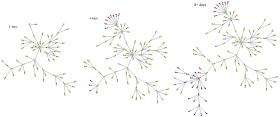
(PhysOrg.com) -- Marketers dream of finding ways to get something to "go viral" on the Internet. Indeed, viral marketing, whether it be through email, YouTube, Facebook or Twitter, has become the Holy Grail of online marketing campaigns. With viral marketing, it is possible for the message to reach millions in a matter of hours. Marketers and scientists alike have been studying this phenomenon in the hopes that it will yield information about human dynamics.
“There has been a lot of research done on social networks,” Esteban Moro tells PhysOrg.com. “However, until now it has been rare to get feedback from an actual performed experiment. Most research on social media is done with data that is inferred. But we have real experimental data for the basis of our model.” Moro is a scientist at the Institute of Mathematical Sciences at Carlos III University in Madrid, Spain. Along with José Luis Iribarren at an IBM division based in Madrid, Moro devised a viral marketing experiment that provides some quantitative conclusions about how something goes viral online. Their work appears in Physical Review Letters: “Impact of Human Activity Patterns on the Dynamics of Information Diffusion.”
“Most models of information diffusion through social media are based on the idea of homogeneity in human response,” Moro explains. According to Moro, most models are based around the average time that it takes for a person to respond to a request and then to pass it on. This model, while it might be useful in predicting some aspects of online marketing campaigns, does not adequately account for the reasons that some rumors, advertisements, content and even viruses suddenly explode worldwide in what is known as “going viral.”
“Humans respond differently,” Moro continues. “We performed a viral marketing experiment and used the response to build a different model, based on the heterogeneity of human response.” The experiment consisted of seeding a campaign over the Internet that rewarded participants for passing it along via email to friends and colleagues. The email messages reached more than 30,000 individuals in 11 European countries, and Moro and Iribarren were able to track the spread of the piece of information through social networks. “Collectively, most information moves at a slower pace through networks than expected,” Moro says.
But, if information moves slower than expected through social networks, how does one explain some information that “goes viral” quickly? Moro says that there is a tipping point of information spreading through social networks. The ability to surpass that tipping point and reach most of the collectivity is determined by those who are more actively involved in social media. “Some people respond to email within a couple of minutes. They are more active on social networks. If these people find something compelling, they respond quickly and propagate the information through their social neighborhood,” Moro says. “It’s about a difference in the way we schedule priorities, and differences in the way humans send information.”
On the other hand, if information does not reach the tipping point needed to “go viral,” it is because that information is at the mercy of those who take longer to respond. Instead of capturing the interest of the fastest responders, some information merely moves slowly through social networks, sometimes lasting months or years as it continues to be pushed through social media channels as people get around to it after days or weeks. “Even though our experiment lasted only a couple of months,” Moro says, “we were still receiving responses after finishing it. People were still responding. It was just taking them longer to get around to it.”
The model offers interesting insight into human dynamics. “Our work shows that there is no such thing as a typical time scale in human dynamics, and the impact of this fact in information diffusion,” Moro insists. “This sharply contrasts with current information diffusion models that base information spread on homogenous response time.” He also points out that this work could also be helpful in tracking the spread of fads, hoaxes, opinions or rumors.
Moro says that IBM has a patent to detail a model for viral marketing campaigns. “Our model allows us to predict how many people get the campaign message the first day, and how long it will take the message to go through social networks. The model provides a mathematical framework for modeling efficiency in social networks.”
More information: José Luis Iribarren, Esteban Moro, “Impact of Human Activity Patterns on the Dynamics of Information Diffusion,” Physical Review Letters (2009). Available online: link.aps.org/doi/10.1103/PhysRevLett.103.038702 .
Copyright 2009 PhysOrg.com.
All rights reserved. This material may not be published, broadcast, rewritten or redistributed in whole or part without the express written permission of PhysOrg.com.


