Japan to use deep-sea probes to search for minerals
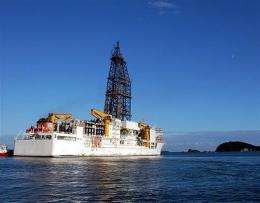
August 6, 2009 A deep-sea drilling vessel off the coast of Japan's Wakayama prefecture

Enlarge

This photo released in 2007 by the Japan Agency for Marine-Earth Science and Technology's (JAMSTEC) Integrated Ocean drilling Program, shows a deep-sea drilling vessel off the coast of Japan's Wakayama prefecture. Japan plans to deploy unmanned probes to scour the sea-floor around the resource-poor island nation for mineral deposits.

Japan plans to deploy unmanned probes to scour the sea-floor around the resource-poor island nation for mineral deposits, a government-backed scientific organisation said Thursday.

Two underwater robots tethered to a ship would explore the for rare metals, said an official of the Japan Agency for Marine-Earth Science and Technology (JAMSTEC), which is set to start the project in fiscal year 2010.

Researchers hope to discover minerals such as manganese, cobalt, lead and zinc used in Japanese products from cars to the batteries in IT gadgets.

JAMSTEC, a government-linked agency that specialises in environmental research and marine technology, plans to invest four billion yen (42.55 million dollars) in the probes, the official said.

The move comes as Japan, the world's second-biggest economy, tries to break away from its dependence on foreign imports of raw materials and energy.

The Ministry of Economy, Trade and Industry is trying to secure stable supplies of rare metals amid growing demand from emerging economies that has sparked worries over a supply crunch.

"It is extremely important to ensure stable supplies of rare metals from the standpoint of maintaining and strengthening the competitiveness of Japan's manufacturing industry," the ministry said in a strategy published last week.

It is important for Japan to "strengthen the technology it holds for securing natural resources," it added.

Experts say deep-sea mining, especially near mineral-belching hydrothermal vents on the , will become feasible despite huge technical challenges and expenses, as certain minerals become more scarce worldwide.

(c) 2009 AFP


print this article email this article download pdf blog this article bookmark this article     Stumble it Digg this share on Facebook retweet share on Reddit add to delicious
Rate this story - not rated yet

Rank Filter

Move the slider to adjust rank threshold, so that you can hide some of the comments.


Display comments: newest first

  • omatumr - Aug 06, 2009
    • Rank: 3 / 5 (1)
    CLEVER!

    This is indeed clever.

    We know very little about geochemistry at the bottom of the ocean.

    One of my former students, Dr. Bin Li, used noble gas isotopes to elucidate the formation of the Kuroko massive sulfide deposits. These economically important minerals likely formed in contact with sea water.

    With kind regards.
    Oliver K. Manuel
    http://www.omatumr.com

August 6, 2009 all stories

Comments: 1

not rated yet
  • Stumble this up

  • Digg this

  • share this

  • hide
  • Related Stories

  • Greying Japan plans robo-nurses in five years: govt
    created Mar 25, 2009 | popularity not rated yet | comments 0
  • Japan mulls high-tech economic stimulus
    created Mar 17, 2009 | popularity not rated yet | comments 0
  • Technology opens promise, perils of ocean mining
    created Apr 01, 2009 | popularity not rated yet | comments 0
  • Japan to develop bioethanol-mix fuel
    created Jul 19, 2005 | popularity not rated yet | comments 0
  • Japan plans WTO complaint on SKorea battery rule
    created Jun 22, 2009 | popularity not rated yet | comments 0


  • hide
  • Relevant PhysicsForums posts

  • The IPCC and the term "most"
    created Nov 23, 2009
  • Is global warming a fact?
    created Nov 23, 2009
  • Random variability of wind patterns
    created Nov 23, 2009
  • Record precipitation in the UK
    created Nov 22, 2009
  • More from Physics Forums - Earth

Other News

Monster Waves on the Sun are Real

Monster Waves on the Sun are Real (w/ Video)

Space & Earth / Astronomy

created 2 hours ago | popularity 5 / 5 (6) | comments 0

Sometimes you really can believe your eyes. That's what NASA's STEREO (Solar Terrestrial Relations Observatory) spacecraft are telling researchers about a controversial phenomenon on the sun known as the "solar ...


Cosmic 'dig' reveals vestiges of the Milky Way's building blocks

Cosmic 'Dig' Reveals Vestiges of the Milky Way's Building Blocks

Space & Earth / Astronomy

created 7 hours ago | popularity 5 / 5 (11) | comments 1

(PhysOrg.com) -- Peering through the thick dust clouds of our galaxy's "bulge" (the myriads of stars surrounding its center), a team of astronomers has unveiled an unusual mix of stars in the stellar grouping ...


No Wheel Stall in Diagnostic Drive

Spirit Mars Rover: No Wheel Stall in Diagnostic Drive

Space & Earth / Space Exploration

created 2 hours ago | popularity 5 / 5 (1) | comments 0

(PhysOrg.com) -- On Sol 2095 (Tuesday, Nov. 24), Spirit performed a set of diagnostic actions related to a stall of the right-rear wheel on the previous drive, three days earlier.


Climate experts debate strategies for reducing atmospheric carbon and future warming

Climate experts debate strategies for reducing atmospheric carbon and future warming

Space & Earth / Environment

created 3 hours ago | popularity 3.7 / 5 (3) | comments 2

(PhysOrg.com) -- Reducing carbon dioxide to safe levels may require extracting carbon from the air, says Cornell climate researcher.


Oceanic crust formation is dynamic after all

Oceanic crust formation is dynamic after all

Space & Earth / Earth Sciences

created 6 hours ago | popularity 4 / 5 (1) | comments 0

Imagine the Earth's crust as the planet's skin: Some areas are old and wrinkled while others have a fresher, more youthful sheen, as if they had been regularly lathered with lotion.