Protein handlers should be effective treatment target for cancer and Alzheimer's
August 6, 2009
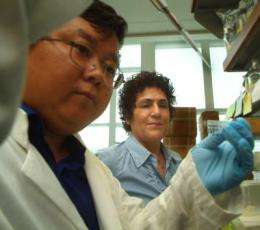
Dr. Xiongjie Jin (left), assistant research scientist, and Dr. Nahid Mivechi are exploring the role of molecular chaperones and heat shock factors in cancer. Credit: Medical College of Georgia
Cancer and Alzheimer's have excess protein in common and scientists say learning more about how proteins are made and eliminated will lead to better treatment for both.
Medical College of Georgia researchers Drs. Nahid F. Mivechi and Dimitrios Moskofidis have received two National Cancer Institute grants totaling nearly $3 million and a $982,800, four-year grant from the U.S. Department of Veterans Affairs in the last 12 months to support studies of proteins and the molecular chaperones that manage them from cradle to grave.
Understanding the exact role molecular chaperones play in cancer and Alzheimer's should lead to better ways to intervene in both, says Dr. Mivechi, director of the MCG Center for Molecular Chaperone Biology/Radiobiology and Cancer Virology.
Everyone needs molecular chaperones which prompt genes to make proteins, move proteins around the body, fold them up into the proper shape to function properly and even haul them off when they no longer work. Cancer needs them even more for the endless cell replication required for tumor growth, Dr. Mivechi says. Essentially the opposite happens in Alzheimer's in which excess protein is a major component of the destructive brain plaque that is the disease's hallmark. Dr. Mivechi believes molecular chaperones, which typically slow in activity with age, are failing at their job so that proteins aggregate in the brain, contributing to Alzheimer's and other neurodegenerative diseases in which brain cell communication is interrupted.
The MCG center has evidence that disabling molecular chaperones or the heat shock factors that control some of them, disables tumor formation in the liver and probably the breast. Researchers are also now examining brain tumors as well as pancreatic and prostate cancer.
They also want to know whether ramping up the activity of molecular chaperone can essentially make them act young again and halt development of Alzheimer's, Parkinson's and other neurodegenerative diseases.
"We have to find the balance," Dr. Mivechi says of the center's concurrent work to find drugs that adjust the activity of molecular chaperones and heat shock factors. She theorizes these drugs would be used for limited periods to avoid trading cancer for an increased risk of neurodegenerative disease or vice versa.
"A lot of drugs, such as chemotherapeutic agents, can kill cancer but they also kill normal tissue. That is a limiting factor. We are looking for better drugs," she says.
The MCG center is among the first to study molecular chaperones and heat shock factors in animals to better understand their role in these diseases. Drs. Mivechi and Moskofidis, a viral immunologist, have developed 20 mouse models missing different molecular chaperones or heat shock factors in the last decade to help explore the large family of molecular chaperones. For contrast, they also have a mouse that over expresses heat shock factor 1, or Hsf1, a major activator of molecular chaperones.
They are now focusing on developing mice that lack molecular chaperones or heat shock factors in targeted areas, such as liver or breast tissue, as well as mice in which these can be removed during cancer to determine what impact their loss has on active disease. They also are cross breeding the mice, to create one, for example, that also over expresses the molecule, Her2/Neu, which is over active in some of the most aggressive breast cancers. By comparing the resulting mouse to one that just over expresses Her2/Neu, they can examine the impact of Hsf1, Dr. Mivechi says.
"That is how these findings will translate to patients," Dr. Mivechi says. "We need to know, not only how deleting or augmenting molecular chaperones and heat shock factors affects disease development, but also how it impacts disease progression."
Their studies also will help researchers pinpoint which molecular chaperones and/or heat shock factors are associated with a specific type of cancer or neurodegenerative disease which will help in the design of targeted therapies.
With the VA-funded study, for example, when they remove a specific molecular chaperone they find Alzheimer's-like disease accelerates dramatically in their animal model. They want to expand these studies to look at traumatic brain injury as well as other neurodegenerative diseases.
Source: Medical College of Georgia
-
Targeting helpers of heat shock proteins could help treat cancer, cardiovascular disease
Jun 22, 2009 |
not rated yet |
0
-
Researchers aim to over-stress already taxed mantle cell lymphoma cells
Nov 10, 2008 |
not rated yet |
0
-
Progress in understanding the malarial parasite
Sep 14, 2007 |
not rated yet |
0
-
Researchers Find Tools Needed To Build a Cellular Shredder
May 28, 2009 |
not rated yet |
0
-
Drug combinations key in treating neurodegenerative diseases
Jan 30, 2009 |
not rated yet |
0
-
Engineers build first sub-10-nm carbon nanotube transistor
Feb 01, 2012 |
4.9 / 5 (33) |
30
-
Something old, something new: Evolution and the structural divergence of duplicate genes
Jan 31, 2012 |
4.6 / 5 (7) |
1
-
The hidden nanoworld of ice crystals: Revealing the dynamic behavior of quasi-liquid layers
Jan 30, 2012 |
5 / 5 (4) |
1
-
Stock market network reveals investor clustering
Jan 27, 2012 |
3.9 / 5 (23) |
8
-
Of microchemistry and molecules: Electronic microfluidic device synthesizes biocompatible probes
Jan 26, 2012 |
5 / 5 (2) |
0
-
Is Everyday Technology Killing Us?
Feb 08, 2012
-
Exercise and weight loss
Feb 08, 2012
-
Why do we have head aches? Our brains can't feel anything.
Feb 07, 2012
-
"The end of diseases" by David Agus, interview from Daily Show with Jon Stewart
Feb 04, 2012
-
Oncolytic adenovirus
Feb 04, 2012
-
Nutrition label stuffs and diets
Feb 02, 2012
- More from Physics Forums - Medical Sciences
More news stories
Starve a virus, feed a cure? Findings show how some cells protect themselves against HIV
A protein that protects some of our immune cells from the most common and virulent form of HIV works by starving the virus of the molecular building blocks that it needs to replicate, according to research published online ...
8 hours ago |
5 / 5 (2) |
0
|
Overeating may double risk of memory loss
New research suggests that consuming between 2,100 and 6,000 calories per day may double the risk of memory loss, or mild cognitive impairment (MCI), among people age 70 and older. The study was released today and will be ...
Medicine & Health / Neuroscience
5 hours ago |
5 / 5 (2) |
0
|
Injured boomers beware: Know when to see doctor
(AP) -- It happened to nurse Jane Byron years after an in-line skating fall, business owner Haralee Weintraub while doing "men's" push-ups, and avid cyclist Gene Wilberg while lifting a heavy box.
10 hours ago |
5 / 5 (1) |
0
Declining health-care productivity in England: Who says so?
Reports that the National Health Service in England has been declining in productivity in the last decade appear to have been accepted as fact. However, a Viewpoint published Online First by The Lancet disputes this. The Vi ...
3 hours ago |
not rated yet |
0
FDA-approved drug rapidly clears amyloid from the brain, reverses Alzheimer's symptoms in mice
Neuroscientists at Case Western Reserve University School of Medicine have made a dramatic breakthrough in their efforts to find a cure for Alzheimer's disease. The researchers' findings, published in the journal Science, show t ...
Medicine & Health / Neuroscience
Feb 09, 2012 |
4.9 / 5 (58) |
17
|
Scientists discover molecular secrets of 2,000-year-old Chinese herbal remedy
For roughly two thousand years, Chinese herbalists have treated Malaria using a root extract, commonly known as Chang Shan, from a type of hydrangea that grows in Tibet and Nepal. More recent studies suggest that halofuginone, ...
New method to examine batteries -- MRI from the inside
There is an ever-increasing need for advanced batteries for portable electronics, such as phones, cameras, and music players, but also to power electric vehicles and to facilitate the distribution and storage of energy derived ...
Google might launch Drive for cloud storage soon
(PhysOrg.com) -- Google's next big move, according to the Wall Street Journal, is a cloud storage service called Drive. Hardly first to the plate, Google is simply catching up to introducing its cloud reposi ...
A mitosis mystery solved: How chromosomes align perfectly in a dividing cell
Although the process of mitotic cell division has been studied intensely for more than 50 years, Whitehead Institute researchers have only now solved the mystery of how cells correctly align their chromosomes during symmetric ...
Lab study raises questions over nano-particle impact
Tests involving chickens have raised questions about the impact on health from engineered nano-particles, the ultra-fine grains commonly used in drugs and processed foods, scientists said on Sunday.
Researchers find extensive RNA editing in human transcriptome
In a new study published online in Nature Biotechnology, researchers from BGI, the world's largest genomics organization, reported the evidence of extensive RNA editing in a human cell line by analysis of RNA-seq data, demons ...