Aesop's fable 'the crow and the pitcher' more fact than fiction (w/ Video)
August 6, 2009
Aesop's fable 'the crow and the pitcher' more fact than fiction (w/ Video)

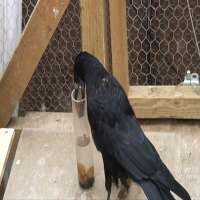
In Aesop's fable 'The crow and the pitcher' a thirsty crow uses stones to raise the level of water in a pitcher to quench its thirst. A new study published online today (06 August) in the journal Current Biology demonstrates that rooks, birds belonging to the corvid (or crow) family, are able to solve complex problems using tools and can easily master the same technique demonstrated in Aesop's fable.

Christopher Bird of the University of Cambridge, lead author of the paper, highlighted the importance of the findings, stating: "Corvids are remarkably intelligent, and in many ways rival the great apes in their physical intelligence and ability to solve problems. The only other animal known to complete a similar task is the orang-utan.

"This is remarkable considering their is so different to the great apes'. Although it has been speculated in folklore, empirical tests are needed to examine the extent of their intelligence and how they solve problems."

This video is not supported by your browser at this time.

The video shows the first trial in which Connelly is required to raise the water level by a varying amount. In this trial seven stones are needed to raise the water level and worm to the "reachable height." Connelly flies to the testing platform and investigates the apparatus before the stones are added. Connelly adds seven stones before successfully acquiring the worm. He then leaves the testing platform.

This video is not supported by your browser at this time.

The video shows the second trial in which Connelly is required to raise the water level by a varying amount. In this trial only one stone is needed to raise the water level and worm to the "reachable height." Connelly flies to the testing platform and investigates the apparatus before the stones are added. Connelly adds one stone before successfully acquiring the worm. He then leaves the testing platform.

In the first part of the study, at which point the researchers varied the height of the water, the four rooks which were the subject of the research used stones to raise the water level to reach a worm floating on top. The clever proved very adept and were highly successful regardless of the starting level of the water and the number of the stones needed.

Two of the birds were successful on their first try to raise the height of the water to a level at which the worm floating on top could be reached whilst the other two birds needed a second try.

The birds were also highly accurate in their ability, adding the exact number of stones needed to raise the water level to the necessary height. Additionally, rather than attempting to reach the worm after each stone was dropped, they apparently estimated the number needed from the outset and waited until the appropriate water level was reached before dipping their beaks into the tube.

This video is not supported by your browser at this time.

The video shows Monroe selectively choosing to use larger stones rather than smaller ones. Monroe flies to the testing platform and investigates the apparatus before the stones are added. Monroe adds three large stones before successfully acquiring the worm. She then leaves the testing platform.

This video is not supported by your browser at this time.

The video shows Cook selectively dropping stones into the tube containing water rather than the tube containing sawdust. Cook flies to the testing platform and investigates both tubes before the stones are added. Cook adds four large stones to the water before successfully acquiring the worm. He then leaves the testing platform

In the second experiment the rooks were presented with stones which varied in size. The rooks selected larger stones over smaller ones (although not straight away). The scientists speculate that the birds learnt rapidly that the larger stones displaced more water and they were therefore able to obtain the reward more quickly than using small stones.

In the third experiment, the rooks were observed to recognise that sawdust could not be manipulated in the same manner as water. Therefore when presented with the choice between a tube half-filled with either sawdust or water, rooks dropped the pebbles into the tube containing water and not the sawdust.

Although the study demonstrates the flexible nature of tool use in rooks, they are not believed to use tools in the wild.

"Wild tool use appears to be dependent on motivation," Bird said. "Rooks do not use tools in the wild because they do not need to, not because they can't. They have access to other food that can be acquired without using tools."

As Bird noted, that fits nicely with Aesop's maxim, demonstrated by the crow: "Necessity is the mother of invention."

More information: The paper 'Rooks Use Stones to Raise the Water Level to Reach a Floating Worm' will be published on the website.

Source: University of Cambridge (news : web)

4.8 /5 (21 votes)  

Filter


Move the slider to adjust rank threshold, so that you can hide some of the comments.


Display comments: newest first

OregonWind
Aug 06, 2009

Rank: 2 / 5 (1)
This is remarkable!

Actually, I think the crow raised the water level to be able to reach and eat an insect (?) that was floating on the surface.
fsmith
Aug 06, 2009

Rank: 3.5 / 5 (2)
Yes, we've known how to do this for some time now. Do you want us to explain how it works? Do you want us to write your thesis for you too?


/rook
RobertKLR
Aug 06, 2009

Rank: 3 / 5 (2)
So that's how you get the worm. For years I just passed them by.
undrgrndgirl
Aug 07, 2009

Rank: 4.5 / 5 (2)
not surprised...most fables and myths are built on truth...the researcher's name is BIRD! lol!
Alexa
Aug 10, 2009

Rank: 1 / 5 (1)
Well, if we consider, scientists cannot recognize, vacuum is dense matter for two thousands of years, then the crows aren't bad at all in recognizing of connections of observable world.
Rank 4.8 /5 (21 votes)
Relevant PhysicsForums posts
  • Amazon fungi found to eat plastic
    createdFeb 01, 2012
  • Tips Picking up TEM grids?
    createdFeb 01, 2012
  • Limits of the imagination
    createdJan 30, 2012
  • Why doesn't the plasmodium falciparum not have shizonts?
    createdJan 29, 2012
  • Goods Books
    createdJan 25, 2012
  • Question about Mitosis
    createdJan 24, 2012
  • More from Physics Forums - Biology

More news stories

Amazon fungi found that eat polyurethane, even without oxygen

(PhysOrg.com) -- Until now polyurethane has been considered non-biodegradable, but a group of students from Yale University in the US has found fungi that will not only eat and digest it, they will do so even in the absence ...

Biology / Cell & Microbiology

created 15 hours ago | popularity 4.9 / 5 (21) | comments 12 | with audio podcast report

Discovery of extremely long-lived proteins may provide insight into cell aging

One of the big mysteries in biology is why cells age. Now scientists at the Salk Institute for Biological Studies report that they have discovered a weakness in a component of brain cells that may explain ...

Biology / Cell & Microbiology

created 8 hours ago | popularity 4.9 / 5 (8) | comments 0 | with audio podcast

Scientists snare 'superprawn' off New Zealand

Scientists have captured a "supergiant" crustacean in waters seven kilometres (4.5 miles) deep off New Zealand, measuring 10 times the normal size of related species.

Biology / Plants & Animals

created 17 hours ago | popularity 4.8 / 5 (8) | comments 8

Collective action: Occupied genetic switches hold clues to cells' history

If you wanted to draw your family tree, you could start by searching for people who share your surname. Cells, of course, don't have surnames, but scientists at the European Molecular Biology Laboratory (EMBL) ...

Biology / Cell & Microbiology

created 11 hours ago | popularity not rated yet | comments 0 | with audio podcast

Genetic information migrates from plant to plant

Plant scientists were confounded by the fact that the DNA extracted from the plants’ green chloroplasts sometimes showed the greatest similarities when related species grew in the same area. They tried ...

Biology / Biotechnology

created 14 hours ago | popularity 4 / 5 (3) | comments 1 | with audio podcast


Scientists chart high-precision map of Milky Way's magnetic fields

(PhysOrg.com) -- Scientists at the Naval Research Laboratory (NRL) are part of an international team that has pooled their radio observations into a database, producing the highest precision map to date of ...

Whole exome sequencing identifies cause of metabolic disease

Sequencing a patient's entire genome to discover the source of his or her disease is not routine – yet. But geneticists are getting close.

Hearing metaphors activates brain regions involved in sensory experience

When a friend tells you she had a rough day, do you feel sandpaper under your fingers? The brain may be replaying sensory experiences to help understand common metaphors, new research suggests.

Renowned physicist invents microscope that can peer at living brain cells

(PhysOrg.com) -- Ever since scientists began studying the brain, they’ve wanted to get a better look at what was going on. Researchers have poked and prodded and looked at dead cells under electron microscopes, ...

New kind of high-temperature photonic crystal could someday power everything from smartphones to spacecraft

A team of MIT researchers has developed a way of making a high-temperature version of a kind of materials called photonic crystals, using metals such as tungsten or tantalum. The new materials — which ...

Hackers intercept FBI, Scotland Yard call (Update)

(AP) -- Trading jokes and swapping leads, investigators from the FBI and Scotland Yard spent the conference call strategizing about how to bring down the hacking collective known as Anonymous, responsible ...