Nanoscale origami from DNA
August 6, 2009 Nanoscale origami from DNA

Enlarge

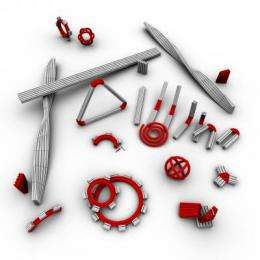
Scientists at the Technische Universitaet Muenchen and Harvard University have thrown the lid off a new toolbox for building nanoscale structures out of DNA, with complex twisting and curving shapes. In the Aug 7 issue of the journal Science, they report a series of experiments in which they folded DNA, origami-like, into 3-D objects including a beach ball-shaped wireframe capsule just 50 nanometers in diameter. Credit: H. Dietz, TUM Dept. of Physics, all rights reserved.

Scientists at the Technische Universitaet Muenchen (TUM) and Harvard University have thrown the lid off a new toolbox for building nanoscale structures out of DNA, with complex twisting and curving shapes. In the August 7 issue of the journal Science, they report a series of experiments in which they folded DNA, origami-like, into three dimensional objects including a beachball-shaped wireframe capsule just 50 nanometers in diameter.

"Our goal was to find out whether we could program DNA to assemble into shapes that exhibit custom curvature or twist, with features just a few nanometers wide," says biophysicist Hendrik Dietz, a professor at the Technische Universitaet Muenchen. Dietz's collaborators in these experiments were Professor William Shih and Dr. Shawn Douglas of Harvard University. "It worked," he says, "and we can now build a diversity of three-dimensional nanoscale machine parts, such as round gears or curved tubes or capsules. Assembling those parts into bigger, more complex and functional devices should be possible."

As a medium for nanoscale engineering, DNA has the dual advantages of being a smart material - not only tough and flexible but also programmable - and being very well characterized by decades of study. Basic tools that Dietz, Douglas, and Shih employ are programmable - directing DNA strands to form custom-shaped bundles of cross-linked double helices - and targeted insertions or deletions of base pairs that can give such bundles a desired twist or curve. Right-handed or left-handed twisting can be specified. They report achieving precise, quantitative control of these shapes, with a radius of curvature as tight as 6 nanometers.

The toolbox they have developed includes a graphical software program that helps to translate specific design concepts into the DNA programming required to realize them. Three-dimensional shapes are produced by "tuning" the number, arrangement, and lengths of helices.

In their current paper, the researchers present a wide variety of nanoscale structures and describe in detail how they designed, formed, and verified them. "Many advanced macroscopic machines require curiously shaped parts in order to function," Dietz says, "and we have the tools to make them. But we currently cannot build something intricate such as an ant's leg or, much smaller, a ten-nanometer-small chemical plant such as a protein enzyme. We expect many benefits if only we could build super-miniaturized devices on the nanoscale using materials that work robustly in the cells of our bodies - biomolecules such as DNA."

More information: "Folding DNA into Twisted and Curved Nanoscale Shapes," by Hendrik Dietz, Shawn M. Douglas, and William M. Shih, published in the August 7, 2009, issue of Science.

Source: Technische Universitaet Muenchen


print this article email this article download pdf blog this article bookmark this article     Stumble it Digg this share on Facebook retweet share on Reddit add to delicious
Rate this story - 5 /5 (8 votes)

Rank Filter

Move the slider to adjust rank threshold, so that you can hide some of the comments.


Display comments: newest first

  • RayCherry - Aug 07, 2009
    • Rank: not rated yet
    Brilliant. Terrifying. Thrilling. Congratulations
  • E_L_Earnhardt - Aug 07, 2009
    • Rank: not rated yet
    Electrostatic "Field Effect" is the method of transfer signals from DNA clusters through neurons.
    They can be observed by osciloscope through shielded hair-wire.

August 6, 2009 all stories

Comments: 2

5 /5 (8 votes)
  • Stumble this up

  • Digg this

  • share this

  • hide
  • Related Stories

  • Scientists create custom 3D structures with 'DNA origami'
    created May 20, 2009 | popularity not rated yet | comments 0
  • Scientists create DNA tubes with programmable sizes for nanoscale manufacturing
    created Aug 29, 2008 | popularity not rated yet | comments 0
  • DNA constraints control structure of attached macromolecules
    created Jun 28, 2005 | popularity not rated yet | comments 0
  • 'Stamping' self-assembling nanowires
    created Oct 17, 2008 | popularity not rated yet | comments 0
  • Researchers create DNA buckyballs for drug delivery
    created Aug 29, 2005 | popularity not rated yet | comments 0


  • hide
  • Relevant PhysicsForums posts

  • What is transpulmonary pressure?
    created Nov 24, 2009
  • Is there a gay gene?
    created Nov 23, 2009
  • Super quick question about Starling forces?
    created Nov 22, 2009
  • Questions about diffusion
    created Nov 22, 2009
  • More from Physics Forums - Biology

Other News

Fast, easy, and highly sensitive arsenic detection with gold nanoparticles

Nanotechnology / Nanomaterials

created 20 hours ago | popularity 5 / 5 (1) | comments 0

(PhysOrg.com) -- Mention of arsenic poisoning usually brings to mind underhanded murder. However, the danger of arsenic poisoning from contaminated drinking water is far greater. Low concentrations of arsenic are found in ...


Water droplets direct self-assembly process in thin-film materials

Nanotechnology / Nanomaterials

created Nov 23, 2009 | popularity 5 / 5 (4) | comments 2

You can think of it as origami - very high-tech origami. Researchers at the University of Illinois have developed a technique for fabricating three-dimensional, single-crystalline silicon structures from thin films by coupling ...


Nanotube defects equal better energy and storage systems

Nanotube defects equal better energy and storage systems

Nanotechnology / Nanomaterials

created Nov 19, 2009 | popularity 4.4 / 5 (10) | comments 2

(PhysOrg.com) -- Most people would like to be able to charge their cell phones and other personal electronics quickly and not too often. A recent discovery made by UC San Diego engineers could lead to carbon ...


Nanotech in Space: Experiment To Weather the Trials of Orbit

Nanotech in Space: Experiment To Weather the Trials of Orbit

Nanotechnology / Nanomaterials

created Nov 24, 2009 | popularity 4 / 5 (2) | comments 0

Novel nanomaterials developed at Rensselaer were sent into orbit on Nov. 16 aboard Space Shuttle Atlantis.


Peptides control crystal growth with 'switches, throttles and brakes'

Peptides control crystal growth with 'switches, throttles and brakes'

Nanotechnology / Bio & Medicine

created Nov 23, 2009 | popularity 5 / 5 (3) | comments 0

(PhysOrg.com) -- By producing some of the highest resolution images of peptides attaching to mineral surfaces, scientists have a deeper understanding how biomolecules manipulate the growth crystals. This research ...