Protein unfolding is key for understanding blood clot mechanics: study
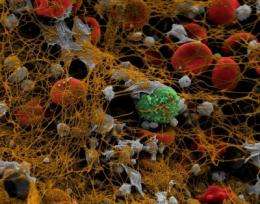
Fibrin, the chief ingredient of blood clots, is a remarkably versatile polymer. On one hand, it forms a network of fibers -- a blood clot -- that stems the loss of blood at an injury site while remaining pliable and flexible. On the other hand, fibrin provides a scaffold for thrombi, clots that block blood vessels and cause tissue damage, leading to myocardial infarction, ischemic stroke, and other cardiovascular diseases. How does fibrin manage to be so strong and yet so extensible under the stresses of healing and blood flow?
The answer is a process known as protein unfolding, report Penn researchers in Science this week. An interdisciplinary team, composed of investigators from the University of Pennsylvania School of Medicine, the School of Arts and Sciences, and the School of Engineering and Applied Science, has revealed how protein unfolding allows fibrin to maintain its remarkable and contradictory characteristics. Understanding blood clot mechanics could help in the design of new treatments not only to prevent or remove clots that cause heart attacks and strokes but also to enhance blood clotting in people with bleeding disorders. Fibrin's unusual characteristics may also lead to applications in designing new synthetic materials based on its biology.
Building on previous work examining the properties of fibrin, senior author John Weisel, PhD, Professor of Cell and Developmental Biology, and his collaborators studied the mechanics of fibrin clots under stress from the macroscopic scale down to the molecular level. The results were achieved by joint efforts of scientists with different skills, knowledge, and backgrounds: A graduate student Andre E. X. Brown and his adviser Professor Dennis E. Discher brought physics and biomedical engineering; Senior Investigator Rustem I. Litvinov provided his expertise in protein chemistry and medicine; and Prashant K. Purohit, an Assistant Professor of Mechanical Engineering, joined the team to perform theoretical analyses of the experimental data and construct mathematical models of what was happening.
The researchers found that individual fibers in a fibrin blood clot are normally randomly oriented in an intricate meshwork pattern. But when the clot is stretched, the fibers begin to align with each other in the direction of the stress. As the strain continues, the clot stretches and gets longer -- but its volume actually decreases, which surprised the scientists. "That's very unusual," notes Weisel. "It's a property that's been found in a few other materials but it's very rare."
This was a sure sign that something unexpected was going on. "Slipping past each other between or within fibers was not a possibility that could give rise to such high unusual extensions because these fibers were cross-linked. This research provides evidence, both in terms of the mathematical model and with x-ray scattering data, that there is indeed unfolding going on," Purohit says."
The team used a variety of techniques from simple controlled stretching to electron microscopy, X-ray diffraction, atomic force microscopy, and mathematical modeling, to provide a coherent picture of how fibrin clots behave from the centimeter to the nanometer scale. This multi-scale strategy was vital: "You have to examine events at different spatial scales with various methodologies to understand how fibrin behaves," explains Weisel.
Protein unfolding explains how the volume of the fibers decreases as they're stretched. "When you unfold proteins, you're exposing parts that are normally buried in the middle of the molecule," Weisel says. "And these are hydrophobic; they don't want to be near water. So the unfolded protein structures interact with each other through those hydrophobic parts and water is expelled from the molecule. We see this when we stretch the fibrin and that's how the whole clot volume decreases about tenfold with threefold stretching." This great extensibility of fibrin on the molecular scale allows a fibrin clot to undergo the stretching and pulling that occurs during wound healing, while remaining permeable enough to allow itself to be broken down by enzymes when it's no longer needed.
That expulsion of water was a surprise, Weisel says. "The volume change, the fact that it's so extensible, that wasn't known previously. At the molecular level this unfolding is necessary for the mechanical properties."
The work has opened up new avenues of research that the researchers are eager to pursue. "The more we know about the mechanism of blood clotting, the greater the possibilities for learning how to control and modulate it, which may lead to new treatments of thrombotic and bleeding problems," surmises Weisel.
Beyond the obvious medical benefits, the team's interdisciplinary approach highlights the relevance of the research to other fields, such as biomedical engineering and materials science.
Source: University of Pennsylvania School of Medicine (news : web)


