Researchers find key to keeping cells in shape
August 6, 2009
Researchers find key to keeping cells in shape

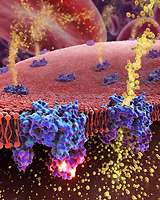
Ion transporter in blue within the red blood cell membrane. When phosphorylated or inactivated (white flash) the transporter shuts down. When dephosphorylated it is active, allowing potassium and chloride to leave the cell. Photo: Yale University

(PhysOrg.com) -- Yale University researchers have discovered how a protein within most cell membranes helps maintain normal cell size, a breakthrough in basic biology that has implications for a variety of diseases such as sickle cell anemia and disorders of the nervous system.

Cell size is regulated by the balance of positively and negatively charged ions and other solutes in the fluid inside and outside cells, which in turn prevents water from moving across cell membranes and changing cell size. Changes in of extracellular fluid can disrupt this balance, sometimes with damaging consequences to health.

"If you eat a bag of salty potato chips or a jug of water, the cells lining your stomach will be under pressure to shrink or expand," explains Richard Lifton, senior author of the paper and Sterling Professor of Genetics and Internal Medicine. "Cells need to rapidly change their ionic composition to compensate and avoid blowing up like balloons or shrinking like raisins, and they do this by almost instantly changing their levels."

In the Aug. 7 issue of the journal Cell, a team of Yale scientists led by Jesse Rinehart, associate research scientist in genetics and Lifton, an investigator of the Howard Hughes Medical Institute, report they used innovative new quantitative proteomics technologies to identify two key regulatory transporter sites that control the exit of potassium and chloride out of cells.

The proteomics technologies allow scientists to observe specific sites on proteins that undergo phosphorylation. Phosphorylation is a common and reversible modification made to a protein after it is synthesized and can turn a protein's function on or off. The Yale scientists show that the regulatory sites they identified are almost completely phosphorylated under normal conditions, when the transporter is inactive. When confronted with changes in the environment that challenge the cell, the proteins are rapidly dephosphorylated and dramatically increase transport activity.

"These transporters are overactive in sickle and play a role in the dehydration of sickle cells," said Patrick Gallagher, professor of pediatrics at the Yale School of Medicine and a co-author of the study. "With this new information, we may be able to find new strategies to manipulate this activity and identify new treatments that are so urgently needed."

Gallagher's lab is already studying genetic variations in the potassium-chloride pathway in a search of new drug targets.

This same system also helps regulate how brain cells respond to the neurotransmitter GABA, which governs wakefulness and has been implicated in anxiety and other disorders, Lifton said. The investigators found that phosphorylation of the regulatory sites worked the same way in the brain.

Looking to the future, Rinehart speculated that application of these new technologies will prove to be relevant to understanding many other biological regulatory systems.

Source: Yale University (news : web)


Rank 5 /5 (2 votes)
Relevant PhysicsForums posts
  • Factors affecting beet root cell membrane
    created10 hours ago
  • Stem cell question.
    createdFeb 10, 2012
  • Protease cleavage
    createdFeb 10, 2012
  • Pertubance in a model
    createdFeb 10, 2012
  • Cancer drugs and Alzheimer's, Oh my!
    createdFeb 09, 2012
  • Squishing cells
    createdFeb 09, 2012
  • More from Physics Forums - Biology

More news stories

A mitosis mystery solved: How chromosomes align perfectly in a dividing cell

Although the process of mitotic cell division has been studied intensely for more than 50 years, Whitehead Institute researchers have only now solved the mystery of how cells correctly align their chromosomes during symmetric ...

Biology / Cell & Microbiology

created 6 hours ago | popularity 4.4 / 5 (10) | comments 0 | with audio podcast

Researchers find extensive RNA editing in human transcriptome

In a new study published online in Nature Biotechnology, researchers from BGI, the world's largest genomics organization, reported the evidence of extensive RNA editing in a human cell line by analysis of RNA-seq data, demons ...

Biology / Biotechnology

created 6 hours ago | popularity 5 / 5 (4) | comments 0 | with audio podcast

The proteins ensuring genome protection

Researchers from the University of Geneva (UNIGE), Switzerland, have discovered the crucial role of two proteins in developing a cell 'anti-enzyme shield'. This protection system, which operates at the level of molecular ...

Biology / Cell & Microbiology

created 6 hours ago | popularity 5 / 5 (3) | comments 0 | with audio podcast

Entire genome of extinct human decoded from fossil

(PhysOrg.com) -- In 2010, Svante Pääbo and his colleagues presented a draft version of the genome from a small fragment of a human finger bone discovered in Denisova Cave in southern Siberia. The ...

Biology / Biotechnology

created Feb 07, 2012 | popularity 4.7 / 5 (59) | comments 48 | with audio podcast

Why are there so few fish in the Earth's oceans?

(PhysOrg.com) -- A Stony Brook University researcher has found that, contrary to popular belief, there are not plenty of fish in the sea.

Biology / Plants & Animals

created Feb 08, 2012 | popularity 4.2 / 5 (18) | comments 27 | with audio podcast


Declining health-care productivity in England: Who says so?

Reports that the National Health Service in England has been declining in productivity in the last decade appear to have been accepted as fact. However, a Viewpoint published Online First by The Lancet disputes this. The Vi ...

Scientists discover molecular secrets of 2,000-year-old Chinese herbal remedy

For roughly two thousand years, Chinese herbalists have treated Malaria using a root extract, commonly known as Chang Shan, from a type of hydrangea that grows in Tibet and Nepal. More recent studies suggest that halofuginone, ...

New method to examine batteries -- MRI from the inside

There is an ever-increasing need for advanced batteries for portable electronics, such as phones, cameras, and music players, but also to power electric vehicles and to facilitate the distribution and storage of energy derived ...

Overeating may double risk of memory loss

New research suggests that consuming between 2,100 and 6,000 calories per day may double the risk of memory loss, or mild cognitive impairment (MCI), among people age 70 and older. The study was released today and will be ...

Lab study raises questions over nano-particle impact

Tests involving chickens have raised questions about the impact on health from engineered nano-particles, the ultra-fine grains commonly used in drugs and processed foods, scientists said on Sunday.

Google might launch Drive for cloud storage soon

(PhysOrg.com) -- Google's next big move, according to the Wall Street Journal, is a cloud storage service called Drive. Hardly first to the plate, Google is simply catching up to introducing its cloud reposi ...