Typhoon Morakot's cloud top extent doubled in size in one day
August 6, 2009
Typhoon Morakot's cloud top extent doubled in size in 1 day

Enlarge

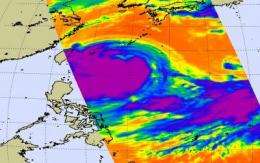
This infrared satellite image shows Typhoon Morakot's cold clouds (depicted in purple and blue) stretching over 1,000 miles in diameter on Aug. 6 in the East China Sea. Credit: NASA JPL, Ed Olsen

Satellite imagery over the last two days has shown Typhoon Morakot to be a monster, and over the last two days, NASA satellites have confirmed the typhoon doubled its size!

"Our satellite scan swath width is 1700 kilometers (1,056 miles) and Morakot looks to be almost that much in diameter in the infrared imagery on August 5," said Ed Olsen, of NASA's Jet Propulsion Laboratory in Pasadena, Calif. Olsen provides images for the Atmospheric Infrared Sounder (AIRS) instrument on the Aqua satellite. "On August Morakot was only about 1/2 the width of our swath width, near 850 kilometers (528 miles) in diameter!"

To put it into perspective, 1,056 miles is longer than the distance from Philadelphia, Pennsylvania to Orlando, Florida. Olsen said that it's important to know that image represents the lateral extent of the cold cloud tops and that the winds definitely do not extend over an area 1,000 miles in diameter.

AIRS captured an infrared image of Typhoon Morakot tracking through the East China Sea on August 6 at 12:35 a.m. EDT (0435 UTC). At 11 a.m. EDT on Aug. 6, Morakot was closing in on Taiwan and was located 240 miles east-southeast of Taipei, Taiwan, near 23.2 north and 125.0 east. Morakot the monster has maximum sustained winds near 92 mph (80 knots) and was moving west near 14 mph.

AIRS provides visible, infrared and microwave images of tropical storms. AIRS also measures cloud top temperature and pressure and the profile of water vapor as functions of height. Infrared imagery shows the temperature of the cloud tops which gives a hint about the power of the thunderstorms in a tropical cyclone. The colder the are, the higher they are, and the more powerful the thunderstorms are that make up the cyclone.

Typhoon Morakot is forecast to strengthen more before it crosses northern Taiwan later today and makes a final landfall in China by the weekend.

Source: /Goddard Space Flight Center

3.5 /5 (2 votes)  

Rank 3.5 /5 (2 votes)
Related Stories
Relevant PhysicsForums posts
  • Do some geologists actually act a lot like Randy Marsh?
    createdFeb 11, 2012
  • Discrepancy between oxygen and carbon-dioxide levels
    createdFeb 09, 2012
  • where gems are found in the world
    createdFeb 09, 2012
  • Wind Waves in Reservoir ~ Wind run-up and Wind set-up
    createdFeb 08, 2012
  • Balance of oxygen in the atmosphere
    createdFeb 01, 2012
  • The case for a methanol-based economy
    createdJan 30, 2012
  • More from Physics Forums - Earth

More news stories

Salvage workers begin pumping fuel from Italian shipwreck

Salvage workers Sunday began pumping fuel from the shipwrecked Italian cruise liner Costa Concordia, a day ahead of schedule, officials said.

Space & Earth / Environment

created 7 hours ago | popularity 5 / 5 (1) | comments 0

Latin America mining boom clashes with conservation

Latin America is experiencing a mining boom as prices rise fuelled by a hike in global demand, but the region is also being hit by a wave of violent protests, strikes and rallies by environmentalists.

Space & Earth / Environment

created 15 hours ago | popularity 5 / 5 (1) | comments 1

Political leaders play key role in how worried Americans are by climate change: study

More than extreme weather events and the work of scientists, it is national political leaders who influence how much Americans worry about the threat of climate change, new research finds.

Space & Earth / Environment

created Feb 06, 2012 | popularity 5 / 5 (7) | comments 73

NASA budget will axe Mars deal with Europe: scientists

US President Barack Obama's budget proposal to be submitted next week for 2013 will cut NASA's budget by 20 percent and eliminate a major partnership with Europe on Mars exploration, scientists said Thursday.

Space & Earth / Space Exploration

created Feb 10, 2012 | popularity 5 / 5 (3) | comments 58

Humans may have helped the decline of African rainforests 3000 years ago

(PhysOrg.com) -- Large areas of rainforests in Central Africa mysteriously disappeared over three thousand years ago, to be replaced by savannas. The prevailing theory has been that the cause was a change ...

Space & Earth / Environment

created Feb 10, 2012 | popularity 4.1 / 5 (14) | comments 21 | with audio podcast report


Scientists discover molecular secrets of 2,000-year-old Chinese herbal remedy

For roughly two thousand years, Chinese herbalists have treated Malaria using a root extract, commonly known as Chang Shan, from a type of hydrangea that grows in Tibet and Nepal. More recent studies suggest that halofuginone, ...

New method to examine batteries -- MRI from the inside

There is an ever-increasing need for advanced batteries for portable electronics, such as phones, cameras, and music players, but also to power electric vehicles and to facilitate the distribution and storage of energy derived ...

A mitosis mystery solved: How chromosomes align perfectly in a dividing cell

Although the process of mitotic cell division has been studied intensely for more than 50 years, Whitehead Institute researchers have only now solved the mystery of how cells correctly align their chromosomes during symmetric ...

Google might launch Drive for cloud storage soon

(PhysOrg.com) -- Google's next big move, according to the Wall Street Journal, is a cloud storage service called Drive. Hardly first to the plate, Google is simply catching up to introducing its cloud reposi ...

Lab study raises questions over nano-particle impact

Tests involving chickens have raised questions about the impact on health from engineered nano-particles, the ultra-fine grains commonly used in drugs and processed foods, scientists said on Sunday.

Overeating may double risk of memory loss

New research suggests that consuming between 2,100 and 6,000 calories per day may double the risk of memory loss, or mild cognitive impairment (MCI), among people age 70 and older. The study was released today and will be ...