Extinction runs in the family
August 6, 2009 By Susan Brown Extinction runs in the family

Enlarge

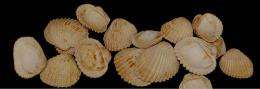
Survivors. Venus clams, a large family with more than 500 living species, made it through the most recent mass extinction. Credit: K.J. McClure, College of William and Mary

(PhysOrg.com) -- Global calamities like the one that doomed most dinosaurs forever alter the varieties of life found on Earth, but new research shows that it doesn't take a catastrophe to end entire lineages. An analysis of 200 million years of history for marine clams found that vulnerability to extinction runs in evolutionary families, even when the losses result form ongoing, background rates of extinction.

"Biologists have long suspected that the of species and lineages play a big role in determining their vulnerability to extinction, with some branches of the tree of life being more extinction-prone than others," said Kaustuv Roy, a biology professor at the University of California, San Diego, noting that human activities threaten some evolutionary lineages of living vertebrates more than others. "Now we know that such differential loss is not restricted to extinctions driven by us but is a general feature of the extinction process itself."

Roy and colleagues Gene Hunt of the Smithsonian Institution and David Jablonski of the University of Chicago report their findings in Science this week.
Extinction runs in the family
Enlarge

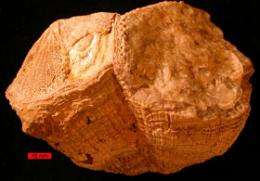
Lost. In an earlier age, these marine bivalves called rudists were so abundant they formed reefs. Rudists vanished in the mass extinction at the end of the Cretaceous period. Credit: Mark A. Wilson, The College of Wooster

Their study focused on marine bivalves such as clams, oysters, mussels, and scallops, whose tough shells fossilize well to provide a rich record for study. By analyzing a global database of bivalve fossils stretching from the to the present, the researchers noted when each genus disappeared and whether their relatives disappeared at the same time.

On average, closely related clusters of clams vanished together more often than expected by chance.

"Both background extinctions, which represent most extinctions in the history of life, and mass extinctions tend to be clumped into particular evolutionary lineages," Jablonski said.

The effect was particularly strong during the at the end of the , when clam lineages with the highest 'background' rates of extinction during more normal times were hardest hit. Three families with the highest background rates disappeared entirely. Two others, with rates more than twice the median, suffered heavy losses and have not recovered to this day.

"Big extinctions have a filtering effect. They tend to preferentially cull the more vulnerable lineages, leaving the resistant ones to proliferate afterwards," Hunt said.

When extinctions are scattered randomly across the evolutionary tree, the breadth of evolutionary history remains represented among living things, even when many species are lost. Clumped extinctions do the opposite, disproportionately removing the deeper history.

"Extinctions in the past and presumably in the future will lop off chunks of evolutionary trees, not just prune the trees and leave most of the history intact," Jablonski said.

The message for conservation is to focus efforts on vulnerable lineages, the authors say. To preserve the full spectrum of evolutionary history found among living things today, the most fragile families will need careful protection.

Even relatively low levels of threat could eliminate large limbs, Roy said. "If you have whole lineages more vulnerable than others, then very soon, even with relatively moderate levels of extinction, you start to lose a lot of evolutionary history."

Source: University of California - San Diego (news : web)


print this article email this article download pdf blog this article bookmark this article     Stumble it Digg this share on Facebook retweet share on Reddit add to delicious
Rate this story - 4.7 /5 (10 votes)

Rank Filter

Move the slider to adjust rank threshold, so that you can hide some of the comments.


Display comments: newest first

  • Avitar - Aug 06, 2009
    • Rank: 1 / 5 (2)
    That natural selection evelolution is not fast enough to produce the biosphere as we see it. Regional contenent size calamities like super volcanow are required every hundred millinum or so to explain the speed of evelution.
  • Ronan - Aug 06, 2009
    • Rank: 4 / 5 (1)
    Avitar, what are you talking about? I don't understand what you're trying to say or what you're basing it on.

    At any rate...This has some somewhat disturbing implications for today, particularly when one thinks of the plight of amphibians in general. Hopefully, amphibia is a large enough group, with enough diversity, that this wouldn't easily apply to them, but...size and diversity didn't save the dinosaurs or the non-crocodilian crurotarsans, so...
  • Ethelred - Aug 07, 2009
    • Rank: not rated yet
    Its not a matter of calamities but change of any kind that accelerates evolution. If the environment is stable there simply isn't much to force change.

    Supervolnoes are not the only things that can cause the change. Splitting and joining plates. Changes in the Sun's output. Major impacts such as the one at Chixiulub. however the right way to spell it. The Deccan and Siberian Traps, which may have been induced by impacts. Yellowstone looks to have pretty nasty.

    Key developments in organisms have clearly had major effects on all organisms. Even those that didn't have the developments.

    Sexual reproduction, specialized cells, Eyesight, exoskeltons, endoskeltons, lungs, wings, DNA replacing RNA for information storage, hemoglobin, blood, vast numbers of things and all allowed rapid changes in the species that developed them and thus changed the environment of the species that had to deal with them or go extinct as many did.

    Ethelred

August 6, 2009 all stories

Comments: 3

4.7 /5 (10 votes)
  • Stumble this up

  • Digg this

  • share this

  • hide
  • Related Stories


  • hide
  • Relevant PhysicsForums posts

  • What is transpulmonary pressure?
    created Nov 24, 2009
  • Is there a gay gene?
    created Nov 23, 2009
  • Super quick question about Starling forces?
    created Nov 22, 2009
  • Questions about diffusion
    created Nov 22, 2009
  • Human Leukocyte Antigen (HLA) typing
    created Nov 21, 2009
  • Breeding program
    created Nov 20, 2009
  • More from Physics Forums - Biology

Other News

Variable Temperatures Leave Insects wtih a Frosty Reception

Biology / Plants & Animals

created 8 hours ago | popularity not rated yet | comments 0

(PhysOrg.com) -- For the first time, scientists at The University of Western Ontario have shown that insects exposed to repeated periods of cold will trade reproduction for immediate survival.


When camouflage is a plant's best protection

Rare woodland plant uses 'cryptic coloration' to hide from predators

Biology / Plants & Animals

created 11 hours ago | popularity 4.3 / 5 (3) | comments 0

It is well known that some animal species use camouflage to hide from predators. Individuals that are able to blend in to their surroundings and avoid being eaten are able to survive longer, reproduce, and ...


Cells defend themselves from viruses, bacteria with armor of protein errors

Biology / Cell & Microbiology

created 12 hours ago | popularity 5 / 5 (7) | comments 0

When cells are confronted with an invading virus or bacteria or exposed to an irritating chemical, they protect themselves by going off their DNA recipe and inserting the wrong amino acid into new proteins to defend them ...


'Safety valve' protects photosynthesis from too much light

Biology / Cell & Microbiology

created 12 hours ago | popularity 4.7 / 5 (3) | comments 0

Photosynthetic organisms need to cope with a wide range of light intensities, which can change over timescales of seconds to minutes. Too much light can damage the photosynthetic machinery and cause cell death. Scientists ...


Researchers discover biological basis of 'bacterial immune system'

Biology / Cell & Microbiology

created 13 hours ago | popularity 4.7 / 5 (3) | comments 0

Bacteria don't have easy lives. In addition to mammalian immune systems that besiege the bugs, they have natural enemies called bacteriophages, viruses that kill half the bacteria on Earth every two days.