NASA eyes Category 4 Hurricane Felicia and a stubborn Enrique
August 6, 2009
NASA eyes Category 4 Hurricane Felicia and a stubborn Enrique

Enlarge

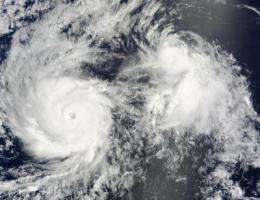
NASA's MODIS instrument on the Terra satellite captured Hurricane Felicia (left) and Tropical Storm Enrique (right) side-by-side on August 5 at 3 p.m. EDT. Credit: NASA, MODIS Rapid Response

Felicia is the storm that rules the Eastern Pacific Ocean this week, but Enrique refuses to give up. Felicia is a major hurricane with sustained winds near 140 mph, and Enrique is still hanging onto tropical storm status with 50 mph sustained winds. Both cyclones are close to each other and NASA satellites captured them together.

On August 6 at 5 a.m. EDT, powerful Felicia is still a Category Four on the Saffir-Simpson hurricane scale. She's far out to sea, about 1,480 miles west-southwest of the southern tip of Baja California near 15.5 north and 131.2 west. She's moving west-northwest near 10 mph, and is expected to speed up and start to weaken in the next couple of days because of colder waters in her path. Felicia's minimum central pressure is 937 millibars.

Boys can be stubborn, and Enrique is proving that, even though he's a with a boy's name. Despite Enrique's close proximity to Felicia, he's maintaining sustained winds near 50 mph. At 5 a.m. EDT, Enrique's center was 345 miles behind Felicia's, near 20.7 north and 125.9 west. He's speeding northwest near 17 mph into cooler waters which is going to weaken him over the next day or two. Enrique's minimum central pressure is 1,000 millibars, much higher than Felicia's indicating a much weaker storm. The higher the the weaker the tropical cyclone.

NASA eyes Category 4 Hurricane Felicia and a stubborn Enrique
Enlarge

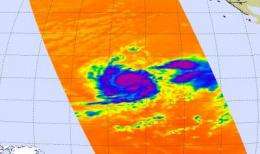
NASA's AIRS instrument on the Aqua satellite caught the icy cold clouds in Felicia (left) and Enrique (right). Notice Felicia's eye in the center of the storm. In this false-colored image, purple indicated temperatures colder than minus 63 F and blue is minus 27 F or colder. Credit: NASA JPL, Ed Olsen

NASA's Terra satellite flew over Felicia and Enrique and using the Moderate Imaging Spectroradiometer (MODIS) instrument captured them side-by-side on August 5 at 3 p.m. EDT. The satellite image clearly showed an eye in powerful Hurricane Felicia, while Tropical Storm Enrique's eye was not clear.

Terra wasn't the only satellite to capture Felicia and Enrique battling it out for territory in the Eastern . NASA's Aqua satellite also flew overhead and its Atmospheric Infrared Sounder (AIRS) instrument captured the frigid cloud temperatures in both storms. Felicia's clouds are colder and higher than Enrique's clouds, because stronger hurricanes have higher (and more powerful) thunderstorms.

Using AIRS and other infrared imagery to determine cloud temperature, the National Hurricane Center noted in their discussion on Aug. 6, that Felicia's eye has been warming and has become more well-defined over the past few hours but at the same time the cold cloud tops around the eye have also been warming." That's an indication that Felicia will start waning in strength.

Source: /Goddard Space Flight Center


Rank not rated yet
Relevant PhysicsForums posts
  • Do some geologists actually act a lot like Randy Marsh?
    createdFeb 11, 2012
  • Discrepancy between oxygen and carbon-dioxide levels
    createdFeb 09, 2012
  • where gems are found in the world
    createdFeb 09, 2012
  • Wind Waves in Reservoir ~ Wind run-up and Wind set-up
    createdFeb 08, 2012
  • Balance of oxygen in the atmosphere
    createdFeb 01, 2012
  • The case for a methanol-based economy
    createdJan 30, 2012
  • More from Physics Forums - Earth

More news stories

Latin America mining boom clashes with conservation

Latin America is experiencing a mining boom as prices rise fuelled by a hike in global demand, but the region is also being hit by a wave of violent protests, strikes and rallies by environmentalists.

Space & Earth / Environment

created 18 hours ago | popularity 5 / 5 (1) | comments 1

Salvage workers begin pumping fuel from Italian shipwreck

Salvage workers Sunday began pumping fuel from the shipwrecked Italian cruise liner Costa Concordia, a day ahead of schedule, officials said.

Space & Earth / Environment

created 10 hours ago | popularity 5 / 5 (2) | comments 0

Political leaders play key role in how worried Americans are by climate change: study

More than extreme weather events and the work of scientists, it is national political leaders who influence how much Americans worry about the threat of climate change, new research finds.

Space & Earth / Environment

created Feb 06, 2012 | popularity 5 / 5 (8) | comments 75

NASA budget will axe Mars deal with Europe: scientists

US President Barack Obama's budget proposal to be submitted next week for 2013 will cut NASA's budget by 20 percent and eliminate a major partnership with Europe on Mars exploration, scientists said Thursday.

Space & Earth / Space Exploration

created Feb 10, 2012 | popularity 5 / 5 (4) | comments 58

Humans may have helped the decline of African rainforests 3000 years ago

(PhysOrg.com) -- Large areas of rainforests in Central Africa mysteriously disappeared over three thousand years ago, to be replaced by savannas. The prevailing theory has been that the cause was a change ...

Space & Earth / Environment

created Feb 10, 2012 | popularity 4.1 / 5 (14) | comments 21 | with audio podcast report


Scientists discover molecular secrets of 2,000-year-old Chinese herbal remedy

For roughly two thousand years, Chinese herbalists have treated Malaria using a root extract, commonly known as Chang Shan, from a type of hydrangea that grows in Tibet and Nepal. More recent studies suggest that halofuginone, ...

New method to examine batteries -- MRI from the inside

There is an ever-increasing need for advanced batteries for portable electronics, such as phones, cameras, and music players, but also to power electric vehicles and to facilitate the distribution and storage of energy derived ...

Google might launch Drive for cloud storage soon

(PhysOrg.com) -- Google's next big move, according to the Wall Street Journal, is a cloud storage service called Drive. Hardly first to the plate, Google is simply catching up to introducing its cloud reposi ...

A mitosis mystery solved: How chromosomes align perfectly in a dividing cell

Although the process of mitotic cell division has been studied intensely for more than 50 years, Whitehead Institute researchers have only now solved the mystery of how cells correctly align their chromosomes during symmetric ...

Lab study raises questions over nano-particle impact

Tests involving chickens have raised questions about the impact on health from engineered nano-particles, the ultra-fine grains commonly used in drugs and processed foods, scientists said on Sunday.

Starve a virus, feed a cure? Findings show how some cells protect themselves against HIV

A protein that protects some of our immune cells from the most common and virulent form of HIV works by starving the virus of the molecular building blocks that it needs to replicate, according to research published online ...