Avalanche! The Incredible Data Stream of SDO
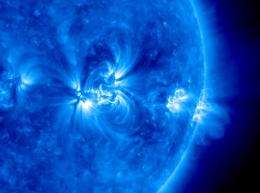
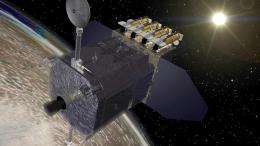
When NASA's Solar Dynamics Observatory (SDO) leaves Earth in November 2009 onboard an Atlas V rocket, the thunderous launch will trigger an avalanche.
Mission planners are bracing themselves -- not for rocks or snow, but an avalanche of data.
"SDO will beam back 150 million bits of data per second, 24 hours a day, 7 days a week," says Dean Pesnell of the Goddard Space Flight Center in Greenbelt, Md. That’s almost 50 times more science data than any other mission in NASA history. "It's like downloading 500,000 iTunes a day."
SDO is on a mission to study the sun in unprecedented detail. Onboard telescopes will scrutinize sunspots and solar flares using more pixels and colors than any other observatory in the history of solar physics. And SDO will reveal the sun’s hidden secrets in a prodigious rush of pictures.
"SDO is going to send us images ten times better than high definition television," says Pesnell, the project scientist for the new mission. A typical HDTV screen has 720 by 1280 pixels; SDO's images will have almost four times that number in the horizontal direction and five times in the vertical. “The pixel count is comparable to an IMAX movie -- an IMAX filled with the raging sun, 24 hours a day."
Spatial resolution is only half the story, though. Previous missions have photographed the sun no faster than once every few minutes. SDO will shatter that record.
"We'll be getting IMAX-quality images every 10 seconds," says Pesnell. "We'll see every nuance of solar activity." Because these fast cadences have never been attempted before by an orbiting observatory, the potential for discovery is great.
To illustrate the effect this might have on solar physics, Pesnell recalls the 18th century photographer Eadweard Muybridge, who won a famous bet with racehorse owner Leland Stanford. In those days, horses were widely thought to keep at least one hoof on the ground even in full gallop. That's how it appeared to the human eye.
"But when Muybridge photographed horses using a new high-speed camera system, he discovered something surprising," says Pesnell. "Galloping horses spend part of the race completely airborne—all four feet are off the ground."
Pesnell anticipates similar surprises from high-speed photography of the sun. The images could upend mainstream ideas about sunspot genesis, what triggers solar flares, and how explosions ripple through the sun's atmosphere en route to Earth.
The Solar Dynamics Observatory has three main instruments. The Atmospheric Imaging Assembly (AIA) is a battery of four telescopes designed to photograph the sun's surface and atmosphere. AIA filters cover 10 different wavelength bands, or colors, selected to reveal key aspects of solar activity. The bulk of SDO's data stream will come from these telescopes.
The Helioseismic and Magnetic Imager (HMI) will map solar magnetic fields and peer beneath the sun's opaque surface using a technique called helioseismology. A key goal of this experiment is to decipher the physics of the sun's magnetic dynamo.
The Extreme Ultraviolet Variability Experiment (EVE) will measure fluctuations in the sun's ultraviolet output. EUV radiation sun has a direct and powerful effect on Earth's upper atmosphere, heating it, puffing it up, and breaking apart atoms and molecules. "We really don't know how fast the sun varies at these wavelengths," notes Pesnell. "We're guaranteed to learn something new."
To gather data from all three instruments, NASA has set up a pair of dedicated radio antennas near Las Cruces, New Mexico. SDO's geosynchronous orbit will keep the observatory in constant view of the two 18-meter dishes around the clock for the duration of the observatory's five-year mission. Not a single bit should be lost.
"We're ready," says Pesnell. "Let the avalanche begin!"
Related links:
NASA's SDO Project Website
sdo.gsfc.nasa.gov/
Stepping Stones to SDO
sdo.gsfc.nasa.gov/multimedia/stepstones.php
What Lies Inside the Sun? (Feature story on the Helioseismic and Magnetic Imager (HMI))
www.nasa.gov/mission_pages/sdo … news/inside_sun.html
Freezing Time with High-Speed Photography
www.buzzle.com/articles/freezi … eed-photography.html
Provided by NASA Heliophysics News Team


