Physicists to study attractive and repulsive forces crucial in designing nano-machines
August 6, 2009 Physicists to study attractive and repulsive forces crucial in designing nano-machines

Enlarge

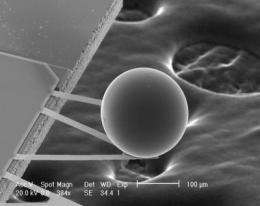
Measuring only around one-tenth of a millimeter, the tiny ball seen in the image is pulled toward a smooth plate (unseen but positioned above the ball in this configuration), in response to the energy fluctuations in the vacuum of empty space. The attraction between the ball and the plate is the Casimir effect. Credit: U. Mohideen, UC Riverside.

The Casimir force, also known as the Casimir effect, is typified by the small attractive force that acts between two close parallel uncharged conducting plates. Today, this force has become an interdisciplinary subject of study, playing an important role in condensed matter physics, quantum field theory, atomic and molecular physics, gravitation and cosmology, and mathematical physics. Most recently the Casimir force has been applied to nanotechnology.

Now, to study this force, UC Riverside physicists have received funding of $1.6 million for two years from the Defense Advanced Research Projects Agency (DARPA), the central research and development office for the U.S. Department of Defense, through the Department of the Navy, Space and Naval Warfare Systems Command (SPAWAR).

Grant recipients, Umar Mohideen and Roya Zandi of the Department of Physics and Astronomy, will conduct experimental and theoretical research on ways to minimize the attractive, or enhance the repulsive, Casimir force between objects—a necessary step in designing extremely small machines.

In the typical geometry of two close parallel uncharged conducting plates (or a sphere and a plate), the Casimir force is attractive. But in other situations, the force can be repulsive, depending on the materials involved or their configuration.

May the force be no hindrance

Today's advances in nanofabrication include the manufacture of micro- and nano-machines with moving parts separated by distances less than a micron (a micron is a millionth of a meter; a single strand of hair is approximately 100 microns). Because the distances are extremely small, the Casimir force needs to be considered in the design and function of the micro/nano-machines for efficient operation.

"The Casimir force, which is usually attractive, is also large at short separation distances between objects," explained Mohideen, a professor of physics and the principal investigator of the grant. "It severely limits and constrains the easy and efficient functioning of nano- and micro-machines. To allow more novel designs of micro-machines, engineers will first need to decrease the Casimir force. One approach we will use in the lab is to use different material coatings to substantially reduce the Casimir force. Another approach is to use specialized coatings to bring about a repulsive Casimir force."

Joining forces for the project

Mohideen is in charge of the experimental section of the research. Zandi, the co-principal investigator of the grant, will be joined by Mehran Kardar, a professor of physics at the Massachusetts Institute of Technology (MIT), and Thorsten Emig, a physicist at the University of Cologne, Germany, in overseeing the theoretical section of the research. Giuseppe Bimonte, a physicist who will visit UCR from the Università di Napoli Federico II, Italy, also will contribute to the theoretical research. They will be joined by four postdoctoral researchers at UCR and one student at MIT. All experiments will be conducted at UCR.

In book form the force

Mohideen has coauthored a book on the Casimir force along with colleagues at North-West Technical University, St. Petersburg, Russia; the University of Leipzig, Germany; and "Scientific Instruments," Moscow, Russia.

Titled Advances in the Casimir Effect, the book is part of the "International Series of Monographs on Physics," a very selective publication list from Oxford University Press.

"The field has undergone an extraordinary phase of growth in the last decade, with many ideas initiated by the co-authors," Mohideen said. "By summarizing all the recent developments, this book will serve as a launching pad for the anticipated rapid growth of the field in the future."

He and his fellow-coauthors took two and a half years to write the book of approximately 750 pages. The book covers a wide range of diverse topics as well as many subdisciplines of physics, for example, quantum field theory, physics, atomic and molecular physics, gravitation and cosmology, mathematical physics and nanotechnology.

"The applications of the Casimir force in nanotechnology are not covered in the existing books because these books were published before the technological relevance was appreciated," Mohideen said.

Intended for all physicists working on different manifestations of vacuum oscillations, as well as applied physicists, the book can be used, too, by advanced undergraduate and graduate students who are beginning work on van der Waals forces (which act between molecules), the Casimir force or related subjects.

"A unique feature of our book is that it presents both experiment and theory, including their mutual influence," Mohideen said.

Source: University of California - Riverside (news : web)


print this article email this article download pdf blog this article bookmark this article     Stumble it Digg this share on Facebook retweet share on Reddit add to delicious
Rate this story - 5 /5 (2 votes)

Rank Filter

Move the slider to adjust rank threshold, so that you can hide some of the comments.


Display comments: newest first

  • nuge - Aug 07, 2009
    • Rank: not rated yet
    isn't this more of an ad than an article?
  • KBK - Aug 10, 2009
    • Rank: 3 / 5 (2)
    Yes. It is attempting to work with the polarization of spin or more specifically the spiraling polarized vortex energies that Maxwell CLEARLY wrote into his original treatise (math) on electromagnetics.

    Not the trash talk that Heaviside and Lorentz brought to the table when they modified Maxwell's works to simplify the works for engineers of electrical motors.

    Thus: no such thing or need for a 'casimir effect'-- it's simply Maxwell's original electromagnetics showing itself.
  • Slotin - Aug 26, 2009
    • Rank: 1 / 5 (1)
    Casimir force is supersymmetric force to gravity, violation of Newton law dual to dark matter decelleration, violation of gravitational law and equivalence principle, demonstration of hidden dimension and Lorentz symmetry - everything in single package. In addition, Casimir force can be applied for explanation of strong nuclear force (cohesion force for nucleons). Please remember it while trying to unstick plastic bag in supermarket.

August 6, 2009 all stories

Comments: 3

5 /5 (2 votes)
  • Stumble this up

  • Digg this

  • share this

  • hide
  • Related Stories

  • Physicist demonstrates how light can be used to remotely operate micromachines
    created Jun 18, 2007 | popularity not rated yet | comments 0
  • Physicist demonstrates how light can be used to remotely operate micromachines
    created May 31, 2007 | popularity not rated yet | comments 0
  • Researchers see exotic force for first time
    created Jan 07, 2009 | popularity not rated yet | comments 0
  • Scientist float levitation theory
    created Aug 06, 2007 | popularity not rated yet | comments 0
  • Pioneering research to assist in creation of nanomachines
    created Nov 14, 2007 | popularity not rated yet | comments 0


  • hide
  • Relevant PhysicsForums posts

  • LED Headlights do not work
    created 1hour ago
  • strange 'weight-lifting' machine in Feynman's lectures on physics book..
    created 2 hours ago
  • tonometer experiment
    created 6 hours ago
  • Radiation heat transfer between air or wall
    created 6 hours ago
  • Hi ,new here and have a question! :)
    created 7 hours ago
  • Hydrostatic pressure in a submerged pipe
    created 9 hours ago
  • More from Physics Forums - General Physics

Other News

First Neutrino Events Observed at T2K Near Detector

First Neutrino Events Observed at T2K Near Detector

Physics / General Physics

created 20 hours ago | popularity 4.8 / 5 (20) | comments 1

(PhysOrg.com) -- Physicists from the Japanese-led multi-national T2K neutrino collaboration announced today that over the weekend they detected the first events generated by their newly built neutrino beam ...


Researchers develop virtual streams to help restore real ones

Physics / General Physics

created 15 hours ago | popularity not rated yet | comments 0

Researchers at the University of Minnesota have developed a unique new computer model called the Virtual StreamLab, designed to help restore real streams to a healthier state. The Virtual StreamLab, which demonstrates the ...


Scientists react as they stand in front of a screen at CERN

First atoms reported smashed in Large Hadron Collider (Update)

Physics / General Physics

created Nov 23, 2009 | popularity 4.7 / 5 (28) | comments 21

Two circulating beams on Monday produced the first particle collisions in the world's biggest atom smasher, the Large Hadron Collider (LHC), three days after its restart, scientists announced.


Restored machine to explore mysteries of Big Bang (AP)

Restored machine to explore mysteries of Big Bang

Physics / General Physics

created Nov 21, 2009 | popularity 4.6 / 5 (18) | comments 26

(AP) -- Scientists are preparing the world's largest atom smasher to explore the depths of matter after successfully restarting the $10 billion machine following more than a year of repairs.


In the Brain, Seven Is A Magic Number

In the Brain, Seven Is A Magic Number

Physics / General Physics

created Nov 23, 2009 | popularity 4.5 / 5 (31) | comments 8

Having a tough time recalling a phone number someone spoke a few minutes ago or forgetting items from a mental grocery list is not a sign of mental decline; in fact, it's natural.