Touchable Hologram Becomes Reality (w/ Video)
August 6, 2009 by Lisa Zyga weblog
Touchable hologram

Enlarge

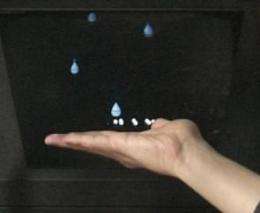
In this demonstration of the touchable hologram, ultrasound is radiated from above and the user feels as if a rain drop hits his palm. Credit: Hiroyuki Shinoda.

(PhysOrg.com) -- Researchers from the University of Tokyo have developed 3D holograms that can be touched with bare hands. Generally, holograms can't be felt because they're made only of light. But the new technology adds tactile feedback to holograms hovering in 3D space.

Called the Airborne Ultrasound Tactile Display, the projector uses an ultrasound phenomenon called acoustic radiation pressure to create a pressure sensation on a user's hands, which are tracked with two Nintendo Wiimotes. As the researchers explain, the method doesn't use any direct contact and so doesn't dilute the quality of the hologram. The researchers, led by Hiroyuki Shinoda, currently have the technology on display at SIGGRAPH 2009 in New Orleans.

This video is not supported by your browser at this time.

"A retroreflective marker is attached on the tip of user's middle finger," the researchers explain on their website. "IR LEDs illuminate the marker and two Wiimotes sense the 3D position of the finger. Owing to this hand-tracking system, the users can handle the floating virtual image with their hands."

In the video, the researchers demonstrate how a user can dribble a virtual bouncing ball, feel virtual raindrops bouncing off their hand, and feel a small virtual creature crawling on their palm. The researchers hope that the technology will have applications in video games, 3D CADs, and other uses.

More information: Shinoda Lab

© 2009 PhysOrg.com

4.6 /5 (55 votes)  

Filter


Move the slider to adjust rank threshold, so that you can hide some of the comments.


Display comments: newest first

earls
Aug 06, 2009

Rank: 5 / 5 (4)
Wave mechanics, for the win.
290163
Aug 06, 2009

Rank: 4.5 / 5 (8)
Please let me know when 'they' can combine this with the most outrageous porn. It will make an absolute fortune, akin to the GDP of most developing nations.
jabo
Aug 06, 2009

Rank: 5 / 5 (3)
I'm ready to fight Bruce Lee. Or a Klingon Bruce Lee.
Teller
Aug 06, 2009

Rank: 4 / 5 (4)
290163- HAHAHAHAHAHAHAHAHA Soo sad but true.
MrKrazy
Aug 06, 2009

Rank: 5 / 5 (4)
Checklist to Hollow-deck nirvana:

1) Holographic Tactile Response System - Check
2) Fusion power source - In Progress
3) Quantum Computing - In Progress

--

1 down, 2 to go...

Truth
Aug 06, 2009

Rank: 5 / 5 (3)
In the 1920's, television was a laboratory oddity; primitive, black and white, and shown only on extremely small screens. Look where television is now. The same thing is happening with holographic projection; laboratory oddity, large heavy equipment, primitive methods. Where will it be in 2015?
Vala
Aug 07, 2009

Rank: 3.5 / 5 (2)
Yes, Finally they can apply this to a Video Game.

1.Get your HoloGram 3000 Gun.
2.Put on your Ultra Z80-9 Body Armour on.
3.Start shooting 3D hologram projectiles at people through there tvs And they could feel the shot :D.


Wait i just remembered Reality beat us to it :(
zbarlici
Aug 07, 2009

Rank: 5 / 5 (4)
Yes, Finally they can apply this to a Video Game.


1.Get your HoloGram 3000 Gun.


2.Put on your Ultra Z80-9 Body Armour on.


3.Start shooting 3D hologram projectiles at people through there tvs And they could feel the shot :D.


Wait i just remembered Reality beat us to it :(


Speaking of games.. its really funny that the game industry is driving innovation in this manner. wow. up until now the general public would get trickle-down technology from the army/airforce/NASA... but now it looks like things might be going the other way?


visual
Aug 07, 2009

Rank: 2.8 / 5 (5)
Disappointing, really.
First thing, the hologram itself is a very poor implementation. A concave mirror is able to fool multiple observers about the location of the image, but the image will still be basically flat, with no perspective and displayed at a fixed depth. With some eye tracking i guess they can make this quite more realistic but only to a single viewer.
Also, it is impossible to put your hand or anything else behind the displayed objects without making them disappear, which really ruins the illusion, and will be happening a lot when you try to touch them.
And last, about the actual innovation in this case - the ultrasound panel that creates the tactile feedback - I think it is really interesting, but obviously not as versatile as the title implies. It will probably never be the same as feeling a real object.
RayCherry
Aug 07, 2009

Rank: 5 / 5 (1)
A lot of testing required to see the affects of sudden ultrasound waves on the human body in games.

The desired game effect would be for the player to feel an impact when hit by a virtual projectile, or a shockwave from an virtual explosion, but the ultrasound waves could do just as much damage as the real thing if they connect with weak human tissues.

After all the trouble with flashing screens for epileptics, we don't want another round of bad press for game developers. We also need good monitoring of how this additional sensory dimension to game play effects the attention/addiction levels.

Outside of games ... a new world of digital knowledge opens up when you consider closing your eyes and running your hands over the face of the The Sphinx, walk your fingers through a 3D map of the Amazon Basin, shake hands with somebody to conclude business in a Video Conference.

Yes ... other pleasures may become possible, legal and even morally acceptable so long as they are properly tested before being made widely available.

Incredible possibilities, and yes, even the holodeck seems less distant than it was ... but a lot of work, testing and funding before you will find one available at the local mall.

Plus we have to make it solar, wind or water mill powered! ;-)
ealex
Aug 07, 2009

Rank: 2 / 5 (4)
visual: I got some news for you. Progress is a process. Shut your ass up and watch it unfold.
docknowledge
Aug 07, 2009

Rank: 1 / 5 (4)
ealex, you call the atomic bomb progress? Anthrax? Computer viruses? You'll just allow and accept anything so long as you can maintain your simple quasi-religious world view that it's "progress"?
callywally
Aug 07, 2009

Rank: 4 / 5 (1)
Disappointing, really.
... I think it is really interesting, but obviously not as versatile as the title implies. It will probably never be the same as feeling a real object.


I think you're wrong. The brain adapts and I think you'll 'get used' to using such a device. The difference between NO mechanical feedback and SOME mechanical feedback, is infinitely large to a brain.

Have an iPhone-like device in your pocket, with flat 2D screen, but with head- and hand-tracking, plus the ultrasound thingy magingy, you got yourself a revolution. And it'll take, what, 2 years to make a working prototype?

Simon
RFC
Aug 07, 2009

Rank: not rated yet
The fact that it uses focused air compression makes this PERFECT for porn.

re: the video - did they have to bring "small creatures" into it? Hahahaha!
acarrilho
Aug 08, 2009

Rank: 1 / 5 (1)
ealex, you call the atomic bomb progress? Anthrax? Computer viruses? You'll just allow and accept anything so long as you can maintain your simple quasi-religious world view that it's "progress"?


I'm fairly curious... How does the simple point that "progress takes time" (which was the only point being conveyed, as far as I could tell), equate to that rambling of yours?
keboeu
Aug 11, 2009

Rank: not rated yet
When it gets to be affordable for schools it will become a great idea for teaching. "Hands on" experience without breakage or actual devices (think repair of automotive, aircraft or any engine, robotics, medical devices, defusing bombs and so on). Tactile sensations will add a new dimension to photographs, models and written text. Textbooks could become demonstrators of physical concepts as well as informing through the classical written word and illustrations. So many venues are available for this new technology. Lets hope it is safe as one reader questioned and someday cheaply available. Perhaps this may make technology, science education and research attractive to our currently disinterested youths. Hopefully a dynamic teaching tool such as this can be used to attract greater enrollment in science programs.
holideck
Aug 11, 2009

Rank: 5 / 5 (1)
Next Step... The Holideck !
denijane
Sep 02, 2009

Rank: not rated yet
Absolutely awesome! I love it :)
Rank 4.6 /5 (55 votes)
Related Stories
Relevant PhysicsForums posts
  • Tennis Court Speed Measurement
    created11 hours ago
  • Fastest way to cool water
    created19 hours ago
  • Counter-weights
    createdFeb 02, 2012
  • Composite electric glass heating elements
    createdFeb 02, 2012
  • pipe stress analysis
    createdFeb 02, 2012
  • Interested in average household energy consumption in 2011...
    createdFeb 01, 2012
  • More from Physics Forums - General Engineering

More news stories

Hackers intercept FBI, Scotland Yard call (Update)

(AP) -- Trading jokes and swapping leads, investigators from the FBI and Scotland Yard spent the conference call strategizing about how to bring down the hacking collective known as Anonymous, responsible ...

Technology / Internet

created 12 hours ago | popularity 5 / 5 (7) | comments 22

Japanese entrepreneurs aim for Silicon Valley

For an emerging generation of Japanese innovators, the dream isn't a job for life at a big company. They have new ambitions, and they're determined to go places. Especially Silicon Valley.

Technology / Business

created 10 hours ago | popularity 5 / 5 (1) | comments 1

A 'natural' solution for transportation

As the United States transitions away from a primarily petroleum-based transportation industry, a number of different alternative fuel sources—ethanol, biodiesel, electricity and hydrogen—have each ...

Technology / Energy & Green Tech

created 13 hours ago | popularity 3 / 5 (2) | comments 13

Hackers deface website of lawyers for US Marine

Members of the hacker group Anonymous defaced the website on Friday of the law firm that defended a US Marine who faced charges in connection with the 2005 killing of 24 Iraqi civilians.

Technology / Internet

created 7 hours ago | popularity 5 / 5 (2) | comments 2

TV executives crave viewers who watch 2 screens

Forget the small screen and the big screen. The hottest new thing in television is the "second screen" - the one on the tablet computer or cell phone that an increasing number of viewers keep an eye on while they're watching ...

Technology / Telecom

created 6 hours ago | popularity 1 / 5 (1) | comments 0


Amazon fungi found that eat polyurethane, even without oxygen

(PhysOrg.com) -- Until now polyurethane has been considered non-biodegradable, but a group of students from Yale University in the US has found fungi that will not only eat and digest it, they will do so even in the absence ...

Scientists chart high-precision map of Milky Way's magnetic fields

(PhysOrg.com) -- Scientists at the Naval Research Laboratory (NRL) are part of an international team that has pooled their radio observations into a database, producing the highest precision map to date of ...

Whole exome sequencing identifies cause of metabolic disease

Sequencing a patient's entire genome to discover the source of his or her disease is not routine – yet. But geneticists are getting close.

Hearing metaphors activates brain regions involved in sensory experience

When a friend tells you she had a rough day, do you feel sandpaper under your fingers? The brain may be replaying sensory experiences to help understand common metaphors, new research suggests.

Renowned physicist invents microscope that can peer at living brain cells

(PhysOrg.com) -- Ever since scientists began studying the brain, they’ve wanted to get a better look at what was going on. Researchers have poked and prodded and looked at dead cells under electron microscopes, ...

New kind of high-temperature photonic crystal could someday power everything from smartphones to spacecraft

A team of MIT researchers has developed a way of making a high-temperature version of a kind of materials called photonic crystals, using metals such as tungsten or tantalum. The new materials — which ...