Rover Confirms Meteorite on Mars
August 6, 2009
Image Credit: NASA/JPL-Caltech/Cornell University
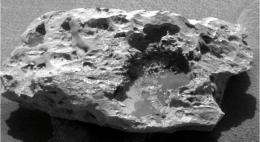
(PhysOrg.com) -- Composition measurements by NASA's Mars Exploration Rover Opportunity confirm that this rock on the Martian surface is an iron-nickel meteorite.
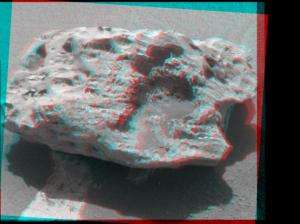
Image Credit: NASA/JPL-Caltech/Cornell University
This image combines exposures from the left eye and right eye of the rover's panoramic camera to provide a three-dimensional view when seen through red-green glasses with the red lens on the left.The camera took the component images during the 1,961st Martian day, or sol, of Opportunity's mission on Mars (July 31), after approaching close enough to touch the rock with tools on the rover's robotic arm.
Researchers have informally named the rock "Block Island." With a width of about two-thirds of a meter (2 feet), it is the largest meteorite yet found on Mars. Opportunity found a smaller iron-nickel meteorite, called "Heat Shield Rock" in late 2004.
Provided by JPL/NASA (news : web)


I've been following all this Mars stuff since I read a book called 'Mars at Last' which was about the Viking missions to Mars back in 1976. It amazes me that the two Mars rovers, Spirit and opportunity, have exceeded their anticipated missions by several hundred percent.
As a Layman with a capitol 'L' it would seem to me me that good old "Buzz Aldrin" was right when he was asking, during the recent fortieth anniversary of the moon landing celebrations, "What the heck are we doing planning to go back to the moon for when the real next frontier is Mars?" though not in quite so many words. Or as inarticulate.
The key thing I see is there is only a small amount of dust on it. This implies that the dust in that area is being blown out of the area at present. Thus the rock could be several or more feet below its initial impact point and the land around it was later eroded down by wind. This is assuming that the surface there is loose rather than rocky.
I looked at the earlier photo and it does seem to be an area that has been eroded down over time. Quite flat with this rock as the biggest thing in the photo.
Ethelred
The meteorite might have landed either in a thick layer of dust or sand (which would have to somehow exist even though wind action must have been greater and Mars a lot wetter back then) cushioning its fall. Or it landed, burying itself deep in some surface more substantial than sand or dust, which then was eroded by wind action sufficient to leave the meteorite sitting proud, but not sufficient to abrade smooth all the contours of the meteorite.
...Or it landed in a body of water?... with no signs of rust?
No free oxygen so no rust.
Ethelred
Sorry for the new signature. But It Needed Killun.
From QubitTamer's fake profile
Qubitwit gets the rest of August in my signature for aiming his idiocy at me. Again.
I had supposed that the appearance of the meteorite was down to being sheltered from the sand blasting it would probably have got - but then your comment about the rust has made me find out something else that is puzzling. There's plenty of iron oxides on Mars (hence the red colour) so I naturally thought that the iron meteorite would also somehow rust. In fact according to this article from Wikipedia
http://en.wikiped...on_metal
"When in contact with water and oxygen, or other strong oxidants and/or acids, iron will rust[...]Other degrading solutions are sulfur dioxide in water and carbon dioxide in water."
There would have been plenty of these solutions in Mar's early history. However the article goes on to describe what kind of rust results -
"Under these corrosive conditions, iron(III) species are formed. Unlike iron(II) oxides, iron(III) oxides are not passivating because these materials do not adhere to the bulk metal. As these iron(III) compounds form and flake off from the surface, fresh iron is exposed, and the corrosion process continues until all of the iron(0) is either consumed or all of the oxygen, water, carbon dioxide, or sulfur dioxide in the system are removed or consumed. [2]"
So it would seem that the rust formed would not have adhered to the iron - and this raises another question. If the meteorite was rusting, with the rust regularly flaking off, then I would have expected all the sharp edges on the meteorite to have been rounded off in time. This doesn't seem to be the case on the right hand side. So again the meteorite seems to have been protected from this treatment, presumably by being buried under sand (or possibly water?).
http://www.mail-a...402.html
Also to put the puzzle into specific questions try the segment subtitled 'Five Samples - Many Questions' in
http://www.psrd.h...ars.html