Kepler Detects Atmosphere of Hot World
August 6, 2009
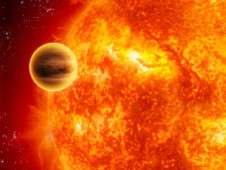
Exoplanet orbiting close to its sun. Image credit: NASA
(PhysOrg.com) -- NASA's new exoplanet-hunting Kepler space telescope has detected the atmosphere of a known giant gas planet, demonstrating the telescope's extraordinary scientific capabilities. The discovery will be published Friday, Aug. 7, in the journal Science.
The find is based on a relatively short 10 days of test data collected before the official start of science operations. Kepler was launched March 6, 2009, from Cape Canaveral Air Force Station in Florida. The observation demonstrates the extremely high precision of the measurements made by the telescope, even before its calibration and data analysis software were finished.
"As NASA's first exoplanets mission, Kepler has made a dramatic entrance on the planet-hunting scene," said Jon Morse, director of the Science Mission Directorate's Astrophysics Division at NASA Headquarters in Washington. "Detecting this planet's atmosphere in just the first 10 days of data is only a taste of things to come. The planet hunt is on!"
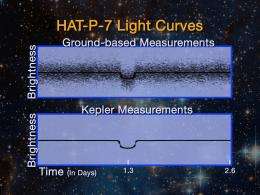
Comparison of ground-based and space-based light curves for hot exoplanet HAT P7b. Image credit: NASA
Kepler team members say these new data indicate the mission is indeed capable of finding Earth-like planets, if they exist. Kepler will spend the next three-and-a-half years searching for planets as small as Earth, including those that orbit stars in a warm zone where there could be water. It will do this by looking for periodic dips in the brightness of stars, which occur when orbiting planets transit, or cross in front of, the stars."When the light curves from tens of thousands of stars were shown to the Kepler science team, everyone was awed; no one had ever seen such exquisitely detailed measurements of the light variations of so many different types of stars," said William Borucki, the principal science investigator and lead author of the paper.
The observations were collected from a planet called HAT-P-7, known to transit a star located about 1,000 light years from Earth. The planet orbits the star in just 2.2 days and is 26 times closer than Earth is to the sun. Its orbit, combined with a mass somewhat larger than the planet Jupiter, classifies this planet as a "hot Jupiter." It is so close to its star, the planet is as hot as the glowing red heating element on a stove.
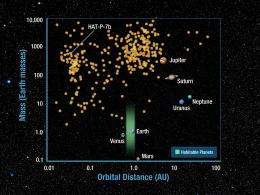
Distributions of mass and orbit size for discovered planets. Image credit: NASA
The Kepler measurements show the transit from the previously detected HAT-P-7. However, these new measurements are so precise, they also show a smooth rise and fall of the light between transits caused by the changing phases of the planet, similar to those of our moon. This is a combination of both the light emitted from the planet and the light reflected off the planet. The smooth rise and fall of light is also punctuated by a small drop in light, called an occultation, exactly halfway between each transit. An occultation happens when a planet passes behind a star.
The new Kepler data can be used to study this hot Jupiter in unprecedented detail. The depth of the occultation and the shape and amplitude of the light curve show the planet has an atmosphere with a day-side temperature of about 4,310 degrees Fahrenheit. Little of this heat is carried to the cool night side. The occultation time compared to the main transit time shows the planet has a circular orbit. The discovery of light from this planet confirms the predictions by researchers and theoretical models that the emission would be detectable by Kepler.
This new discovery also demonstrates Kepler has the precision to find Earth-size planets. The observed brightness variation is just one and a half times what is expected for a transit caused by an Earth-sized planet. Although this is already the highest precision ever obtained for an observation of this star, Kepler will be even more precise after analysis software being developed for the mission is completed.
"This early result shows the Kepler detection system is performing right on the mark," said David Koch, deputy principal investigator of NASA's Ames Research Center at Moffett Field, Calif. "It bodes well for Kepler's prospects to be able to detect Earth-size planets."
-
Kepler Set to Launch Tonight on Planet Finding Mission
Mar 06, 2009 |
not rated yet |
0
-
Transit Search Finds Super-Neptune
Jan 20, 2009 |
not rated yet |
0
-
Let the Planet Hunt Begin
May 13, 2009 |
not rated yet |
0
-
Kepler Planet Finding Mission Set for March 5 Launch
Feb 19, 2009 |
not rated yet |
0
-
NASA's Kepler Spacecraft Baked and Ready for More Tests
Sep 23, 2008 |
not rated yet |
0
-
Engineers build first sub-10-nm carbon nanotube transistor
Feb 01, 2012 |
4.9 / 5 (31) |
30
-
Something old, something new: Evolution and the structural divergence of duplicate genes
Jan 31, 2012 |
4.6 / 5 (7) |
1
-
The hidden nanoworld of ice crystals: Revealing the dynamic behavior of quasi-liquid layers
Jan 30, 2012 |
5 / 5 (3) |
1
-
Stock market network reveals investor clustering
Jan 27, 2012 |
3.9 / 5 (23) |
8
-
Of microchemistry and molecules: Electronic microfluidic device synthesizes biocompatible probes
Jan 26, 2012 |
5 / 5 (1) |
0
-
Never ending outer space.....
13 hours ago
-
Neutron Star fragments?
15 hours ago
-
stationary or not?
19 hours ago
-
Scale of the Universe
Feb 10, 2012
-
Titan's lack of impact craters
Feb 09, 2012
-
Real pictures of black hole eating a star?
Feb 08, 2012
- More from Physics Forums - General Astronomy
More news stories
Latin America mining boom clashes with conservation
Latin America is experiencing a mining boom as prices rise fuelled by a hike in global demand, but the region is also being hit by a wave of violent protests, strikes and rallies by environmentalists.
6 hours ago |
not rated yet |
0
Political leaders play key role in how worried Americans are by climate change: study
More than extreme weather events and the work of scientists, it is national political leaders who influence how much Americans worry about the threat of climate change, new research finds.
Feb 06, 2012 |
5 / 5 (6) |
72
NASA budget will axe Mars deal with Europe: scientists
US President Barack Obama's budget proposal to be submitted next week for 2013 will cut NASA's budget by 20 percent and eliminate a major partnership with Europe on Mars exploration, scientists said Thursday.
Space & Earth / Space Exploration
Feb 10, 2012 |
5 / 5 (3) |
55
Humans may have helped the decline of African rainforests 3000 years ago
(PhysOrg.com) -- Large areas of rainforests in Central Africa mysteriously disappeared over three thousand years ago, to be replaced by savannas. The prevailing theory has been that the cause was a change ...
Study shows global glaciers, ice caps, shedding billions of tons of mass annually
Earth's glaciers and ice caps outside of the regions of Greenland and Antarctica are shedding roughly 150 billion tons of ice annually, according to a new study led by the University of Colorado Boulder.
Space & Earth / Earth Sciences
Feb 08, 2012 |
4.4 / 5 (9) |
14
|
Google might launch Drive for cloud storage soon
(PhysOrg.com) -- Google's next big move, according to the Wall Street Journal, is a cloud storage service called Drive. Hardly first to the plate, Google is simply catching up to introducing its cloud reposi ...
Love a click away in Indonesia's Twitter Republic
He was a geeky kid from Yogyakarta, she a glamorous city girl in Jakarta. In a country with one of the world's most vibrant social networking scenes they fell in love on Twitter.
Europeans protest controversial Internet pact
Tens of thousands of people marched in protests in more than a dozen European cities Saturday against a controversial anti-online piracy pact that critics say could curtail Internet freedom.
Walney offshore wind farm is world's biggest (for now)
(PhysOrg.com) -- The Walney wind farm on the Irish Sea--characterized by high tides, waves and windy weather--officially opened this week. The farm is treated in the press as a very big deal as the Walney ...
Navy to begin tests on electromagnetic railgun prototype launcher
The Office of Naval Research (ONR)'s Electromagnetic (EM) Railgun program will take an important step forward in the coming weeks when the first industry railgun prototype launcher is tested at a facility ...
Explained: Sigma
It's a question that arises with virtually every major new finding in science or medicine: What makes a result reliable enough to be taken seriously? The answer has to do with statistical significance -- but ...


Aug 07, 2009
Rank: 4 / 5 (3)
Aug 07, 2009
Rank: not rated yet
Aug 07, 2009
Rank: not rated yet
Aug 07, 2009
Rank: 1.7 / 5 (3)
The following information on the Earth and the Sun may help NASA's Astrophysics Division use the Kepler space telescope to locate other Earth-like planets.
Ordinary meteorites and rocky, Earth-like planets are made mostly of Fe, O, Ni, Si and S - elements that violent nuclear reactions formed near the core of a supernova.
In 1977 Peter Toth reported that the Sun may be a pulsar [1].
In 1983 it was reported that Fe, O, Ni, Si and S are the most abundant elements in the Sun, although its surface is covered with a veneer of lightweight elements [2]
In 1992 Aleksander Wolszczan and Dale Frail [3] discovered rocky, Earth-like planets orbiting another pulsar, PSR 1257 12. In 1994 this finding was confirmed [4].
In 2001, it was shown that repulsive interactions between neutrons in the core of the Sun trigger a series of nuclear reactions that generate solar luminosity, solar neutrinos and solar wind H (a neutron-decay product) in the proportions observed [5].
In 2003 repulsive interactions between neutrons in a pulsar about 1 AU away was confirmed as the energy source that heats Earth, the first known rocky planet [6].
http://tinyurl.com/2et3mc
With kind regards,
Oliver K. Manuel
http://www.omatumr.com
REFERENCES:
1. Peter Toth, "Is the Sun a pulsar?", Nature 270 (1977) 159-160.
2. O. K. Manuel and Golden Hwaung, "Solar abundance of the elements", Meteoritics 18 (1983) 209-222.
3. A. Wolszczan and D. A. Frail, %u201CA planetary system around the millisecond pulsar PSR1257 12", Nature 355 (1992) 145-147.
4. A. Wolszczan, %u201CConfirmation of earth-mass planets orbiting the millisecond pulsar PSR B 1257 12%u201D, Science 264 (1994) 538-542.
5. O. Manuel, C. Bolon, A. Katragada, and M. Insall1, "Attraction and repulsion of nucleons: Sources of stellar energy", Journal of Fusion Energy 19 (2001) 93-98: http://tinyurl.com/39kwoz
6. O. Manuel, E. Miller, and A. Katragada, "Neutron repulsion confirmed as energy source", Journal of Fusion Energy 20 (2002) 197-201: http://tinyurl.com/38un57
Aug 12, 2009
Rank: 5 / 5 (1)
Inherent in the way atoms evolve and meteorites form. They are too small for volatiles to stay and non-volatile elements that are inherently rare due to way they are created cannot be expected to be in meteorites. So this kind of like pointing out that water is wet. Only a bit less obvious.
For which there is no followup. Not even by Peter Toth.
By Oliver. With no confirmation from anyone, except Oliver of course. The only way Oliver could even begin to show evidence would be to build Sun Diver. And I think Dr. Brin skipped over a few details on how Sun Diver could work. Great book by the way.
Again by Oliver. There is no evidence to support Oliver's claim except for other unsupported papers by Oliver. This is usually called circular reasoning.
Oliver means HE CLAIMS that this is the case based on his unsupported theories. Similar to people claiming the Earth is only 6000 years old because the Bible shows it, something that would be true only if the Bible was reliable. Neither can be considered reliable sources without confirmation from independent sources. Oliver has none although he has claimed such in several posts. In all cases the independent paper was from Oliver or from long ago papers that are no longer considered to have much to do with reality by anyone except Oliver.
Ethelred