Nissan's 'Leaf' to challenge Toyota's Prius (Update)
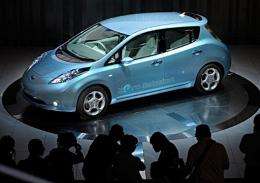
August 6, 2009 by Mira Oberman Nissan Motor's electric vehicle called "Leaf"

Enlarge

Photographers take pictures of the new Japanese Nissan Motor's electric vehicle called "Leaf" during the opening ceremony for the new company headquarters in Yokohama, Kanagawa prefecture, on August 2, 2009. Nissan's upcoming all-electric car could outsell hybrids like Toyota's Prius even though it can't drive more than about 100 miles (160 kilometers) without stopping to recharge.

Nissan's upcoming all-electric car could outsell hybrids like Toyota's Prius even though it can't drive more than about 100 miles (160 kilometers) without stopping to recharge, a senior executive said.

That's because, unlike more expensive hybrids, owners of the zero-emission Leaf will be able to save money while saving the environment, said Larry Dominique, Nissan North America's vice president for product planning.

"Hybrids won't get you there, range extended () won't get you there," Dominique told reporters on the sidelines of an automotive conference in Traverse City, Michigan.

"They're good technologies, but for the mass market appeal, they have much bigger obstacles, especially on upfront cost."

Hybrids currently account for about two percent of global auto sales. Nissan expects electric vehicles to swallow ten percent of the global market by 2016 to 2020.

"We are very confident that Leaf will give you a lower cost to ownership," Dominique said on the margins of the CAR Management Briefing Seminar.

Nissan plans to sell the midsized Leaf hatchback for somewhere in the 25,000- to 33,000-dollar range.

That's slightly more than the current price of the Prius but up to 20,000 dollars less than the expected cost of the Volt, General Motors' plug-in hybrid.

The savings also come in the cost of refueling: even in the most expensive electricity markets, most drivers should be able to charge their Leaf at home for less than a dollar.

And even if prices were to fall below 1.10 a gallon, most vehicles would still cost more to fuel than the Leaf, Dominique said.

Nissan will introduce the Leaf to business and government fleet customers in the United States, Japan and Europe next year.

It is also working with a number of utility companies and local governments to set up public recharging stations so the Leaf can be sold to consumers as soon as late 2010. The Leaf is targeted for a mass market release in 2012.

Dominique acknowledged that it will be a challenge to mass market a limited-range vehicle in the geographically spread out United States.

But the current range will be sufficient to meet the daily commuting needs of the vast majority of drivers and it comes at a time when a growing number of US consumers are concerned about cutting their carbon footprint, he said.

"It's going to be hard to convince the guy who lives in Butte, Montana who has to drive 40 miles to the grocery store to buy an electric vehicle," Dominique said.

"We do believe that we're at this tipping point where if we bring in the right technology at the right price with the right execution... that we'll be able to convince people this is a great alternative."

Owners will be able to recharge the battery at home through the domestic power supply in about eight hours, or top it up to 80 percent capacity in around 30 minutes at planned electric recharging stations.

Among other features, drivers will be able to use their mobile telephones to turn on the air conditioning and set the battery charging functions.

If they need help finding the nearest charging station, the navigation system will point the way.

Nissan, Japan's third largest automaker, was slower than Toyota and Honda to embrace fuel-sipping petrol-electric hybrids, but it is determined to steal a march on its larger competitors in cars.

The dream of an electric car, which has been around since the time of Thomas Edison, has so far failed to break into the mainstream because of limited battery life and high costs.

Technological breakthroughs in the development of long-lasting lithium-ion batteries have significantly and lowered the cost of and increased their range and top speed potential.

The Leaf will not be the first mainstream electric car on the market. Mitsubishi Motors recently rolled out its "i-MiEV" minicar while Fuji Heavy Industries launched the Subaru plug-in STELLA.

(c) 2009 AFP


print this article email this article download pdf blog this article bookmark this article     Stumble it Digg this share on Facebook retweet share on Reddit add to delicious
Rate this story - 3.6 /5 (8 votes)

Rank Filter

Move the slider to adjust rank threshold, so that you can hide some of the comments.


Display comments: newest first

  • deatopmg - Aug 07, 2009
    • Rank: 5 / 5 (2)
    What is going to replace the fuel tax presently used exclusively to maintain the existing (failing) highway infrastructure?
    Will that be in the form of a new annual federal registration tax on electric vehicles?
    Will the fuel tax be increased as revenues fall due to the introduction of higher mileage vehicles?
  • PaulLove - Aug 07, 2009
    • Rank: 5 / 5 (2)
    I suppose you could ask the reverse do the drivers of monster SUV's and big dualie pickups deserve a tax discount because they burn more gas?

    Lets have a tax credit for vehicals who get less than 15mpg. And don't forget to arrest those fellows who are using biodiesel setups to turn cooking grease into fuel oil because they also aren't paying fuel tax.

    Perhaps if they find themselves short on money they might stop selling unborn babies into tax slavery to fund the bailout of special interest groups.
  • Soylent - Aug 07, 2009
    • Rank: 5 / 5 (1)
    I suppose you could ask the reverse do the drivers of monster SUV's and big dualie pickups deserve a tax discount because they burn more gas?


    Heavy vehicles and high speeds do a disproportionate amount of damage to roads, even accounting for poorer fuel economy.

    Taxing fuel is a very inequitable way to charge for use of roads.
  • jimbo92107 - Aug 07, 2009
    • Rank: 4 / 5 (1)
    I wonder if Nissan will have the foresight to understand that its biggest market may wind up being Lithium-ion batteries for various uses other than its own cars?

August 6, 2009 all stories

Comments: 4

3.6 /5 (8 votes)
  • Stumble this up

  • Digg this

  • share this

  • hide
  • Related Stories

  • Japan electric car makers, utility plan battery-charge stations
    created Aug 05, 2009 | popularity not rated yet | comments 0
  • Nissan rolls out electric car at new headquarters
    created Aug 02, 2009 | popularity not rated yet | comments 0
  • Toyota Not Too Keen On Plug-In Hybrids
    created May 22, 2009 | popularity not rated yet | comments 0
  • UC Davis Will Study Users of New Plug-in Hybrid Cars
    created Oct 30, 2007 | popularity not rated yet | comments 0
  • Renault to test electric cars in Paris, Milan: company
    created Jul 02, 2009 | popularity not rated yet | comments 0


  • hide
  • Relevant PhysicsForums posts

  • Trying to adapt a fuel gage circuit
    created 15 hours ago
  • Pushing the piston.
    created 20 hours ago
  • Do Camcorders/ Video camera have Sensors in them?
    created Nov 22, 2009
  • Aspiring Engineering major looking for general answers
    created Nov 19, 2009
  • Calculating max load of square tube (steel)
    created Nov 19, 2009
  • Passive Chemical Heating
    created Nov 19, 2009
  • More from Physics Forums - General Engineering

Other News

Fox CEO wants US to join France on Internet piracy

Technology / Internet

created 42 minutes ago | popularity not rated yet | comments 0

(AP) -- The chief executive of Fox Filmed Entertainment said Monday the U.S. should join France in cutting off the Internet connection of users who repeatedly download copyright-protected films.


Intel logo A

Intel wants a chip implant in your brain

Technology / Hi Tech

created 4 hours ago | popularity 4 / 5 (7) | comments 15

(PhysOrg.com) -- Computer chip maker Intel wants to implant a brain-sensing chip directly into the brains of its customers to allow them to operate computers and other devices without moving a muscle.


Workers at the Statkraft Osmotic power plant prototype in Tofte

Harnessing the power of salt, Norway tries osmotic power

Technology / Energy

created 5 hours ago | popularity 4 / 5 (1) | comments 2

After wind, sun, currents and tides, a company is preparing to make clean electricity by harnessing another natural phenomenon, the energy-unleashing encounter of freshwater and seawater.


Microsoft has held talks with Rupert Murdoch's News Corp over removing its news websites from Google, a report said

News Corp, Microsoft hold talks on Google: report

Technology / Internet

created 5 hours ago | popularity 3 / 5 (2) | comments 1

Microsoft has held talks with Rupert Murdoch's News Corp over a possible plan for the software giant to pay the media company to remove its news websites from Google, a report said Monday.


The Symbian platform is used on almost 50% of mobiles worldwide

Spotify launches application for Nokia phones

Technology / Software

created 4 hours ago | popularity not rated yet | comments 0

Swedish streaming software Spotify announced on Monday the launch of a music application for the Symbian platform, used by the world's biggest mobile phone maker Nokia and other smartphones.