The perfect cut

August 7, 2009 The perfect cut

Enlarge

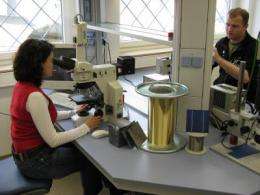
Using a light microscope to study sawed silicon wafer surfaces. In the foreground: a silicon block with sawed wafers, coils of wire and a finished solar cell. Credit: Fraunhofer IWM

You need the right tool to slice silicon blocks into paper-thin wafers: a several-kilometer-long wire wetted with a type of grinding paste. And all the parameters must be optimally adjusted -- only then can significant material losses be avoided during the cutting process.

The ability to cut onions into thin slices isn't just a matter of practice - choosing the right implement also helps make good onion rings. The same principle applies when cutting blocks to make wafers for .

You need a special slicing tool to produce paper-thin wafers from silicon blocks ("ingots"): reminiscent of an egg slicer, a filigree wire is used to cut through the ingot at a speed of up to 60 km/h. This wire is several hundred kilometers long and arranged in such a way that the ingot is sliced into hundreds of wafers simultaneously. The process takes around six hours and the resultant slices are approximately 180 µm thick.

Dr. Rainer Kübler, business unit manager at the Fraunhofer Institute for Mechanics of Materials IWM, explains: "When slicing the wafers, the challenge is to reduce the saw gap width." The space between two wafers is governed by the thickness of the wire. The steel wire is wetted with a type of paste ("slurry"), a mixture of silicon carbide and polyethylene glycol. This is harder than silicon and cuts through the ingot. The gap arises where the silicon is reduced to powder during cutting. "Gap widths are currently around 180 µm," says Kübler, "which means that given a thickness of 180 µm, we generate the same amount of waste for each silicon slice. That's inefficient." The researchers "want to achieve smaller saw gap widths of around 100 µm, which are also suitable for industrial applications."

In a project funded by the federal ministry for the environment (BMU), they are currently studying the abrasion process and contact regimes using a single-wire saw and are principally interested in the interactions between the wire, the slurry and the silicon. They are also using computer modeling to simulate different configurations. What forces are at work when sawing with thin wires? How can one ensure the wire is well wetted? What is the best grain size for the slurry and how must the particles be distributed?

"We want to answer all these questions and ultimately arrive at optimal and slurry systems that are suitable for industrial applications," says Kübler. The researchers are currently striving to achieve gap widths of 90 µm, which would represent a huge increase in efficiency as waste would be halved.

Source: Fraunhofer-Gesellschaft (news : web)


print this article email this article download pdf blog this article bookmark this article     Stumble it Digg this share on Facebook retweet share on Reddit add to delicious
Rate this story - 4.5 /5 (2 votes)

Rank Filter

Move the slider to adjust rank threshold, so that you can hide some of the comments.


Display comments: newest first

  • sender - Aug 07, 2009
    • Rank: not rated yet
    vacuum gas deposition sounds cheaper than cutting ingots
  • NeilFarbstein - Aug 07, 2009
    • Rank: 1 / 5 (1)
    why not use femtosecond laser or deposition.
  • el_gramador - Aug 08, 2009
    • Rank: not rated yet
    I'll tell you why fellas, cost. That's why. Cost rules everything.

August 7, 2009 all stories

Comments: 3

4.5 /5 (2 votes)
  • Stumble this up

  • Digg this

  • share this

  • hide
  • Related Stories


  • hide
  • Relevant PhysicsForums posts

Other News

Friends go online at Foursquare to meet offline (AP)

Friends go online at Foursquare to meet offline

Technology / Internet

created 53 minutes ago | popularity not rated yet | comments 0

(AP) -- Laura Fitton's ascent has been staggering: In less than a year, she's become mayor of nine different places in several different states, all without giving any speeches or kissing any babies.


The KLM airplane which runs on biokerosene is seen at Schiphol airport, near Amsterdam

KLM flies world's first 'passenger flight on biofuel'

Technology / Energy

created 6 minutes ago | popularity not rated yet | comments 0

A Boeing 747, one of four engines powered by a 50-percent biokerosene mix, circled the Netherlands for an hour on Monday for what airline KLM called the world's first passenger flight using biofuel.


IBM Researchers Lower Language Barrier With Text Translator

Technology / Computer Sciences

created 33 minutes ago | popularity 4 / 5 (1) | comments 0

IBM Researchers are helping to break the language barrier with the advent of technology dubbed "n.Fluent" -- smart software that translates text between English and 11 other languages. IBM employees use it to instantaneously ...


HP's profit up 14 pct despite sales drop (AP)

HP's profit up 14 pct despite sales drop

Technology / Business

created 48 minutes ago | popularity not rated yet | comments 0

(AP) -- Hewlett-Packard Co.'s profit jumped 14 percent in the latest quarter, helped by cost-cutting and better results from its technology services division.


Retailers look to stretch out Cyber Monday push

Technology / Business

created 33 minutes ago | popularity not rated yet | comments 0

(AP) -- Retailers are thinking beyond Cyber Monday - a holiday marketing promotion many push for the Monday after Thanksgiving - and trying to spin their discounts into into Cyber Weekends or even Cyber Weeks.