Ground segment declared ready for CryoSat-2 launch
August 7, 2009
Ground segment declared ready for CryoSat-2 launch

Enlarge

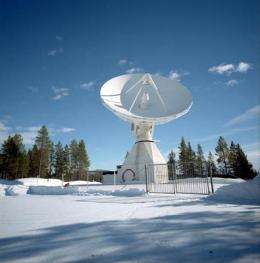
The Kiruna S- and X-band station supports ESA's Envisat and ERS-2 satellites, and is scheduled to support CryoSat-2 in 2009. The station is located at Salmijärvi, 38 km east of Kiruna, in northern Sweden. The station is equipped for tracking, telemetry and command operations as well as for reception, recording, processing and dissemination of data. Credits: ESA - S.Corvaja

(PhysOrg.com) -- An Earth observation mission does not just involve the building of a satellite, it also includes the all-important infrastructure to control the satellite and handle the data - the ground segment. As ESA prepares for the launch of CryoSat-2 at the end of the year, its associated ground segment is now ready.

ESA's ice mission CryoSat-2 is due to launch on a Dnepr rocket from the in Kazakhstan in December. CryoSat-2 replaces the original CryoSat satellite, which was lost as a result of a failure in the timing of the launch sequence in October 2005. Now, just three and a half years after the decision was taken to rebuild CryoSat, the new satellite is awaiting shipment to the launch site and the ground segment infrastructure is in place for launch.

The ground segment mainly comprises the Flight Operations Segment (FOS), through which the satellite is controlled and monitored and the Payload Data Ground Segment (PDGS), which allows the data from the satellite to be received, processed, archived and distributed to the users.

ESA's European Space Operations Centre (ESOC) in Darmstadt, Germany, is responsible for controlling and monitoring the satellite via the ESA/ESTRACK ground station in Kiruna in northern Sweden. The data will also be received by the ground station, where they will be processed under the control of ESA's Centre for (ESRIN) in Frascati, Italy, for final delivery to the users.
Ground segment declared ready for CryoSat-2 launch
Enlarge

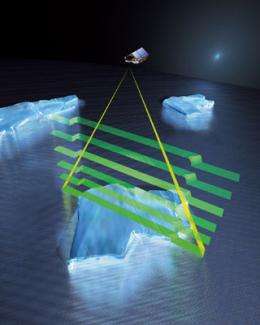
Using a sophisticated radar altimeter called SIRAL (Synthetic Aperture Radar Interferometric Radar Altimetry), CryoSat-2 will make accurate measurements of the thickness of floating sea-ice so that seasonal to inter-annual variations can be detected. It will also survey the surface of continental ice sheets to detect small elevation changes. Credits: ESA - AOES Medialab

Although CryoSat-2 is a rebuild, the ground segment architecture has been completely redesigned. This is partly to accommodate a new PDGS philosophy and also to account for the many enhancements made to the new satellite, in particular due to the fact that CryoSat-2 will carry a backup core instrument.

The Ground Segment Acceptance Review has just been successfully completed. Christoph Goetz who is responsible for the CryoSat-2 ground segment commented, "Given the timescale of ground segment redesign, it has been a huge achievement to be in such good shape five months before the planned launch. The fact that the Review Board have already concluded that we are ready to support CryoSat-2 is down to the excellent work performed by all the teams involved."

Following on from ESA's gravity mission GOCE, which launched in March this year, and the water mission SMOS, which is scheduled for launch in November, CryoSat-2 will be ESA's third Earth Explorer satellite in orbit.

With diminishing ice cover fast becoming a reality, the CryoSat mission is dedicated to measuring the exact rate of change in the thickness of both ice floating in the oceans and ice sheets on land. To measure the thickness of relatively thin sea ice as well as survey the surface of ice sheets that are kilometres thick means that the satellite will carry specialised instrumentation in the form of an innovative radar altimeter called the Synthetic Aperture Interferometric Radar Altimeter-2 (SIRAL-2).

ESA's CryoSat-2 Project Manager Richard Francis said that, "The Ground Segment Acceptance Review is an important milestone as we build up to the launch. Next will be the Flight Acceptance Review of the itself, which will start in September. After that we’ll be ready to ship to the launch site. All this leads up to the key moment in mid-December when we’ll start the countdown. As we lost the original CryoSat just 300 seconds after liftoff, you can well imagine how anxiously we are all waiting to get CryoSat-2 successfully into orbit."

Provided by European Space Agency (news : web)


Rank not rated yet
Related Stories
Relevant PhysicsForums posts
  • Never ending outer space.....
    created14 hours ago
  • Neutron Star fragments?
    created16 hours ago
  • stationary or not?
    created20 hours ago
  • Scale of the Universe
    createdFeb 10, 2012
  • Titan's lack of impact craters
    createdFeb 09, 2012
  • Real pictures of black hole eating a star?
    createdFeb 08, 2012
  • More from Physics Forums - General Astronomy

More news stories

Latin America mining boom clashes with conservation

Latin America is experiencing a mining boom as prices rise fuelled by a hike in global demand, but the region is also being hit by a wave of violent protests, strikes and rallies by environmentalists.

Space & Earth / Environment

created 7 hours ago | popularity not rated yet | comments 0

Political leaders play key role in how worried Americans are by climate change: study

More than extreme weather events and the work of scientists, it is national political leaders who influence how much Americans worry about the threat of climate change, new research finds.

Space & Earth / Environment

created Feb 06, 2012 | popularity 5 / 5 (6) | comments 73

NASA budget will axe Mars deal with Europe: scientists

US President Barack Obama's budget proposal to be submitted next week for 2013 will cut NASA's budget by 20 percent and eliminate a major partnership with Europe on Mars exploration, scientists said Thursday.

Space & Earth / Space Exploration

created Feb 10, 2012 | popularity 5 / 5 (3) | comments 55

Humans may have helped the decline of African rainforests 3000 years ago

(PhysOrg.com) -- Large areas of rainforests in Central Africa mysteriously disappeared over three thousand years ago, to be replaced by savannas. The prevailing theory has been that the cause was a change ...

Space & Earth / Environment

created Feb 10, 2012 | popularity 4.1 / 5 (14) | comments 20 | with audio podcast report

Study shows global glaciers, ice caps, shedding billions of tons of mass annually

Earth's glaciers and ice caps outside of the regions of Greenland and Antarctica are shedding roughly 150 billion tons of ice annually, according to a new study led by the University of Colorado Boulder.

Space & Earth / Earth Sciences

created Feb 08, 2012 | popularity 4.4 / 5 (9) | comments 14 | with audio podcast


Injured boomers beware: Know when to see doctor

(AP) -- It happened to nurse Jane Byron years after an in-line skating fall, business owner Haralee Weintraub while doing "men's" push-ups, and avid cyclist Gene Wilberg while lifting a heavy box.

Google might launch Drive for cloud storage soon

(PhysOrg.com) -- Google's next big move, according to the Wall Street Journal, is a cloud storage service called Drive. Hardly first to the plate, Google is simply catching up to introducing its cloud reposi ...

Love a click away in Indonesia's Twitter Republic

He was a geeky kid from Yogyakarta, she a glamorous city girl in Jakarta. In a country with one of the world's most vibrant social networking scenes they fell in love on Twitter.

Europeans protest controversial Internet pact

Tens of thousands of people marched in protests in more than a dozen European cities Saturday against a controversial anti-online piracy pact that critics say could curtail Internet freedom.

Walney offshore wind farm is world's biggest (for now)

(PhysOrg.com) -- The Walney wind farm on the Irish Sea--characterized by high tides, waves and windy weather--officially opened this week. The farm is treated in the press as a very big deal as the Walney ...

Navy to begin tests on electromagnetic railgun prototype launcher

The Office of Naval Research (ONR)'s Electromagnetic (EM) Railgun program will take an important step forward in the coming weeks when the first industry railgun prototype launcher is tested at a facility ...