NASA satellite image shows deadly Typhoon Morakot slamming Taiwan
August 7, 2009 NASA satellite image shows deadly Typhoon Morakot slamming Taiwan

Enlarge

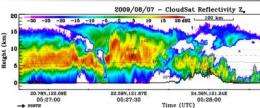
NASA's CloudSat captured a side view of Morakot on Aug. 7 and found Morakot's clouds are over 17 km (10 miles) high! Credit: NASA/JPL/CSU/NRL-Monterey

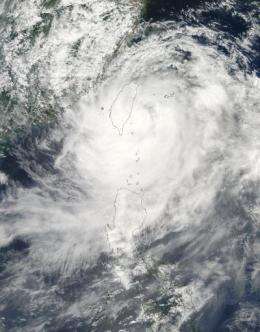
Sometimes satellite imagery will leave a person in awe of nature's power and that's what the latest satellite image from NASA's Aqua satellite will do as it shows the giant Typhoon Morakot's center about to cross Taiwan. Morakot has already caused problems in Taiwan on its approach and has proven deadly in the Philippines.

Taiwan has already reported flooding rains, landslides, gusty winds and power outages on Friday, August 7 as Morakot was making landfall and crossing the island nation on its way to a final landfall in China on Saturday. BBC News reported some mountainous areas of northern had already received up to 20 inches of rain. Taiwan has ordered airline flights canceled and schools closed.

NASA's Aqua flew over the 1,000 mile in diameter-wide Morakot and captured an awesome image of its clouds using the Moderate Imaging Spectroradiometer (MODIS) instrument on August 7 at 1:25 a.m. EDT. The image shows Morakot's center about to cross over east-central Taiwan. Morakot is so large that the southern extent of its cloud cover and heavy rains reach into the northern . According to People's Daily on-line, ten people have already lost their lives to Morakot's wrath.
NASA satellite image shows deadly Typhoon Morakot slamming Taiwan
Enlarge

The MODIS instrument on NASA's Aqua satellite captured this stunning image of giant Typhoon Morakot just before landfall in Taiwan on August 6 at 1:25 a.m. EDT. Credit: NASA/MODIS Rapid Response

On Friday, Aug. 7 at 11 a.m. EDT, Morakot's sustained winds were near 92 mph (80 knots). Satellite imagery is showing the beginning development of an "eye" in Morakot's center, indicating its strengthening as it approaches landfall in Taiwan. The center of the was near 24.0 north and 121.7 east, about 70 miles south-southeast of Taipei, Taiwan, moving west-northwest.

After Morakot's landfall in Taiwan it is forecast to turn northwest after reemerging into the Strait of Taiwan. Forecasters at the U.S. Navy's Joint Typhoon Warning Center are forecasting that Morakot "will enter the Taiwan Strait as a weak typhoon and should maintain its intensity through the strait due to favorable sea surface temperatures and minimal vertical wind shear values."

The forecast track looks like the storm will form an "L" on its path. It is expected to lose some of its strength as its eye crosses part of Taiwan. Landfall is expected to occur on Saturday in mainland China near Fuzhou and the storm is then expected to shoot north, just to the west of Shanghai.

Source: NASA/Goddard Space Flight Center


print this article email this article download pdf blog this article bookmark this article     Stumble it Digg this share on Facebook retweet share on Reddit add to delicious
Rate this story - 4.5 /5 (2 votes)


August 7, 2009 all stories

Comments: 0

4.5 /5 (2 votes)
  • Stumble this up

  • Digg this

  • share this

  • hide
  • Related Stories


  • hide
  • Relevant PhysicsForums posts

  • Human...nature
    created 52 minutes ago
  • Fusion or fission within the Earth?
    created Dec 22, 2009
  • West Mata - Explosive Deep-Ocean Volcano
    created Dec 20, 2009
  • did al gore really say that
    created Dec 20, 2009
  • More from Physics Forums - Earth

Other News

Iran to unveil new home-built satellite: report

Space & Earth / Space Exploration

created 13 hours ago | popularity 3 / 5 (4) | comments 1

Iran will unveil a new home-built satellite in February, a newspaper reported Thursday, amid Western concerns that Tehran is using its nuclear and space industries to develop atomic and ballistic weapons.


Global warming likely to be amplified by slow changes to Earth systems

Global warming likely to be amplified by slow changes to Earth systems

Space & Earth / Earth Sciences

created Dec 20, 2009 | popularity 2.6 / 5 (38) | comments 46

Researchers studying a period of high carbon dioxide levels and warm climate several million years ago have concluded that slow changes such as melting ice sheets amplified the initial warming caused by greenhouse ...


Computer simulation strengthens link between climate change and release of subsea methane

Computer simulation strengthens link between climate change and release of subsea methane

Space & Earth / Earth Sciences

created Dec 17, 2009 | popularity 4.1 / 5 (23) | comments 45

(PhysOrg.com) -- A first-of-its-kind computer simulation that mirrors real-world observations of methane bubbling up from a seabed in the Arctic Ocean provides further evidence that warming oceans may unleash ...


Arctic ice

Study: Earth's polar ice sheets vulnerable to even moderate global warming

Space & Earth / Earth Sciences

created Dec 16, 2009 | popularity 2.8 / 5 (45) | comments 40

A new analysis of the geological record of the Earth's sea level, carried out by scientists at Princeton and Harvard universities and published in the Dec. 16 issue of Nature, employs a novel statistical approa ...


A man walks his dog in the snow in the East Village

Polluting pets: the devastating impact of man's best friend

Space & Earth / Environment

created Dec 21, 2009 | popularity 1.7 / 5 (26) | comments 26

Man's best friend could be one of the environment's worst enemies, according to a new study which says the carbon pawprint of a pet dog is more than double that of a gas-guzzling sports utility vehicle.