Unlikely genetic suspect implicated in common brain defect
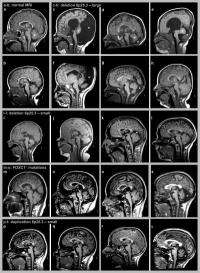
A genetic search that wound its way from patients to mouse models and back to patients has uncovered an unlikely gene critically involved in a common birth defect which causes mental retardation, motor delays and sometimes autism, providing a new mechanism and potentially improving treatment for the disorder.
Researchers from the University of Chicago, University of Alberta and other institutions announce in the September issue of Nature Genetics--available online August 10--that the FOXC1 gene contributes to Dandy-Walker malformation (DWM), a brain defect that occurs in 1 of every 5,000 births.
The role of the gene in Dandy-Walker malformation dispels the fog surrounding what goes awry in the brains of children born with the disorder. DWM is characterized by an improperly formed cerebellum, the region at the back of the brain involved in movement and coordination. As a result children with this disorder require considerable medical care, and in some cases surgery to treat the build up of fluid around the brain, a condition called hydrocephalus.
Researchers were surprised to discover that the FOXC1 gene mediated development of the cerebellum and contributed to DWM, as the gene is never actually expressed in the brain itself. Instead, the FOXC1 gene is expressed in fetal tissue called mesenchyme, which forms the skull and other layers that surround and protect the brain. That mechanism suggests an exciting new element of embryonic brain development, said study co-author Kathleen Millen, Ph.D., assistant professor of human genetics at the University of Chicago.
"The developing skull and all the stuff around the brain actually are as important for brain development as the brain itself," Millen said.
In the developing fetus, FOXC1 acts as a "master regulator," directing the expression of other genes that, in turn, give instructions necessary for the adjacent embryonic brain to properly form.
"It's controlling downstream genes, and some of those downstream genes we know are signaling molecules and growth factors that apparently are required for brain development," Millen said. "When you don't have them the brain gets screwed up; not because the causative gene is expressed in the brain but because it's in the surrounding tissue."
The new discovery follows research from the same group, published in 2004, that found the first genes associated with DWM.
"The first gene didn't give us a huge clue, but this one gives us a major clue to the underlying cause," said study co-author William Dobyns, M.D., professor of Human Genetics, Neurology and Pediatrics at the University of Chicago.
The path to the unlikely FOXC1 gene began with a Dandy-Walker patient referred to Dobyns in 2004, shortly after the researchers had published on the first two genes associated with the disorder. While those genes were located on chromosome 3, this patient exhibited an abnormal chromosome 6, implicating a second hotspot for DWM.
The researchers narrowed their search to a region of eight genes on chromosome 6. Patients with severe DWM were missing as many as seven genes in the target region, while patients missing just one gene showed mild abnormalities detectable only by MRI brain scans.
To determine which of the eight genes were most critical in development of the disorder, researchers turned to mouse models. One mouse, selectively lacking the FOXC1 gene, was created to study eye, heart and muscle defects, but no one had studied its brain.
Millen herself said she was skeptical that the mouse lacking the FOXC1 gene would be relevant to their study, and said she bet Kimberly Aldinger, the University of Chicago neurobiology graduate student who is first author on the study, a free lunch that the gene would not be the one they were seeking. It was a bet she happily lost.
"The moment we looked at the very first brain, it was so obvious they had a very messed up cerebellum and it had been completely overlooked," Millen said.
Now confident that FOXC1 was important for cerebellar development in mice, the researchers then searched for humans lacking all or part of the gene. Fortunately, they found 11 such subjects through Ordan Lehmann, associate professor of ophthalmology and medical genetics at the University of Alberta, who was studying patients with pediatric-onset glaucoma caused by FOXC1.
When the glaucoma patients were given MRI scans, the researchers observed cerebellar abnormalities that proved the involvement of FOXC1 in Dandy-Walker malformation.
"These patients were essential for blaming the brain malformation on the FOXC1 gene," Millen said. "Based on the mouse mutants we had a huge suspicion it had to be FOXC1, and the patients confirmed it."
The dramatic changes in the brains of these patients offers new insight into mechanisms contributing to glaucoma, a common disorder previously considered to be just a disease of the optic nerve - the nerve connecting the eye to the brain. Further studies of how the FOXC1 gene directs development of the cerebellum and other brain structures could also lead to new research avenues and treatments for hydrocephalous, autism and other diseases.
"Now that we understand what's going on, we can look at all the other loci and see if there are any other genes that fit this framework," Millen said. "From now on gene finding should be a lot faster because we understand the basic biology."
"This finding makes us rethink the basis of this disease," said Joseph Gleeson, M.D., an investigator with the Howard Hughes Medical Institute at the University of California, San Diego, who was not involved with the study. "It's going to be a shift from the way we were thinking about it to a new paradigm where there are a whole bunch of new ideas about how we understand Dandy-Walker malformation."
Source: University of Chicago Medical Center


