Vast expanses of Arctic ice melt in summer heat
August 9, 2009 By CHARLES J. HANLEY , AP Special Correspondent
Vast expanses of Arctic ice melt in summer heat (AP)

Enlarge

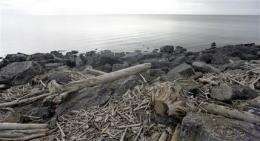
The shore line from Tuktoyaktuk, in the Northwest Territories, Canada, is shown on Saturday Aug. 8, 2009. The Arctic Ocean has given up tens of thousands more square miles of ice in a relentless summer of melt, as scientists watched through satellite eyes for a possible record low polar ice cap. (AP Photo/Rick Bowmer)

(AP) -- The Arctic Ocean has given up tens of thousands more square miles (square kilometers) of ice on Sunday in a relentless summer of melt, with scientists watching through satellite eyes for a possible record low polar ice cap.

From the barren Arctic shore of this village in Canada's far northwest, 1,500 miles (2,414 kilometers) north of Seattle, veteran observer Eddie Gruben has seen the summer retreating more each decade as the world has warmed. By this weekend the ice edge lay some 80 miles (128 kilometers) at sea.

"Forty years ago, it was 40 miles (64 kilometers) out," said Gruben, 89, patriarch of a local contracting business.

Global average temperatures rose 1 degree Fahrenheit (0.6 degree Celsius) in the past century, but Arctic temperatures rose twice as much or even faster, almost certainly in good part because of manmade greenhouse gases, researchers say.

In late July the mercury soared to almost 86 degrees Fahrenheit (30 degrees Celsius) in this settlement of 900 Inuvialuit, the name for western Arctic Eskimos.

"The water was really warm," Gruben said. "The kids were swimming in the ocean."

As of Thursday, the U.S. National Snow and Ice Data Center reported, the polar ice cap extended over 2.61 million square miles (6.75 million square kilometers) after having shrunk an average 41,000 square miles (106,000 square kilometers) a day in July -- equivalent to one Indiana or three Belgiums daily.

The rate of melt was similar to that of July 2007, the year when the ice cap dwindled to a record low minimum extent of 1.7 million square miles (4.3 million square kilometers) in September.

In its latest analysis, the Colorado-based NSIDC said Arctic atmospheric conditions this summer have been similar to those of the summer of 2007, including a high-pressure ridge that produced clear skies and strong melt in the Beaufort Sea, the arm of the Arctic Ocean off northern Alaska and northwestern Canada.

In July, "we saw acceleration in loss of ice," the U.S. center's Walt Meier told The Associated Press. In recent days the pace has slowed, making a record-breaking final minimum "less likely but still possible," he said.

Scientists say the makeup of the frozen polar sea has shifted significantly the past few years, as thick multiyear ice has given way as the Arctic's dominant form to thin ice that comes and goes with each winter and summer.

The past few years have "signaled a fundamental change in the character of the ice and the Arctic climate," Meier said.

Ironically, the summer melts since 2007 appear to have allowed disintegrating but still thick multiyear ice to drift this year into the relatively narrow channels of the Northwest Passage, the east-west water route through Canada's Arctic islands. Usually impassable channels had been relatively ice-free the past two summers.

"We need some warm temperatures with easterly or southeasterly winds to break up and move this ice to the north," Mark Schrader, skipper of the sailboat "Ocean Watch," e-mailed The Associated Press from the west entrance to the passage.

The steel-hulled sailboat, with scientists joining it at stops along the way, is on a 25,000-mile (40,232-kilometer), foundation-financed circumnavigation of the Americas, to view and demonstrate the impact of climate change on the continents' environments.

Environmentalists worry, for example, that the ice-dependent polar bear will struggle to survive as the Arctic cap melts. Schrader reported seeing only one bear, an animal chased from the Arctic shore of Barrow, , that "swam close to Ocean Watch on its way out to sea."

Observation satellites' remote sensors will tell researchers in September whether the polar cap diminished this summer to its smallest size on record. Then the sun will begin to slip below the horizon for several months, and temperatures plunging in the polar darkness will freeze the surface of the sea again, leaving this and other Arctic coastlines in the grip of ice. Most of the sea ice will be new, thinner and weaker annual formations, however.

At a global conference last March in Copenhagen, scientists declared that climate change is occurring faster than had been anticipated, citing the fast-dying Arctic cap as one example. A month later, the U.S. National Oceanic and Atmospheric Administration predicted summers could be almost ice-free within 30 years, not at the century's end as earlier predicted.

©2009 The Associated Press. All rights reserved. This material may not be published, broadcast, rewritten or redistributed.

4.1 /5 (16 votes)  

Filter


Move the slider to adjust rank threshold, so that you can hide some of the comments.


Display comments: newest first

omatumr
Aug 10, 2009

Rank: 1.8 / 5 (5)
HELP, THE SKY IS FALLING (AGAIN)

Come off it! Enough of this scare mongering!

Real science is a beautiful and rewarding way of life.

Science has been derailed by federal funds going to the researcher with the most scary story.

That's my opinion,
Oliver K. Manuel
http://www.omatumr.com

Velanarris
Aug 12, 2009

Rank: not rated yet
The shore line from Tuktoyaktuk, in the Northwest Territories, Canada, is shown on Saturday Aug. 8, 2009. The Arctic Ocean has given up tens of thousands more square miles of ice in a relentless summer of melt, as scientists watched through satellite eyes for a possible record low polar ice cap.


Here's the shoreline from 05: http://seattletim...0167.jpg

03: Sorry for the small size, was the only image I could find of the same area. http://earthhopen...rost.jpg

02:
http://farm1.stat...02bb.jpg


I think we get the "drift" Tuktoyatuk is in a region where the sea ice is not multiyear ice.

The photo is more propaganda. The artic "gives up" hundreds of thousands of square miles of ice regularly during the summer thaw, which has been so bad in past history as to devastate towns with flooding and in some cases liquefaction of the soil on which the structures were standing.
ChiRaven
Aug 14, 2009

Rank: 1 / 5 (1)
Anybody done a polar bear census lately? How are they holding out? We hear a lot about their plight, but I don't see any hard data to back it up.
Velanarris
Aug 14, 2009

Rank: not rated yet
Anybody done a polar bear census lately? How are they holding out? We hear a lot about their plight, but I don't see any hard data to back it up.

From what I understand, even during the "Inconvenient Truth" filming there were no threatened polar bear groups.
Oceanic
Aug 15, 2009

Rank: not rated yet
Excluding volcanic activity, the abnormal melting of ice/snow can be attributed to the pollutants, soot/black carbon, from fossil fuel burning emissions. Human activities create some of these pollutants, but by far the largest source is forest fires. Both are escalating in frequency and size. The human contribution is mainly due to industrialization, whereas the global proliferation and intensity of forest fires is directly related to drought.

Obviously, decreases in rainfall create drought conditions. A large scale reduction of ocean evaporation in equatorial regions is the only occurrence which could create a lessening of such global consequence.

An event capable of disrupting global hydrology exists and it is known as the Asian Brown Haze.

Located in the northern reaches of the Indian Ocean this haze, enormous in size and effect was discovered in 1999 by INDOEX. Covering an area the size of Australia and being 3 km thick in places, the large amount of equatorial water shaded prevents solar radiation from heating the ocean for the necessary cloud creating evaporation to occur.

This haze, being held over the ocean by the influence of the Himalayas, is maintained by the unrelenting emissions stemming from the fire activities of the huge populations of South Eastern Asia and forest fires elsewhere - the latter capable of sourcing pollutants despite being thousands of kilometres away.

The paradox is - while the haze persists rainfall will remain reduced; forests will continue to dry; fires will result and more pollutants will feed the haze.

Rank 4.1 /5 (16 votes)
Relevant PhysicsForums posts
  • Wind Waves in Reservoir ~ Wind run-up and Wind set-up
    createdFeb 08, 2012
  • Balance of oxygen in the atmosphere
    createdFeb 01, 2012
  • The case for a methanol-based economy
    createdJan 30, 2012
  • Weather in a rotating cylinder
    createdJan 25, 2012
  • Importance of difference between SVP over ice and water?
    createdJan 19, 2012
  • Ozone and atmosphere sampling
    createdJan 16, 2012
  • More from Physics Forums - Earth

More news stories

Astronomy team discovers nearby dwarf galaxy

(PhysOrg.com) -- A team led by UCLA research astronomer Michael Rich has used a unique telescope to discover a previously unknown companion to the nearby galaxy NGC 4449, which is some 12.5 million light years ...

Space & Earth / Astronomy

created 12 hours ago | popularity 4.3 / 5 (4) | comments 5 | with audio podcast

Amasia: As next supercontinent forms, Arctic Ocean, Caribbean will vanish first

(PhysOrg.com) -- Geologists at Yale University have proposed a new theory to describe the formation of supercontinents, the epic process by which Earth’s major continental blocks combine into a single ...

Space & Earth / Earth Sciences

created 13 hours ago | popularity 4.1 / 5 (11) | comments 4 | with audio podcast

In scientific coup, Russians reach Antarctic lake

After more than two decades of drilling in Antarctica, Russian scientists have reached a gigantic freshwater lake hidden under miles of ice for some 20 million years - a pristine body of water that may hold ...

Space & Earth / Earth Sciences

created 13 hours ago | popularity 4.8 / 5 (6) | comments 6

Chandra finds Milky Way's black hole grazing on asteroids

(PhysOrg.com) -- The giant black hole at the center of the Milky Way may be vaporizing and devouring asteroids, which could explain the frequent flares observed, according to astronomers using data from NASA's ...

Space & Earth / Astronomy

created 13 hours ago | popularity 5 / 5 (5) | comments 5 | with audio podcast

Study shows global glaciers, ice caps, shedding billions of tons of mass annually

Earth's glaciers and ice caps outside of the regions of Greenland and Antarctica are shedding roughly 150 billion tons of ice annually, according to a new study led by the University of Colorado Boulder.

Space & Earth / Earth Sciences

created 16 hours ago | popularity 5 / 5 (5) | comments 5 | with audio podcast


Amazing skin gives sharks a push

Shark skin has long been known to improve the fish's swimming performance by reducing drag, but now George Lauder and Johannes Oeffner from Harvard University show that in addition, the skin generates thrust, giving the fish ...

Fruit flies drawn to the sweet smell of youth

Aging takes its toll on sex appeal and now an international team of researchers led by Baylor College of Medicine and the University of Michigan find that in fruit flies, at least, it even diminishes the come-hither ...

Life in Antarctic lake? It's everywhere else

If scientists find microbes in a frigid lake two miles beneath the thick ice of Antarctica, it will illustrate once again that somehow life finds a way to survive in the strangest and harshest places.

New study shows high cost of defensive medicine

Vanderbilt University Medical Center researchers estimate that U.S. orthopaedic surgeons create approximately $2 billion per year in unnecessary health care costs associated with orthopaedic care due to the practice of defensive ...

Continental mosquito with 'vector' potential found breeding in UK after 60 year absence

A species of mosquito has been discovered breeding in the UK that has not been seen in the country since 1945. Populations of the mosquito, found across mainland Europe and known only by its Latin name Culex modestus, were r ...

Presdisposition to common heart disease 'passed on from father to son'

A common heart disease which kills thousands each year may be passed genetically from father to son, according to a study led by the University of Leicester.