Flying frog among 353 new Himalayan species: WWF
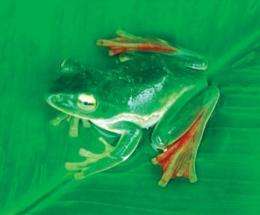
August 10, 2009 by Claire Cozens The flying frog's large webbed feet allows it to glide when falling

Enlarge

The WWF said that a flying frog, the world's smallest deer and the first new monkey to be found in over a century are among 350 new species discovered in the eastern Himalayas in the past decade.

Over 350 new species including the world's smallest deer, a "flying frog" and a 100 million-year old gecko have been discovered in the Eastern Himalayas, a biological treasure trove now threatened by climate change.

A decade of research carried out by scientists in remote mountain areas endangered by rising global temperatures brought exciting discoveries such as a bright green frog that uses its red and long webbed feet to glide in the air.

One of the most significant findings was not exactly "new" in the classic sense. A 100-million year-old gecko, the oldest fossil gecko species known to science, was discovered in an amber mine in the Hukawng Valley in the northern Myanmar.

The WWF report The Eastern Himalayas - Where Worlds Collide details discoveries made by scientists from various organizations between 1998 and 2008 in a region reaching across Bhutan and north-east India to the far north of Myanmar as well as Nepal and southern parts of Tibet Autonomus Region (China).
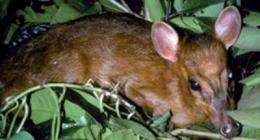
Leaf deer
Enlarge

Leaf deer (Muntiacus putaoensis). The world’s smallest deer species, a miniature muntjac, discovered in 1999. Standing 60-80cm tall and weighing just about 11kg, was fi rst seen by a team of scientists undertaking fi eld surveys in the Himalayan region of northern Myanmar. © Alan Rabinowitz / WWF Nepal

"The good news of this explosion in species discoveries is tempered by the increasing threats to the Himalayas' cultural and biological diversity," said Jon Miceler, Director of WWF's Eastern Himalayas Program. "This rugged and remarkable landscape is already seeing direct, measurable impacts from climate change and risks being lost forever."

In December world leaders will gather in Copenhagen to reach an agreement on a new climate deal, which will replace the existing Kyoto Protocol.

The Eastern Himalayas- Where Worlds Collide describes more than 350 new species discovered - including 244 plants, 16 amphibians, 16 reptiles, 14 fish, 2 birds, 2 mammals and at least 60 new invertebrates.

The report mentions the miniature muntjac, also called the "leaf deer," which is the world's oldest and smallest deer species. Scientists initially believed the small creature found in the world's largest mountain range was a juvenile of another species but DNA tests confirmed the light brown animal with innocent dark eyes was a distinct and new species.

The Eastern Himalayas harbor a staggering 10,000 plant species, 300 mammal species, 977 bird species, 176 reptiles, 105 amphibians and 269 types of freshwater fish. The region also has the highest density of Bengal tigers in the world and is the last bastion of the charismatic greater one-horned rhino.

WWF is working to conserve the habitat of endangered species such as snow leopards, Bengal tigers, Asian elephants, red pandas, takin, golden langurs, Gangetic dolphins and one-horned rhinos.

Historically, the rugged and largely inaccessible landscape of the Eastern Himalayas has made biological surveys in the region extremely difficult. As a result, wildlife has remained poorly surveyed and there are large areas that are still biologically unexplored.

Today further species continue to be unearthed and many more species of amphibians, reptiles and fish are currently in the process of being officially named by scientists.

Source: World Wildlife Fund


print this article email this article download pdf blog this article bookmark this article     Stumble it Digg this share on Facebook retweet share on Reddit add to delicious
Rate this story - 4.7 /5 (12 votes)

Rank Filter

Move the slider to adjust rank threshold, so that you can hide some of the comments.


Display comments: newest first

  • Birthmark - Aug 13, 2009
    • Rank: not rated yet
    If we can find that many species in that short of time in just one location, imagine the ones we still don't know of, especially from the sea.

August 10, 2009 all stories

Comments: 1

4.7 /5 (12 votes)
  • Stumble this up

  • Digg this

  • share this

  • hide
  • Related Stories

  • WWF: 52 New Species Discovered on Borneo
    created Dec 19, 2006 | popularity not rated yet | comments 0
  • Tigers disappear from Himalayan refuge
    created Jul 02, 2008 | popularity not rated yet | comments 0
  • Tanzanian survey reveals new species
    created Jun 22, 2006 | popularity not rated yet | comments 0
  • New animal and plant species found in Vietnam
    created Sep 26, 2007 | popularity not rated yet | comments 0
  • New golden frog discovered in remote region of Colombia
    created Aug 28, 2007 | popularity not rated yet | comments 0


  • hide
  • Relevant PhysicsForums posts

  • Breeding program
    created 23 hours ago
  • How does a concentration gradient provide energy?
    created Nov 20, 2009
  • Eyesight and Neural Damage from Electronics
    created Nov 19, 2009
  • Quick question about the Golgi Apparatus?
    created Nov 19, 2009
  • More from Physics Forums - Biology

Other News

Atomic-level Snapshot Catches Protein Motor in Action (w/ Video)

Atomic-level Snapshot Catches Protein Motor in Action (w/ Video)

Biology / Cell & Microbiology

created 23 hours ago | popularity 4.5 / 5 (2) | comments 1

(PhysOrg.com) -- The atomic-level action of a remarkable class of ring-shaped protein motors has been uncovered by researchers with the Lawrence Berkeley National Laboratory using a state-of-the-art protein ...


Termite creates sustainable monoculture fungus-farming

Termite creates sustainable monoculture fungus-farming

Biology / Plants & Animals

created 23 hours ago | popularity 5 / 5 (1) | comments 0

(PhysOrg.com) -- Food production of modern human societies is mostly based on large-scale monoculture crops, but it now appears that advanced insect societies have the same practice. Our societies took just ...


Extinct goat Myotragus balearicus

Extinct goat was cold-blooded

Biology / Plants & Animals

created Nov 18, 2009 | popularity 4.9 / 5 (29) | comments 10

(PhysOrg.com) -- An extinct goat that lived on a barren Mediterranean island survived for millions of years by reducing in size and by becoming cold-blooded, which has never before been discovered in mammals.


Bigger not necessarily better, when it comes to brains

Bigger not necessarily better, when it comes to brains

Biology / Plants & Animals

created Nov 17, 2009 | popularity 4.4 / 5 (14) | comments 10

(PhysOrg.com) -- Tiny insects could be as intelligent as much bigger animals, despite only having a brain the size of a pinhead, say scientists at Queen Mary, University of London.


Right-handed chimpanzees provide clues to the origin of human language

Biology / Plants & Animals

created Nov 16, 2009 | popularity 3 / 5 (1) | comments 7

Most of the linguistic functions in humans are controlled by the left cerebral hemisphere. A study of captive chimpanzees at the Yerkes National Primate Research Center (Atlanta, Georgia), reported in the January 2010 issue ...