First black holes born starving (w/ Video)
August 10, 2009 First black holes born starving

Enlarge

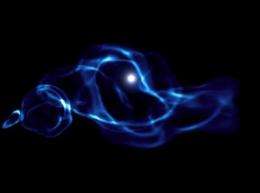
This computer-simulated image shows gas (blue) interacting with one of the first black holes (white) in the early universe, approximately 200 million years after the Big Bang. Credit: Image courtesy of Marcelo Alvarez (KIPAC), Tom Abel (KIPAC) and John H. Wise (NASA).

The first black holes in the universe had dramatic effects on their surroundings despite the fact that they were small and grew very slowly, according to recent supercomputer simulations carried out by astrophysicists Marcelo Alvarez and Tom Abel of the Kavli Institute for Particle Astrophysics and Cosmology, jointly located at the Department of Energy's SLAC National Accelerator Laboratory and Stanford University, and John Wise, formerly of KIPAC and now of NASA Goddard Space Flight Center.

Several popular theories posit that the first black holes gorged themselves on gas clouds and dust in the , growing into the supersized black holes that lurk in the centers of galaxies today. However, the new results, published in The , point to a much more complex role for the first black holes.

"I'm thrilled that we now can do calculations that start to capture the most relevant physics, and we can show which ideas work and which don't," said Abel. "In the next decade, using calculations like this one, we will settle some of the most important issues related to the role of black holes in the universe."

To make their discovery, the researchers created the most detailed simulations to date of the first black holes in the universe that formed from the collapse of stars. The simulations started with data taken from observations of the cosmic background radiation—the earliest view of the structure of the universe. The researchers then applied the basic laws that govern the interaction of matter, allowing the early universe in their simulation to evolve as it did in reality.

You need Flash installed to watch this ideo

This computer-simulated animation shows gas (blue) interacting with one of the first black holes (white) in the early universe, approximately 200 million years after the Big Bang. Credit: Simulation courtesy of Marcelo Alvarez (KIPAC), John H. Wise (NASA) and Tom Abel (KIPAC).

In the simulation, clouds of gas left over from the Big Bang slowly coalesced under the force of , and eventually formed the first stars. These massive, hot stars burned bright for a short time, emitting so much energy in the form of starlight that they pushed nearby gas clouds far away. Yet these stars could not sustain such a fiery existence for long, and they soon exhausted their internal fuel. This caused one of the stars in the simulation to collapse under its own weight, forming a black hole located in a pocket of emptiness. With very little matter in the near vicinity, this black hole was essentially "starved" of food on which to grow.

"Quasars [extremely strong sources of radiation] powered by black holes a billion times more massive than our sun have been observed in the early universe, and we have to explain how these behemoths could have grown so big so fast," said Alvarez. "Their origin remains among the most fundamental unanswered questions in astrophysics."

One explanation for the existence of supermassive black holes in the early universe postulates that the first black holes were 'seeds' that grew into much larger black holes by gravitationally attracting and then swallowing matter. But in their simulation, Alvarez, Abel and Wise found that such growth was negligible, with the black hole in the simulation growing by less than one percent of its original mass over the course of a hundred million years.

Although the simulations do not yet completely rule out the theory, this makes it less likely that these first black holes could have grown directly into the supermassive black holes observed to have existed less than a billion years later, Alvarez said.

An Alternative Theory

Although the early stars pushed away nearby clouds of gas, delaying significant growth of the black holes the stars later became, wisps of gas sometimes found their way to the black holes. As this matter was sucked into the black hole in the researchers' simulation, it accelerated and released enough X-ray radiation to heat gas as much as a hundred light years away to several thousand degrees. The additional heat from the X-rays caused the gas to expand away from the black hole, helping to keep the snack from turning into a feast.

Heating due to the X-rays was also enough to effectively prevent nearby gas from collapsing to form stars for tens and maybe even hundreds of millions of years. As a result, the researchers hypothesize, significantly larger than usual gas clouds may have had the opportunity to form without creating stars. Such enormous may have eventually collapsed under their own weight, creating a supermassive black hole.

"While X-rays from matter falling onto the first black holes hindered their further growth, that very same radiation may have later cleared the way for direct formation of supermassive black holes by suppressing star formation," said Alvarez. "However, a lot of work remains to be done to test whether this idea will actually pan out; this is really just the tip of the iceberg in terms of realistic simulations of black holes in the early universe."

"This work will likely make people rethink how the radiation from these black holes affected the surrounding environment," added Wise. " are not just dead pieces of matter; they actually affect other parts of the galaxy."

Source: SLAC National Accelerator Laboratory (news : web)


Rate this story - 4.2 /5 (17 votes)

Rank Filter

Move the slider to adjust rank threshold, so that you can hide some of the comments.


Display comments: newest first

  • omatumr - Aug 10, 2009
    • Rank: 1.5 / 5 (8)
    NEUTRON REPULSION PREVENTS FORMATION OF BLACK HOLE

    See: "Attraction and repulsion of nucleons: Sources of stellar energy", Journal of Fusion Energy 19 (2001) 93-98.

    http://tinyurl.com/39kwoz

    With kind regards,
    Oliver K. Manuel
    http://www.omatumr.com


  • omatumr - Aug 10, 2009
    • Rank: 1.6 / 5 (7)
    THE BIRTH OF THE COSMOS . . .

    Is discussed on this Naked Scientist forum:

    http://tinyurl.com/lkj7zw

    The conclusion is this:

    "Today we have evidence that the Sun, other stars, and galactic centers are powered by nuclear dissociation that releases Hydrogen to interstellar space as a waste product.

    Therefore if there really was a "Big Bang" then it produced neutrons and compressed them into massive neutron stars -- the most compact, energetic form of nuclear matter -- rather than Hydrogen, the most dispersed form of nuclear matter.

    The concept of a "Big Bang" became more plausible to me after reading the recent paper by Coyne and D. C. Cheng ["A Scenario for Strong Gravity in Particle Physics: An alternative mechanism for black holes to appear at accelerator experiments," http://arxiv.org/...5.1667v1 ]. According to that scenario, neutrons themselves may be considered as particle-sized black holes that were made in the "Big Bang."

    On the other hand if the universe is infinite, then it probably oscillates between:

    a.) The expansion that is observed currently as interstellar space is filled with Hydrogen from neutron decay, and

    b.) A subsequent contraction after the neutron stars have evaporated and gravitational forces become dominant."

    With kind regards,
    Oliver K. Manuel
    http://www.omatumr.com

  • lomed - Aug 10, 2009
    • Rank: 5 / 5 (4)
    NEUTRON REPULSION PREVENTS FORMATION OF BLACK HOLE
    I could be wrong but, I have not seen any equations or data that extrapolate your neutron repulsion idea to macroscopic numbers of neutrons (say 10^23 to have macroscopic weight, and 10^56 to be relevant astrophysically). In order to determine if neutron repulsion can prevent the formation of a black hole, one would need to know the equation of state (a pressure function and a mass density function that are functions of the number density (number of neutrons per unit volume)). If you have already done the relevant calculations, I would like to know what they predict; if not, perhaps someone here would be willing to do them.
  • nonoice - Aug 10, 2009
    • Rank: 5 / 5 (4)
    Manuel
    why the spam man?

    Try checking yourself out at your local physician for ocd your getting boring and repetitive.
  • omatumr - Aug 10, 2009
    • Rank: 2.3 / 5 (3)
    NEUTRON REPULSION PREVENTS FORMATION OF BLACK HOLE
    I could be wrong but, I have not seen any equations or data that extrapolate your neutron repulsion idea to macroscopic numbers of neutrons (say 10^23 to have macroscopic weight, and 10^56 to be relevant astrophysically).


    Good comment, lomed.

    See the paper by D. Lunney, J. M. Pearson and C. Thibault, Rev. Mod. Phys., 75, 1021-1082 (2003).

    With kind regards,
    Oliver K. Manuel
    http://www.omatumr.com

  • omatumr - Aug 10, 2009
    • Rank: 2 / 5 (4)
    BETTER REFERENCE TO PAPER ON
    NUCLEI NEAR THE "NEUTRON DRIP LINE"

    Below is a better reference to the paper by Lunney et al. on exotic nuclei near the "neutron drip line."

    However, neutrons do not "drip" from neutron-rich nuclei. They are violently ejected because of repulsive interactions between neutrons.

    D. Lunney, J. M. Pearson and C. Thibault, "Recent trends in the determination of nuclear masse," Reviews of Modern Physics 75 (2003) 1021-1082

    http://tinyurl.com/252aov

    http://tinyurl.com/lz6uvj

    With kind regards,
    Oliver K. Manuel
    http://www.omatumr.com
  • Ant - Aug 10, 2009
    • Rank: 3.7 / 5 (3)
    Never trust computer simulations, they are based on what others believe to be correct.
  • omatumr - Aug 10, 2009
    • Rank: 1.8 / 5 (5)
    CAN NEUTRON REPULSION BE EXTRAPOLATED TO MACROSCOPIC
    NUMBERS OF NEUTRONS TO BE RELEVANT ASTROPHYSICALLY?

    Yes.

    Lunney et al. (Reviews of Modern Physics 75 (2003) page 1042) agree that useful information can be obtained by extrapolating nuclear mass data:

    [quote]. . . out to homogeneous or infinite nuclear matter (INM) [quote end]

    which

    [quote. . . has a real existence, being found in the interior of neutron stars. [quote end]

    With kind regards,
    Oliver K. Manuel
    http://www.omatumr.com/
  • lomed - Aug 11, 2009
    • Rank: 5 / 5 (2)
    However, neutrons do not "drip" from neutron-rich nuclei. They are violently ejected because of repulsive interactions between neutrons.
    CAN NEUTRON REPULSION BE EXTRAPOLATED TO MACROSCOPIC

    NUMBERS OF NEUTRONS TO BE RELEVANT ASTROPHYSICALLY?

    Yes.

    Lunney et al. (Reviews of Modern Physics 75 (2003) page 1042) agree that useful information can be obtained by extrapolating nuclear mass data:

    [quote]. . . out to homogeneous or infinite nuclear matter (INM) [quote end]

    which

    [quote. . . has a real existence, being found in the interior of neutron stars. [quote end]
    The article was enlightening, I read the theory section (and appendices which together comprise the majority of the article) and enjoyed it. However, while all the models described in the article employ terms that describe neutron repulsion, they only produce a lower limit on a neutron star's mass. Presumably, above the minimum mass (~.1 solar masses) a neutron star is supported against gravity by another form of neutron repulsion, that of the Fermi Energy from the Pauli exclusion principle. However, due to general relativistic effects, not even the Pauli exclusion principle can produce the pressure necessary to support a sufficiently massive star (limit ~3 solar masses). This is because the pressure at the center of such a massive star becomes infinite as the limiting mass is reached; therefore, no finite force can counterbalance it, and the star collapses (once it is smaller than sqrt(GM/(c^2)) it is a black hole, whether or not it continues to collapse (in string theory it may stop at this radius)).

    Actually, understanding of matter at nuclear densities is not really necessary show black holes can exist. Since the radius of the event horizon of a black hole increases as the square root of its mass, and since the volume of a sphere increases as the cube of its radius, the volume within a black hole's event horizon increases as the 1.5 power of its mass. However, since the density of an object is its mass divided by its volume, the density of a black hole is inversely proportional to the square root of its mass. Thus, very small black holes are extremely dense, but very large black holes have low densities. Indeed, a large enough volume of any substance (with positive energy density e.g. air) will have an event horizon and be a black hole.
  • omatumr - Aug 14, 2009
    • Rank: 2.3 / 5 (3)
    ARE NEUTRONS PARTICLE-SIZED BLACK HOLES?

    See the paper by Coyne and D. C. Cheng ["A Scenario for Strong Gravity in Particle Physics: An alternative mechanism for black holes to appear at accelerator experiments," http://arxiv.org/...5.1667v1 ].

    According to that scenario, neutrons themselves may be considered as particle-sized black holes that were made in the "Big Bang."

    With kind regards,
    Oliver K. Mnauel
    http://www.omatumr.com
  • Ethelred - Aug 15, 2009
    • Rank: 3 / 5 (2)
    According to that scenario, neutrons themselves may be considered as particle-sized black holes that were made in the "Big Bang."


    Let see if I can do Oliver's job for him and fix the link.

    http://arxiv.org/...1667.pdf

    ARE NEUTRONS PARTICLE-SIZED BLACK HOLES?


    Why do you post such stupid irrelevant links? This one is beyond your usual as the word 'neutron' isn't even used in the article. I am not about to read a 40 page PDF that cannot possibly support your claim when you claim involves neutrons and the article doesn't even use the word. Search is my friend and it clearly is not Oliver's.

    However I have to say something that is so bloody obvious that it wouldn't matter if the paper did use the word neutron, neutrons are made up of three quarks so they can't be considered black holes either be me or anyone else but especially by someone that is claiming that black holes don't exist.

    Don't even read your own writing? You can be against Black Holes despite the strong evidence for them but being both for and against them at the same time is just plain bizarre.

    This goes along with you claiming that suns are neutron stars and they have iron cores. You are contradicting yourself on that one. Choose one or the other. And pretending that the issue doesn't exist won't make it go away.

    Ethelred
  • omatumr - Aug 15, 2009
    • Rank: 2 / 5 (4)
    Thanks, Ethelred, for providing the correct link.

    The title of the paper is: A Scenario for Strong Gravity in Particle Physics: An alternative mechanism for black holes to appear at accelerator experiments.

    The point is that strong gravity in particles might produce neutrons as miniature black holes.

    If so, the product of the accelerator experiment at the LHC (Large Hadron Collider) may be the world's most expensive neutron!

    See the story in Physics World,
    Austria performs U-turn over CERN pull-out
    http://physicswor...ws/39128

    With kind regards,
    Oliver K. Manuel
    http://www.omatumr.com
  • SmartK8 - Aug 17, 2009
    • Rank: not rated yet
    If so, the product of the accelerator experiment at the LHC (Large Hadron Collider) may be the world's most expensive neutron!


    Yeah, but also that neutron would be a proof of such claim! A concept which you trolls in denial cannot understand. Also there are several other (if not more important) reasons why the LHC was built.

August 10, 2009 all stories

Comments: 13

4.2 /5 (17 votes)

  • hide
  • Related Stories

  • Huge Black Holes Stifle Star Formation
    created Aug 23, 2006 | popularity not rated yet | comments 0
  • Chandra finds black holes are 'green'
    created Apr 24, 2006 | popularity not rated yet | comments 0
  • The mystery of young stars near black holes solved
    created Aug 22, 2008 | popularity not rated yet | comments 0
  • Astronomers discover upper mass limit for black holes
    created Sep 11, 2008 | popularity not rated yet | comments 0
  • Growing Supermassive Black Holes from Seeds
    created Jan 12, 2006 | popularity not rated yet | comments 0


  • hide
  • Relevant PhysicsForums posts

Other News

Climate 'Tipping Points' May Arrive Without Warning, Says Top Forecaster

Space & Earth / Environment

created 19 minutes ago | popularity not rated yet | comments 0 | with audio podcast

(PhysOrg.com) -- A new University of California, Davis, study by a top ecological forecaster says it is harder than experts thought to predict when sudden shifts in Earth's natural systems will occur -- a worrisome finding ...


URI researcher calls for global effort to monitor marine pollutants

Space & Earth / Environment

created 1hour ago | popularity 5 / 5 (1) | comments 1

A University of Rhode Island researcher who studies chemical pollutants in the marine environment has called on colleagues around the world to establish a global monitoring network to verify that the chemicals banned by the ...


A new 3-D map of the interstellar gas within 300 parsecs from the sun

A new 3D map of the interstellar gas within 300 parsecs from the Sun

Space & Earth / Astronomy

created 3 hours ago | popularity 5 / 5 (3) | comments 0 | with audio podcast

(PhysOrg.com) -- Astronomy & Astrophysics is publishing new 3D maps of the interstellar gas in the local area around our Sun. A French-American team of astronomers presents new absorption measurements toward ...


Rho Ophiuchus cloud

Professor: We have a 'moral obligation' to seed universe with life

Space & Earth / Astronomy

created 11 hours ago | popularity 3.7 / 5 (19) | comments 33 | with audio podcast report

(PhysOrg.com) -- Eventually, the day will come when life on Earth ends. Whether that’s tomorrow or five billion years from now, whether by nuclear war, climate change, or the Sun burning up its fuel, the last ...


New international satellite observations help assess future earthquake risk in Haiti

New international satellite observations help assess future earthquake risk in Haiti

Space & Earth / Earth Sciences

created 3 hours ago | popularity not rated yet | comments 0

Virginia Key, Florida--Scientists at the University of Miami have analyzed images based on Synthetic Aperture Radar (SAR) observations taken before and just after Haiti's earthquake, on January 12. The images ...