The violent youth of solar proxies steer course of genesis of life
August 10, 2009 The violent youth of solar proxies steer course of genesis of life

Enlarge

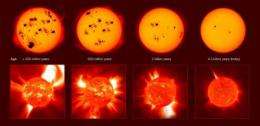
Stars similar to our Sun -- "solar proxies" -- enable scientists to look through a window in time to see the harsh conditions prevailing in the early or future Solar System, as well as in planetary systems around other stars. These studies could lead to profound insights into the origin of life on Earth and reveal how likely (or unlikely) the rise of life is elsewhere in the cosmos. This work has revealed that the Sun rotated more than ten times faster in its youth (over four billion years ago) than today generating a stronger magnetic field and stronger activity. This also meant that the young Sun emitted X-rays and ultraviolet radiation up to several hundred times stronger than the Sun does today. Credit: IAU/E. Guinan

Just how rare life is in the Universe is one of the key questions in the natural sciences today. By pulling in multidisciplinary expertise from biology, geology, physics and astronomy, astrobiologists are addressing different facets of this very profound question, and notably how the conditions around different types of stars in an early stage of development might help or hinder the emergence of life in a solar system. Several scientists at the forefront of this research have just concluded IAU Symposium 264 on "Solar and Stellar Variability -- impact on Earth and Planets".

The Sun is awe-inspiring and fearsome ― a superheated ball about 300,000 times as heavy as the , radiating immense amounts of energy and hurling great globs of hot plasma millions of kilometres out into space. The intense radiation from this giant powerhouse would be fatal close to the Sun, but for a planet like Earth, orbiting at a safe distance from these violent outbursts, and bathed by a gentler radiation, the Sun can provide the steady energy supply needed to sustain life. Now sedate and middle-aged, at around 4.5 billion years old, the Sun's wild youth is behind it.

Edward Guinan, a professor of astronomy and astrophysics at Villanova University in the USA, and his "Sun-in-Time" project team have studied stars that are analogues of the Sun at both early and late stages of its lifecycle. These "solar proxies" enable scientists to look through a window in time to see the harsh conditions prevailing in the early or future , as well as in planetary systems around other stars. These studies could lead to profound insights into the origin of life on Earth and reveal how likely (or unlikely) the rise of life is elsewhere in the cosmos. This work has revealed that the Sun rotated more than ten times faster in its youth (over four billion years ago) than today. The faster a star rotates, the harder the magnetic dynamo at its core works, generating a stronger magnetic field, so the young Sun emitted X-rays and ultraviolet radiation up to several hundred times stronger than the Sun today.

A team led by Jean-Mathias Grießmeier from ASTRON in the Netherlands looked at another type of magnetic fields ― that around planets. They found that the presence of planetary magnetic fields plays a major role in determining the potential for life on other planets as they can protect against the effects of both short-lived intense particle storms when the star ejects mass from its corona and the persistent onslaught of particles from the stellar wind. Grießmeier says: "Planetary magnetic fields are important for two reasons: they protect the planet against the incoming charged particles, thus preventing the planetary atmosphere from being blown away, and also act as a shield against high energy cosmic rays. The lack of an intrinsic magnetic field may be the reason why today Mars does not have an atmosphere".

Guinan explains a surprising realisation that emerged from their work: "The Sun does not seem like the perfect star for a system where life might arise. Although it is hard to argue with the Sun's 'success' as it so far is the only star known to host a planet with life, our studies indicate that the ideal stars to support planets suitable for life for tens of billions of years may be a smaller slower burning 'orange dwarf' with a longer lifetime than the Sun ― about 20-40 billion years. These stars, also called K stars, are stable stars with a habitable zone that remains in the same place for tens of billions of years. They are 10 times more numerous than the Sun, and may provide the best potential habitat for life in the long run". He continues: "On the more speculative side we have also found indications that planets like Earth are also not necessarily the best suited for life to thrive. two to three times more massive than the Earth, with a higher gravity, can retain the atmosphere better. They may have a larger liquid iron core giving a stronger magnetic field that protects against the early onslaught of cosmic rays. Furthermore, a larger planet cools more slowly and maintains its magnetic protection. This kind of planet may be more likely to harbour life. I would not trade though ― you can't argue with success".

Manfred Cuntz, an associate professor of physics at the University of Texas at Arlington, USA, and his collaborators have examined both the damaging and the favourable effects of ultraviolet radiation from stars on DNA molecules. This allows them to study the effect on other potential carbon-based extraterrestrial life forms in the habitable zones around other stars. Cuntz says: "The most significant damage associated with ultraviolet light occurs from UV-C, which is produced in enormous quantities in the photosphere of hotter F-type stars and further out, in the chromospheres, of cooler orange K-type and red M-type stars. Our Sun is an intermediate, yellow G-type star. The ultraviolet and cosmic ray environment around a star may very well have 'chosen' what type of life could arise around it".

Rocco Mancinelli, an astrobiologist with the Search for Extraterrestrial Life (SETI) Institute in the USA, observes that as life arose on Earth at least 3.5 billion years ago, it must have withstood a barrage of intense solar ultraviolet radiation for a billion years before the oxygen released by these life forms formed the protective ozone layer. Mancinelli studies DNA to delve into some of the ultraviolet protection strategies that evolved in early life forms and still persist in a recognisable form today. As any life in other planetary systems must also contend with radiation from their host stars, these methods for repairing and protecting organisms from ultraviolet damage serve as models for life beyond Earth. Mancinelli says "We also see ultraviolet radiation as a kind of selection mechanism. All three domains of life that exist today have common ultraviolet protection strategies such as a DNA repair mechanism and sheltering in water or in rocks. Those that did not were likely wiped out early on".

The scientists agree that we do yet know how ubiquitous or how fragile life is, but as Guinan concludes: "The Earth's period of habitability is nearly over ― on a cosmological timescale. In a half to one billion years the will start to be too luminous and warm for water to exist in liquid form on Earth, leading to a runaway greenhouse effect in less than 2 billion years".

Source: International Astronomical Union


print this article email this article download pdf blog this article bookmark this article     Stumble it Digg this share on Facebook retweet share on Reddit add to delicious
Rate this story - 4.5 /5 (8 votes)

Rank Filter

Move the slider to adjust rank threshold, so that you can hide some of the comments.


Display comments: newest first

  • omatumr - Aug 10, 2009
    • Rank: 1 / 5 (1)
    HOW VIOLENT WAS THE BIRTH OF SOLAR SYSTEM ?

    The Sun, rocky planets, and ordinary meteorites came from the very eye of the supernova that gave birth to the solar system:

    http://tinyurl.com/359q3u

    That is why they consist almost entirely of seven even-numbered elements - Fe, O, Ni, Si, S, Mg and Ca - that were produced by violent nuclear reactions near the pulsar core.

    Earth's iron core and iron meteorites came directly from the iron-rich material closest to the pulsar.

    Thus iron meteorites still have Mo isotopes from various nucleosynthesis reactions that are unmixed:

    http://tinyurl.com/mwsevr

    And excess Xe-136 from the r-process accompanied all primordial He when the solar system formed directly from fresh supernova debris:

    http://tinyurl.com/m54xz5

    This is the story that first became evident in 1975:
    1. Trans. Missouri Acad. Sci. 9, 104 122 (1975).
    2. Science 195, 208-209 (1977).
    3. Nature 277, 615-620 (1979).
    4. Proc. 11th Lunar Planet Sci. Conf, Vol. 15 (1980) pages 879-899.
    5. Meteoritics 15 (30 June 1980) 117-138.
    6. J. Inorg. Nucl. Chem. 43, 2207-2216 (1981).
    7. Geokhimiya (12) 1776-1801 (1981) [Russian].
    8. Geochemical Journal 15, 247-267 (1981).
    9. Meteoritics 18, 209-222 (1983).
    10. etc.

    With kind regards,
    Oliver K. Manuel
    http://www.omatumr.com
  • Ethelred - Aug 11, 2009
    • Rank: 5 / 5 (2)
    The Sun, rocky planets, and ordinary meteorites came from the very eye of the supernova that gave birth to the solar system:


    This is nonsense. It is based on a number of dubious claims of yours and they dependent on each other. They ALL must true and the only thing you definitely have evidence of is that a super nova was involved in the origin of the Solar System. Which is not controversial on its own since there is good reason to believe the Sun, like the new suns we can see forming today, was one of many and some of those many that we see are super nova candidates.

    That is why they consist almost entirely of seven even-numbered elements - Fe, O, Ni, Si, S, Mg and Ca - that were produced by violent nuclear reactions near the pulsar core.


    Or it could be that the standard models which produce exactly the result are correct and the reason that stable nuclei that form solids even close to new suns are exactly what should be expected. There is no need to suppose the super nova was the Sun since the Sun, in the standard model, should have driven off helium and hydrogen to the out Solar System.

    Yet you act like this is some kind of surprise and He and H should be in the inner Solar System if you were wrong. Which is just plan rubbish.

    Earth's iron core and iron meteorites came directly from the iron-rich material closest to the pulsar.


    Or more likely from the metal rich gas that could condense in close to the Sun where it was too had and had too much Solar wind for the light stuff to remain. And when the early Earth heated up and melted the heavy stuff moved to the core. Which is why we have so little of the platinum elements in the crust. They are the heaviest stuff and moved to the core.

    You do these false dichotomies all the time. You claim things can't happen by accident, which is true, and then you claim that therefor you must be right. Which is false since you just plain ignore all the MANY rational models that produce a Solar System like the one we have.

    Ethelred
  • HenisDov - Aug 13, 2009
    • Rank: 1 / 5 (1)
    Beyond Einstein-Hubble And Beyond Darwin

    On The Origin Of Origins

    Dark Matter-Energy And Higgs Particle?
    Energy-Mass Superposition
    Mass Simply Reverts To Energy
    The Fractal Oneness Of The Universe
    All Earth Life Creates and Maintains Genes


    A. On Energy, Mass, Gravity, Galaxies Clusters AND Life, A Commonsensible Recapitulation
    http://www.the-sc...age#2125
    The universe is the archetype of quantum within classical physics, which is the fractal oneness of the universe.

    Astronomically there are two physics. A classical physics behaviour of and between galactic clusters, and a quantum physics behaviour WITHIN the galactic clusters.

    The onset of big-bang's inflation, the cataclysmic resolution of the Original Superposition, started gravity, with formation - BY DISPERSION - of galactic clusters that behave as classical Newtonian bodies and continuously reconvert their original pre-inflation masses back to energy, thus fueling the galactic clusters expansion, and with endless quantum-within-classical intertwined evolutions WITHIN the clusters in attempt to delay-resist this reconversion.


    B. Updated Life's Manifest May 2009
    http://www.physfo...ic=14988&st=480&#entry412704
    http://www.the-sc...age#2321

    All Earth life creates and maintains Genes. Genes, genomes, cellular organisms - All create and maintain genes.

    For Nature, Earth's biosphere is one of the many ways of temporarily constraining an amount of ENERGY within a galaxy within a galactic cluster, for thus avoiding, as long as possible, spending this particularly constrained amount as part of the fuel that maintains the clusters expansion.

    Genes are THE Earth's organisms and ALL other organisms are their temporary take-offs.

    For Nature genes are genes are genes. None are more or less important than the others. Genes and their take-offs, all Earth organisms, are temporary energy packages and the more of them there are the more enhanced is the biosphere, Earth's life, Earth's temporary storage of constrained energy. This is the origin, the archetype, of selected modes of survival.

    The early genes came into being by solar energy and lived a very long period solely on direct solar energy. Metabolic energy, the indirect exploitation of solar energy, evolved at a much later phase in the evolution of Earth's biosphere.

    However, essentially it is indeed so. All Earth life, all organisms, create and maintain the genes. Genes, genomes, cellular organisms - all create and maintain genes.


    Dov Henis
    (Comments from 22nd century)
    http://profiles.y...MFQSDYEU
  • Ethelred - Aug 14, 2009
    • Rank: 5 / 5 (1)
    For Nature genes are genes are genes. None are more or less important than the others.


    Now that is total crap. Any gene that is involved in the ribosomes is far more important than almost any other gene. You simply are full of it on genes. Life makes life. Genes are just a tool to support the reproduction of any life.

    Do you just pontificate or do you ever respond to anything anyone says? So far I have just seen pontification. Perhaps its just intended as a joke. Obviously the 22nd century part is a joke. Clearly anyone from the 22nd century that knew enough about biochemistry to write about it wouldn't make silly errors like claiming that all the genes are equal importance. So that leaves jokes or insanity. Both is not out of the question.

    Ethelred

August 10, 2009 all stories

Comments: 4

4.5 /5 (8 votes)
  • Stumble this up

  • Digg this

  • share this

  • hide
  • Related Stories

  • Researchers Say Tides Can Cut Life Short On Planets Orbiting Smaller Stars
    created Nov 27, 2008 | popularity not rated yet | comments 0
  • Planet orbiting a giant red star discovered with hobby-eberly telescope
    created Aug 02, 2007 | popularity not rated yet | comments 0
  • M Dwarfs: The Search For Life Is On
    created Aug 30, 2005 | popularity not rated yet | comments 0
  • Astronomers Map Out Planetary Danger Zone
    created Apr 18, 2007 | popularity not rated yet | comments 0
  • Gliese 581: one planet might indeed be habitable
    created Dec 13, 2007 | popularity not rated yet | comments 0


  • hide
  • Relevant PhysicsForums posts

  • Sideral question
    created 16 hours ago
  • Doppler shifted blackbody spectrum
    created 19 hours ago
  • Earth v. Moon
    created 21 hours ago
  • help me with coordinates and orbits
    created 21 hours ago
  • basic 'our universe' question..
    created Nov 20, 2009
  • deriving keplers law
    created Nov 19, 2009
  • More from Physics Forums - General Astronomy

Other News

Astronauts finish another spacewalk, still no baby (AP)

Astronauts finish another spacewalk, still no baby

Space & Earth / Space Exploration

created 7 hours ago | popularity 3 / 5 (2) | comments 0

(AP) -- A spacewalking astronaut put aside the impending birth of his daughter and blazed through his first-ever venture outside the International Space Station on Saturday.


Unseasonably hot and dry weather combined with strong winds to fan scores of blazes in the country's southeastern states

Australia issues 'catastrophic' alerts as fires rage

Space & Earth / Environment

created 14 hours ago | popularity 4.5 / 5 (2) | comments 0

Australia has issued "catastrophic" alerts after record-breaking temperatures and wild lightning storms sparked more than 100 fires across the country, officials said Saturday.


Commuters wait on the platform shrouded by fog in London

Climate change not man-made, say majority of Britons: poll

Space & Earth / Environment

created Nov 15, 2009 | popularity 3.3 / 5 (15) | comments 46

Less than half of Britons believes that human activity is to blame for global warming, according to a poll carried out for The Times newspaper and published on Saturday.


Mysteriously warm times in Antarctica

Mysteriously warm times in Antarctica

Space & Earth / Earth Sciences

created Nov 18, 2009 | popularity 4.2 / 5 (21) | comments 28

(PhysOrg.com) -- A new study of Antarctica's past climate reveals that temperatures during the warm periods between ice ages (interglacials) may have been higher than previously thought. The latest analysis ...


UN: Fight climate change with free condoms (AP)

UN: Fight climate change with free condoms

Space & Earth / Environment

created Nov 18, 2009 | popularity 3.1 / 5 (11) | comments 24

(AP) -- The battle against global warming could be helped if the world slowed population growth by making free condoms and family planning advice more widely available, the U.N. Population Fund said Wednesday.