Tiny 'MEMS' devices to filter, amplify electronic signals
August 10, 2009 Tiny 'MEMS' devices to filter, amplify electronic signals

Enlarge

Researchers are developing a new class of tiny mechanical devices containing vibrating, hair-thin structures that could be used to filter electronic signals in cell phones and for other more exotic applications. The work is done inside a vacuum chamber sitting on top of a special vibration-absorbing platform critical to making the precise measurements. A tiny prototype, roughly comparable in size to a grain of sand, is pictured on the monitor at right. The device is an example of a microelectromechanical system, or a MEMS, which contains tiny moving parts. Credit: Birck Nanotechnology Center, Purdue University

(PhysOrg.com) -- Researchers are developing a new class of tiny mechanical devices containing vibrating, hair-thin structures that could be used to filter electronic signals in cell phones and for other more exotic applications.

Because the devices, called resonators, vibrate in specific patterns, they are able to cancel out signals having certain frequencies and allow others to pass. The result is a new type of "band-pass" filter, a component commonly used in electronics to permit some signals to pass through a cell phone's circuitry while blocking others, said Jeffrey Rhoads, an assistant professor of mechanical engineering at Purdue University.

Such filters are critical for cell phones and other portable electronics because they allow devices to process signals with minimal and maximum efficiency. The new technology represents a potential way to further miniaturize band-pass filters while improving their performance and reducing power use, Rhoads said.

The device is an example of a microelectromechanical system, or a , which contain tiny moving parts. Incoming signals generate voltage that produces an electrostatic force, causing the MEMS filters to vibrate.

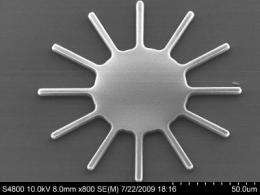
Researchers have proposed linking tiny beams in straight chains, but Rhoads has pursued a different approach, arranging the structures in rings and other shapes, or "non-traditional coupling arrangements." One prototype, which resembles spokes attached to a wheel's hub, is about 160 microns in diameter, or comparable in size to a grain of sand.

Findings are detailed in a research paper to be presented on Sept. 2 during a meeting of the American Society of Mechanical Engineers' Third International Conference on Micro and Nano Systems. The conference runs from Aug. 30 to Sept. 2 in San Diego. The paper was written by Rhoads and mechanical engineering graduate student Venkata Bharadwaj Chivukula.
Tiny 'MEMS' devices to filter, amplify electronic signals
Enlarge

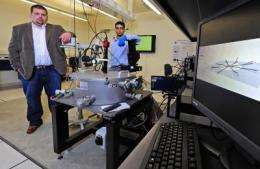
Jeffrey Rhoads, a Purdue assistant professor of mechanical engineering, and graduate student Venkata Bharadwaj Chivukula use equipment called a vacuum probe station in research to develop a new class of tiny mechanical devices. An early prototype, shown on the monitor at right, contains vibrating, hair-thin structures that could be used to filter electronic signals in cell phones. The tiny structure is called a microelectromechanical system, or a MEMS. The work is conducted on top of a special vibration-absorbing platform critical to making the precise measurements. Credit: Purdue News Service photo/Andrew Hancock

In addition to their use as future cell phone filters, such resonators also could be used for advanced chemical and biological sensors in medical and homeland-defense applications and possibly for a new type of "mechanical memory element" that harnesses vibration patterns to store information.

"The potential computer-memory application is the most long term and challenging," Rhoads said. "We are talking about the possibility of creating complex behaviors out of relatively simple substructures, similar to how in cellular biology you can have a relatively complex behavior by combining hundreds or thousands of simple cells."

The band-pass filter design promises higher performance than previous MEMS technology because it more sharply defines which frequencies can pass and which are rejected. The new design also might be more robust than the traditional linear arrangement, meaning devices could contain manufacturing flaws and still perform well.

The devices are made of silicon and are manufactured using a "silicon-on-insulator" procedure commonly used in the electronics industry to make computer chips and electronic circuits. The small, vibrating mechanical structures contain beams about 10 microns in diameter, which is roughly one-tenth the width of a human hair. The beams can be connected mechanically, like tiny springs, or they can be linked using electric fields and magnetic attractions.

"We are in the process of making a second prototype," said Rhoads, who has used simulations and also conducted experiments with the devices to demonstrate that the concept works.

The devices are being fabricated at the Birck Nanotechnology Center in Purdue's Discovery Park through a collaboration with Dimitrios Peroulis, an assistant professor of electrical and computer engineering.

The research is based at a new Dynamic Analysis of Micro/Nanosystems Laboratory at Birck. The lab, managed by Rhoads and mechanical engineering professor Arvind Raman, is equipped with an instrument called a scanning laser Doppler vibrometer, which uses a laser to measure the minute movement of the tiniest structures. The system is housed inside a vacuum chamber sitting on top of a special vibration-absorbing platform critical to making the precise measurements.

Source: Purdue University (news : web)


print this article email this article download pdf blog this article bookmark this article     Stumble it Digg this share on Facebook retweet share on Reddit add to delicious
Rate this story - 4 /5 (4 votes)


August 10, 2009 all stories

Comments: 0

4 /5 (4 votes)
  • Stumble this up

  • Digg this

  • share this

  • hide
  • Related Stories

  • Purdue creating wireless sensors to monitor bearings in jet engines
    created Oct 30, 2007 | popularity not rated yet | comments 0
  • Purdue creating wireless sensors to monitor bearings in jet engines
    created Nov 14, 2007 | popularity not rated yet | comments 0
  • Researchers push resonator frequency limit
    created Mar 14, 2008 | popularity not rated yet | comments 0
  • New stretchable electrodes created to study stresses on cardiac cells
    created Jan 22, 2009 | popularity not rated yet | comments 0
  • Micro-pump is cool idea for future computer chips
    created Apr 26, 2006 | popularity not rated yet | comments 0


  • hide
  • Relevant PhysicsForums posts

  • Galileo's Pendulum
    created 5 hours ago
  • Going to CERN in December! can anybody help?
    created 7 hours ago
  • Concept of 3 balls falling from building at different angles
    created 7 hours ago
  • "Pendulum"
    created 7 hours ago
  • Passage principle
    created 8 hours ago
  • is weight universal?
    created 9 hours ago
  • More from Physics Forums - General Physics

Other News

Nanotech in Space: Experiment To Weather the Trials of Orbit

Nanotech in Space: Experiment To Weather the Trials of Orbit

Nanotechnology / Nanomaterials

created 5 hours ago | popularity 4 / 5 (2) | comments 0

Novel nanomaterials developed at Rensselaer were sent into orbit on Nov. 16 aboard Space Shuttle Atlantis.


Nanoparticles used in common household items caused genetic damage in mice

Nanotechnology / Bio & Medicine

created Nov 16, 2009 | popularity 4.8 / 5 (24) | comments 11

Titanium dioxide (TiO2) nanoparticles, found in everything from cosmetics to sunscreen to paint to vitamins, caused systemic genetic damage in mice, according to a comprehensive study conducted by researchers at UCLA's Jonsson ...


Water droplets direct self-assembly process in thin-film materials

Nanotechnology / Nanomaterials

created Nov 23, 2009 | popularity 5 / 5 (4) | comments 2

You can think of it as origami - very high-tech origami. Researchers at the University of Illinois have developed a technique for fabricating three-dimensional, single-crystalline silicon structures from thin films by coupling ...


Peptides control crystal growth with 'switches, throttles and brakes'

Peptides control crystal growth with 'switches, throttles and brakes'

Nanotechnology / Bio & Medicine

created Nov 23, 2009 | popularity 5 / 5 (3) | comments 0

(PhysOrg.com) -- By producing some of the highest resolution images of peptides attaching to mineral surfaces, scientists have a deeper understanding how biomolecules manipulate the growth crystals. This research ...


Nanotube defects equal better energy and storage systems

Nanotube defects equal better energy and storage systems

Nanotechnology / Nanomaterials

created Nov 19, 2009 | popularity 4.4 / 5 (10) | comments 2

(PhysOrg.com) -- Most people would like to be able to charge their cell phones and other personal electronics quickly and not too often. A recent discovery made by UC San Diego engineers could lead to carbon ...