Planet Smash-Up Sends Vaporized Rock, Hot Lava Flying (w/ Video)
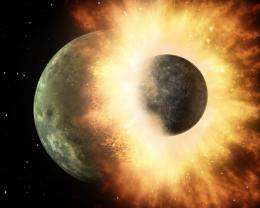
August 10, 2009 Planetary Smash-Up

Enlarge

This artist's concept shows a celestial body about the size of our moon slamming at great speed into a body the size of Mercury. NASA's Spitzer Space Telescope found evidence that a high-speed collision of this sort occurred a few thousand years ago around a young star, called HD 172555, still in the early stages of planet formation. The star is about 100 light-years from Earth. Image credit: NASA/JPL-Caltech

(PhysOrg.com) -- NASA's Spitzer Space Telescope has found evidence of a high-speed collision between two burgeoning planets around a young star.

Astronomers say that two rocky bodies, one as least as big as our moon and the other at least as big as Mercury, slammed into each other within the last few thousand years or so -- not long ago by cosmic standards. The impact destroyed the smaller body, vaporizing huge amounts of rock and flinging massive plumes of hot lava into space.

Spitzer's infrared detectors were able to pick up the signatures of the vaporized rock, along with pieces of refrozen lava, called tektites.

"This collision had to be huge and incredibly high-speed for rock to have been vaporized and melted," said Carey M. Lisse of the Johns Hopkins University Applied Physics Laboratory, Laurel, Md., lead author of a new paper describing the findings in the Aug. 20 issue of the . "This is a really rare and short-lived event, critical in the formation of Earth-like and moons. We're lucky to have witnessed one not long after it happened."

FLV player

Animation: NASA/JPL-Caltech

Lisse and his colleagues say the cosmic crash is similar to the one that formed our moon more than 4 billion years ago, when a body the size of Mars rammed into .

"The collision that formed our moon would have been tremendous, enough to melt the surface of Earth," said co-author Geoff Bryden of NASA's Jet Propulsion Laboratory, Pasadena, Calif. "Debris from the collision most likely settled into a disk around Earth that eventually coalesced to make the moon. This is about the same scale of impact we're seeing with Spitzer -- we don't know if a moon will form or not, but we know a large rocky body's surface was red hot, warped and melted."

Our solar system's early history is rich with similar tales of destruction. Giant impacts are thought to have stripped Mercury of its outer crust, tipped Uranus on its side and spun Venus backward, to name a few examples. Such violence is a routine aspect of planet building. Rocky planets form and grow in size by colliding and sticking together, merging their cores and shedding some of their surfaces. Though things have settled down in our solar system today, impacts still occur, as was observed last month after a small space object crashed into Jupiter.

Lisse and his team observed a star called HD 172555, which is about 12 million years old and located about 100 light-years away in the far southern constellation Pavo, or the Peacock (for comparison, our solar system is 4.5 billion years old). The astronomers used an instrument on Spitzer, called a spectrograph, to break apart the star's light and look for fingerprints of chemicals, in what is called a spectrum. What they found was very strange. "I had never seen anything like this before," said Lisse. "The spectrum was very unusual."

After careful analysis, the researchers identified lots of amorphous silica, or essentially melted glass. Silica can be found on Earth in obsidian rocks and tektites. Obsidian is black, shiny volcanic glass. Tektites are hardened chunks of that are thought to form when meteorites hit Earth.

Large quantities of orbiting silicon monoxide gas were also detected, created when much of the rock was vaporized. In addition, the astronomers found rocky rubble that was probably flung out from the planetary wreck.
The mass of the dust and gas observed suggests the combined mass of the two charging bodies was more than twice that of our .

Their speed must have been tremendous as well -- the two bodies would have to have been traveling at a velocity relative to each other of at least 10 kilometers per second (about 22,400 miles per hour) before the collision.
Spitzer has witnessed the dusty aftermath of large asteroidal impacts before, but did not find evidence for the same type of violence -- melted and vaporized rock sprayed everywhere. Instead, large amounts of dust, gravel, and boulder-sized rubble were observed, indicating the collisions might have been slower-paced. "Almost all large impacts are like stately, slow-moving Titanic-versus-the-iceberg collisions, whereas this one must have been a huge fiery blast, over in the blink of an eye and full of fury," said Lisse.

Other authors include C.H. Chen of the Space Telescope Science Institute, Baltimore, Md.; M.C. Wyatt of the University of Cambridge, England; A. Morlok of the Open University, London, England; I. Song of The University of Georgia, Athens, Ga.; and P. Sheehan of the University of Rochester, N.Y.

Provided by JPL/NASA (news : web)


print this article email this article download pdf blog this article bookmark this article     Stumble it Digg this share on Facebook retweet share on Reddit add to delicious
Rate this story - 4.6 /5 (16 votes)

Rank Filter

Move the slider to adjust rank threshold, so that you can hide some of the comments.


Display comments: newest first

  • omatumr - Aug 11, 2009
    • Rank: 1 / 5 (1)
    ANOTHER MOON-MAKING EVENT?

    There is little doubt that the Moon was thrown off from the Earth, but we do not understand details of the event that caused the ejection.

    Likewise, there is little doubt that all the material in planets, moons, asteroids and meteorites were thrown off from the Sun. The exact mechanism is unclear:

    http://tinyurl.com/359q3u

    But it appears that the event was associated with the violent nuclear reactions that made short-lived radioactive elements and isotopes by the r-, p- and e-processes of nucleosynthesis, as shown above [See: B2FH, Reviews of Modern Physics 29 (1957) 547-650].

    It is great that observations with NASA's Spitzer Space Telescope may provide more information on the Moon-forming event. I look forward to the day when NASA scientists accept and start working to elucidate further the catastrophic event that gave birth to the solar system.

    With kind regards,
    Oliver K. Manuel
    http://www.omatumr.com
  • yyz - Aug 11, 2009
    • Rank: not rated yet
    When do you expect NASA scientists to start looking for evidence that a neutron star exists at the core of our Sun, the product of a former (solar) supernova, OKM?
  • Nik_2213 - Aug 11, 2009
    • Rank: 4 / 5 (1)
    "There is little doubt that the Moon was thrown off from the Earth, but we do not understand details of the event that caused the ejection."

    Um, I thought the Proto-Earth dwarf-planet 'Big Splat & Splash' theory had edged out the rivals...

    "Likewise, there is little doubt that all the material in planets, moons, asteroids and meteorites were thrown off from the Sun."

    Do you mean 'Solar Nebula' ? Because, after the early Sun 'lit', it was going to modify the materials...
  • Ethelred - Aug 11, 2009
    • Rank: not rated yet
    No, Oliver means that HE, unlike everybody else, thinks the Sun is a super nova remnant with an iron or perhaps neutron core(He says one or the other in different papers and hasn't been willing to clear up the ambiguity). He thinks the inner planets formed from the debris of this alleged super nova.

    He has good evidence the a super nova was involved in the origin of the Solar System but that is all he has. That is pretty much standard theory now and Oliver's work probably contributed to that.

    Ethelred
  • omatumr - Aug 12, 2009
    • Rank: 1 / 5 (1)
    EXPERIMENTAL DATA

    Here are a few of the experimental data that forced me to unpopular conclusions about the birth of the solar system and the source of solar energy:

    1. This table of extinct elements that were alive when supernova debris formed meteorites is based on data from the best research laboratories worldwide - Australia, France, India, and the United States [University of Arkansas, University of California-Berkeley, Cal Tech, and the University of California-San Diego]:

    http://www.omatumr.com/Data/1960Data.htm" title="http://http://www.omatumr.com/Data/1960Data.htm" rel="nofollow" target="_blank">http://www.omatum...Data.htm

    2. This graph shows Ne isotopes that I measured in the Fayetteville meteorite while in the laboratory of Professor John H. Reynolds at UC-Berkeley:

    http://www.omatumr.com/Data/1964Data.htm" title="http://http://www.omatumr.com/Data/1964Data.htm" rel="nofollow" target="_blank">http://www.omatum...Data.htm

    3. This is a graph of data from my laboratory at the University of Missouri showing that isotopes of Kr and Xe in the solar wind have been mass fractionated.

    http://www.omatumr.com/Data/1972Data1.htm" title="http://http://www.omatumr.com/Data/1972Data1.htm" rel="nofollow" target="_blank">http://www.omatum...ata1.htm

    4. This graph is based on He and Xe in the Allende meteorite as measured in Professor Edward Anders' laboratory at the University of Chicago:

    http://www.omatumr.com/Data/1975Data.htm" title="http://http://www.omatumr.com/Data/1975Data.htm" rel="nofollow" target="_blank">http://www.omatum...Data.htm

    5. This graph of mass fractionated isotopes in the solar wind is based on measurements in Professor Geiss' laboratory at the University of Bern (Switzerland), in Professor Reynolds' laboratory at the University of California-Berkeley, and in Professor A. O. Nier's laboratory the University of Minnesota:

    http://www.omatumr.com/Data/1983Data.htm" title="http://http://www.omatumr.com/Data/1983Data.htm" rel="nofollow" target="_blank">http://www.omatum...Data.htm

    6. This graph of oxygen isotopes in various classes of meteorites and planets is based on data from Robert Clayton's laboratory at the University of Chicago.

    http://www.omatumr.com/Data/1976Data.htm" title="http://http://www.omatumr.com/Data/1976Data.htm" rel="nofollow" target="_blank">http://www.omatum...Data.htm

    7. This graph of molybdenum isotopes - showing that massive iron meteorites came directly from a supernova - is from measurements made at the University of Tokyo.

    http://www.omatumr.com/Data/1991Data.htm" title="http://http://www.omatumr.com/Data/1991Data.htm" rel="nofollow" target="_blank">http://www.omatum...Data.htm

    With kind regards,
    Oliver K. Manuel
    http://www.omatumr.com

August 10, 2009 all stories

Comments: 5

4.6 /5 (16 votes)
  • Stumble this up

  • Digg this

  • share this

  • hide
  • Related Stories

  • Astronomer spies conditions 'just right' for building an Earth
    created Oct 03, 2007 | popularity not rated yet | comments 0
  • Astronomers Say Moons Like Ours Are Uncommon
    created Nov 20, 2007 | popularity not rated yet | comments 0
  • Scientists Gaining Clearer Picture of Comet Makeup and Origin
    created Jul 17, 2006 | popularity not rated yet | comments 0
  • Signs Of Alien Asteroid Belt
    created Apr 20, 2005 | popularity not rated yet | comments 0
  • Spitzer and Deep Impact Build Recipe for Comet Soup
    created Sep 07, 2005 | popularity not rated yet | comments 0


  • hide
  • Relevant PhysicsForums posts

  • Sideral question
    created 17 hours ago
  • Doppler shifted blackbody spectrum
    created 20 hours ago
  • Earth v. Moon
    created 22 hours ago
  • help me with coordinates and orbits
    created 22 hours ago
  • basic 'our universe' question..
    created Nov 20, 2009
  • deriving keplers law
    created Nov 19, 2009
  • More from Physics Forums - General Astronomy

Other News

Astronauts finish another spacewalk, still no baby (AP)

Astronauts finish another spacewalk, still no baby

Space & Earth / Space Exploration

created 8 hours ago | popularity 3 / 5 (2) | comments 0

(AP) -- A spacewalking astronaut put aside the impending birth of his daughter and blazed through his first-ever venture outside the International Space Station on Saturday.


Unseasonably hot and dry weather combined with strong winds to fan scores of blazes in the country's southeastern states

Australia issues 'catastrophic' alerts as fires rage

Space & Earth / Environment

created 15 hours ago | popularity 4.5 / 5 (2) | comments 0

Australia has issued "catastrophic" alerts after record-breaking temperatures and wild lightning storms sparked more than 100 fires across the country, officials said Saturday.


Commuters wait on the platform shrouded by fog in London

Climate change not man-made, say majority of Britons: poll

Space & Earth / Environment

created Nov 15, 2009 | popularity 3.3 / 5 (15) | comments 46

Less than half of Britons believes that human activity is to blame for global warming, according to a poll carried out for The Times newspaper and published on Saturday.


Mysteriously warm times in Antarctica

Mysteriously warm times in Antarctica

Space & Earth / Earth Sciences

created Nov 18, 2009 | popularity 4.2 / 5 (21) | comments 28

(PhysOrg.com) -- A new study of Antarctica's past climate reveals that temperatures during the warm periods between ice ages (interglacials) may have been higher than previously thought. The latest analysis ...


UN: Fight climate change with free condoms (AP)

UN: Fight climate change with free condoms

Space & Earth / Environment

created Nov 18, 2009 | popularity 3.1 / 5 (11) | comments 24

(AP) -- The battle against global warming could be helped if the world slowed population growth by making free condoms and family planning advice more widely available, the U.N. Population Fund said Wednesday.