Nanoelectronic transistor combined with biological machine could lead to better electronics
August 10, 2009 Nanoelectronic transistor combined with biological machine could lead to better electronics

Enlarge

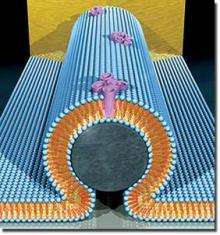
An artist's representation of a nanobioelectronic device incorporating alamethycin biological pore. In the core of the device is a silicon nanowire (grey), covered with a lipid bilayer (blue). The bilayer incorporates bundles of alamethicin molecules (purple) that form pore channels in the membrane. Transport of protons though these pore channels changes the current through the nanowire. Image by Scott Dougherty, LLNL

(PhysOrg.com) -- If manmade devices could be combined with biological machines, laptops and other electronic devices could get a boost in operating efficiency.

Lawrence Livermore National Laboratory researchers have devised a versatile hybrid platform that uses lipid-coated nanowires to build prototype bionanoelectronic devices.

Mingling biological components in electronic circuits could enhance biosensing and diagnostic tools, advance neural prosthetics such as , and could even increase the efficiency of future computers.

While modern communication devices rely on electric fields and currents to carry the flow of information, biological systems are much more complex. They use an arsenal of membrane receptors, channels and pumps to control signal transduction that is unmatched by even the most powerful computers. For example, conversion of sound waves into is a very complicated process, yet the human ear has no trouble performing it.

“Electronic circuits that use these complex biological components could become much more efficient,” said Aleksandr Noy, the LLNL lead scientist on the project.

While earlier research has attempted to integrate biological systems with microelectronics, none have gotten to the point of seamless material-level incorporation.

“But with the creation of even smaller nanomaterials that are comparable to the size of biological molecules, we can integrate the systems at an even more localized level,” Noy said.

To create the bionanoelectronic platform the LLNL team turned to lipid membranes, which are ubiquitous in biological cells. These membranes form a stable, self-healing,and virtually impenetrable barrier to ions and small molecules.

“That's not to mention that these lipid membranes also can house an unlimited number of protein machines that perform a large number of critical recognition, transport and signal transduction functions in the cell,” said Nipun Misra, a UC Berkeley graduate student and a co-author on the paper.

Julio Martinez, a UC Davis graduate student and another co-author added: “Besides some preliminary work, using lipid membranes in nanoelectronic devices remains virtually untapped.”

The researchers incorporated lipid bilayer membranes into silicon nanowire by covering the nanowire with a continuous lipid bilayer shell that forms a barrier between the nanowire surface and solution species.

“This 'shielded wire' configuration allows us to use membrane pores as the only pathway for the ions to reach the nanowire,” Noy said. “This is how we can use the nanowire device to monitor specific transport and also to control the membrane protein.”

The team showed that by changing the gate voltage of the device, they can open and close the membrane pore electronically.

The research appears Aug. 10 in the online version of the Proceedings of the National Academy of Sciences.

Provided by Lawrence Livermore National Laboratory


Rate this story - 4.6 /5 (11 votes)


August 10, 2009 all stories

Comments: 0

4.6 /5 (11 votes)

  • hide
  • Related Stories

  • Researchers use carbon nanotubes for molecular transport
    created Jun 09, 2008 | popularity not rated yet | comments 0
  • Nanomaterials to Mimic Cells
    created Aug 23, 2005 | popularity not rated yet | comments 0
  • Liquid or solid? Charged nanoparticles in lipid membrane decide
    created Nov 10, 2008 | popularity not rated yet | comments 0
  • Macromolecules on surface control mobility in phospholipid bilayers
    created Jun 20, 2005 | popularity not rated yet | comments 0
  • Nanoscale Fiber Optics
    created Jul 14, 2005 | popularity not rated yet | comments 0


  • hide
  • Relevant PhysicsForums posts

  • How to find static friction
    created 5 hours ago
  • Calculating decible increases
    created 12 hours ago
  • Coefficients of friction
    created 12 hours ago
  • Deduction of centripetal force
    created 13 hours ago
  • More from Physics Forums - General Physics

Other News

Nanoscale Structures with Superior Mechanical Properties Developed

Nanoscale Structures with Superior Mechanical Properties Developed

Nanotechnology / Nanomaterials

created 13 hours ago | popularity 4.6 / 5 (9) | comments 1 | with audio podcast

(PhysOrg.com) -- Researchers at the California Institute of Technology have developed a way to make some notoriously brittle materials ductile -- yet stronger than ever -- simply by reducing their size.


Spray-on liquid glass

Spray-on liquid glass is about to revolutionize almost everything

Nanotechnology / Nanomaterials

created Feb 02, 2010 | popularity 4.7 / 5 (240) | comments 93 | with audio podcast report

(PhysOrg.com) -- Spray-on liquid glass is transparent, non-toxic, and can protect virtually any surface against almost any damage from hazards such as water, UV radiation, dirt, heat, and bacterial infections. ...


IBM Scientists Demonstrate World's Fastest Graphene Transistor

IBM Scientists Demonstrate World's Fastest Graphene Transistor

Nanotechnology / Nanophysics

created Feb 05, 2010 | popularity 4.9 / 5 (38) | comments 25 | with audio podcast

(PhysOrg.com) -- In a just-published paper in the magazine Science, IBM researchers demonstrated a radio-frequency graphene transistor with the highest cut-off frequency achieved so far for any graphene device ...


Conductive eTextiles: Stanford finds a new use for cloth

Conductive eTextiles: Researchers move from making batteries from paper to making batteries from cloth

Nanotechnology / Nanomaterials

created Feb 05, 2010 | popularity 4.3 / 5 (7) | comments 4 | with audio podcast

(PhysOrg.com) -- Stanford researchers have moved from making batteries from paper to making batteries from cloth. Your-T-shirt could become a lighted, moving display.


Carbon Based Chips May One Day Replace Silicon Transistors

Carbon Based Chips May One Day Replace Silicon Transistors

Nanotechnology / Nanomaterials

created Feb 03, 2010 | popularity 4.7 / 5 (18) | comments 3 | with audio podcast weblog

(PhysOrg.com) -- IBM researchers are hopeful that, over the next decade, silicon-based transistors will be replaced by carbon-based transistors. IBM has already laid out the ground work for carbon-based transistors.