Climate models confirm more moisture in atmosphere attributed to humans
August 10, 2009
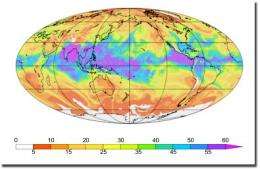
Total amount of atmospheric water vapor over the oceans on July 4, 2009. The scale is 10° x 10° latitude/longitude. These results are from operational weather forecasts of the European Centre for Medium-Range Weather Forecasting (ECMWF).
(PhysOrg.com) -- When it comes to using climate models to assess the causes of the increased amount of moisture in the atmosphere, it doesn't much matter if one model is better than the other.
They all come to the same conclusion: Humans are warming the planet, and this warming is increasing the amount of water vapor in the atmosphere.
In new research appearing in the Aug. 10 online issue of the Proceedings of the National Academy of Sciences, Lawrence Livermore National Laboratory scientists and a group of international researchers found that model quality does not affect the ability to identify human effects on atmospheric water vapor.
“Climate model quality didn't make much of a difference,” said Benjamin Santer, lead author from LLNL's Program for Climate Modeling and Intercomparison. “Even with the computer models that performed relatively poorly, we could still identify a human effect on climate. It was a bit surprising. The physics that drive changes in water vapor are very simple and are reasonably well portrayed in all climate models, bad or good.”
The atmosphere's water vapor content has increased by about 0.4 kilograms per cubic meter (kg/m3) per decade since 1988, and natural variability alone can't explain this moisture change, according to Santer. “The most plausible explanation is that it's due to human-caused increases in greenhouse gases,” he said.
More water vapor - which is itself a greenhouse gas - amplifies the warming effect of increased atmospheric levels of carbon dioxide.
Previous LLNL research had shown that human-induced warming of the planet has a pronounced effect on the atmosphere's total moisture content. In that study, the researchers had used 22 different computer models to identify a human “fingerprint” pattern in satellite measurements of water vapor changes. Each model contributed equally in the fingerprint analysis. “It was a true model democracy,” Santer said. “One model, one vote.”
But in the recent study, the scientists first took each model and tested it individually, calculating 70 different measures of model performance. These “metrics” provided insights into how well the models simulated today's average climate and its seasonal changes, as well as on the size and geographical patterns of climate variability.
This information was used to divide the original 22 models into various sets of “top ten” and “bottom ten” models. “When we tried to come up with a David Letterman type 'top ten' list of models,” Santer said, “we found that it's extremely difficult to do this in practice, because each model has its own individual strengths and weaknesses.”
Then the group repeated their fingerprint analysis, but now using only “top ten” or “bottom ten” models rather than the full 22 models. They did this more than 100 times, grading and ranking the models in many different ways. In every case, a water vapor fingerprint arising from human influences could be clearly identified in the satellite data.
“One criticism of our first study was that we were only able to find a human fingerprint because we included inferior models in our analysis,” said Karl Taylor, another LLNL co-author. “We've now shown that whether we use the best or the worst models, they don't have much impact on our ability to identify a human effect on water vapor.”
This new study links LLNL's “fingerprint” research with its long-standing work in assessing climate model quality. It tackles the general question of how to make best use of the information from a large collection of models, which often perform very differently in reproducing key aspects of present-day climate. This question is not only relevant for “fingerprint” studies of the causes of recent climate change. It is also important because different climate models show different levels of future warming. Scientists and policymakers are now asking whether we should use model quality information to weight these different model projections of future climate change.
“The issue of how we are going to deal with models of very different quality will probably become much more important in the next few years, when we look at the wide range of models that are going to be used in the Fifth Assessment Report of the Intergovernmental Panel on Climate Change,” Santer said.
Provided by Lawrence Livermore National Laboratory
-
Increase in atmospheric moisture tied to human activities
Sep 18, 2007 |
not rated yet |
0
-
Scientists advance in detection and attribution of climate change
Feb 21, 2005 |
not rated yet |
0
-
New observations and climate model data
Aug 12, 2005 |
not rated yet |
0
-
Water vapor confirmed as major player in climate change
Nov 17, 2008 |
not rated yet |
0
-
Human activities contribute to California's global warming
Jan 18, 2008 |
not rated yet |
0
-
Engineers build first sub-10-nm carbon nanotube transistor
Feb 01, 2012 |
4.9 / 5 (32) |
30
-
Something old, something new: Evolution and the structural divergence of duplicate genes
Jan 31, 2012 |
4.6 / 5 (7) |
1
-
The hidden nanoworld of ice crystals: Revealing the dynamic behavior of quasi-liquid layers
Jan 30, 2012 |
5 / 5 (4) |
1
-
Stock market network reveals investor clustering
Jan 27, 2012 |
3.9 / 5 (23) |
8
-
Of microchemistry and molecules: Electronic microfluidic device synthesizes biocompatible probes
Jan 26, 2012 |
5 / 5 (2) |
0
-
Do some geologists actually act a lot like Randy Marsh?
Feb 11, 2012
-
Discrepancy between oxygen and carbon-dioxide levels
Feb 09, 2012
-
where gems are found in the world
Feb 09, 2012
-
Wind Waves in Reservoir ~ Wind run-up and Wind set-up
Feb 08, 2012
-
Balance of oxygen in the atmosphere
Feb 01, 2012
-
The case for a methanol-based economy
Jan 30, 2012
- More from Physics Forums - Earth
More news stories
Salvage workers begin pumping fuel from Italian shipwreck
Salvage workers Sunday began pumping fuel from the shipwrecked Italian cruise liner Costa Concordia, a day ahead of schedule, officials said.
2 hours ago |
not rated yet |
0
Latin America mining boom clashes with conservation
Latin America is experiencing a mining boom as prices rise fuelled by a hike in global demand, but the region is also being hit by a wave of violent protests, strikes and rallies by environmentalists.
10 hours ago |
5 / 5 (1) |
1
Political leaders play key role in how worried Americans are by climate change: study
More than extreme weather events and the work of scientists, it is national political leaders who influence how much Americans worry about the threat of climate change, new research finds.
Feb 06, 2012 |
5 / 5 (6) |
73
NASA budget will axe Mars deal with Europe: scientists
US President Barack Obama's budget proposal to be submitted next week for 2013 will cut NASA's budget by 20 percent and eliminate a major partnership with Europe on Mars exploration, scientists said Thursday.
Space & Earth / Space Exploration
Feb 10, 2012 |
5 / 5 (3) |
58
Humans may have helped the decline of African rainforests 3000 years ago
(PhysOrg.com) -- Large areas of rainforests in Central Africa mysteriously disappeared over three thousand years ago, to be replaced by savannas. The prevailing theory has been that the cause was a change ...
Scientists discover molecular secrets of 2,000-year-old Chinese herbal remedy
For roughly two thousand years, Chinese herbalists have treated Malaria using a root extract, commonly known as Chang Shan, from a type of hydrangea that grows in Tibet and Nepal. More recent studies suggest that halofuginone, ...
New method to examine batteries -- MRI from the inside
There is an ever-increasing need for advanced batteries for portable electronics, such as phones, cameras, and music players, but also to power electric vehicles and to facilitate the distribution and storage of energy derived ...
Google might launch Drive for cloud storage soon
(PhysOrg.com) -- Google's next big move, according to the Wall Street Journal, is a cloud storage service called Drive. Hardly first to the plate, Google is simply catching up to introducing its cloud reposi ...
Lab study raises questions over nano-particle impact
Tests involving chickens have raised questions about the impact on health from engineered nano-particles, the ultra-fine grains commonly used in drugs and processed foods, scientists said on Sunday.
A mitosis mystery solved: How chromosomes align perfectly in a dividing cell
Although the process of mitotic cell division has been studied intensely for more than 50 years, Whitehead Institute researchers have only now solved the mystery of how cells correctly align their chromosomes during symmetric ...
Starve a virus, feed a cure? Findings show how some cells protect themselves against HIV
A protein that protects some of our immune cells from the most common and virulent form of HIV works by starving the virus of the molecular building blocks that it needs to replicate, according to research published online ...
Aug 11, 2009
Rank: 3 / 5 (6)
water vapor, which contributes 36%-72%
carbon dioxide, which contributes 9%-26%
methane, which contributes 4%-9%
ozone, which contributes 3%-7%
Water vapor is signifigantly more of a factor with any human activities and climate change. Yet everyone is worried about CO2 and ignores the water vapor.
Aug 11, 2009
Rank: 2.7 / 5 (7)
Aug 11, 2009
Rank: 2.7 / 5 (7)
Aug 11, 2009
Rank: 3.3 / 5 (7)
So if they all disagree with one another over some details, but agree on others, it means they are all right on those things they agree about? Bad logic there. Emperor's new clothes, in fact.
In the arena of climate research, the project which can show that more research is required is the one which gets more money.
Aug 11, 2009
Rank: 2.6 / 5 (5)
As well they should.
The ideal is not a world without ANY greenhouse(uninhabitable iceball), the ideal is not any specific mean temperature it's just managable rates of change.
It's very hard to have a significant impact on water vapour. If you emit some steam it's just going to come back out as percipitation in a week or so.
Aug 11, 2009
Rank: 3.4 / 5 (5)
The water will increase in the atmosphere as the earth's temperature rises...which will then serve to balance things out by blocking the sun, which will in turn bring the earth's temperature back down, and then the water will return to the ground as rain and/or snow. Now what exactly was the problem again???
Aug 11, 2009
Rank: 2.8 / 5 (6)
Humans produce many thousands of times the amount of CO2 in regard to water vapor, and water vapor is a far more potent GHG. CO2 is a joke comparitively.
Aug 11, 2009
Rank: 3 / 5 (6)
Aug 11, 2009
Rank: 3 / 5 (8)
So tell me this, where is your proof that they are fudging the numbers and fabricating data? If you can't produce any proof, then all you are doing is making assumptions. Honestly, the people who claim that global warming is like a religion are right is some respects... especially as far as the average joe is concerned: most random people don't know anything about the science behind it so they have to take it on faith one way or the other. But that's true of ALL science. In any field of science, if you are not able to see the experimental data and perform those experiments yourself, then you have to take it on faith (or not).
Do you think that science therefor hasn't benefited us more then almost any other "faith" in history? Sure some people in the "priesthood" will always abuse their power, but unless you are a climatologist directly involved in global warming research, then your opinion on global warming means next to nothing to me when compared to that of any person who IS involved in the field.
And it's like wearing your seatbelt. Sure you PROBABLY wont need it... but is it worth the risk of not wearing it? Our understanding of global warming may not be (read: probably isn't) correct... but if it is the consequences could be dire. The small amount (comparatively) we as a society spend on the research is insurance against the POSSIBILITY that it could be real and dire.
Bashing on global warming research has become a fad and religion just as much as its support.
So please stop posting drivel like "why is the Earth cooling?" without posting ANY of the proof of the matter. I'm not saying it might not be right, but I certainly am not going to take your word for it "just 'cause".
My opinion on global warming at the moment is the same as my opinion on most matters: I don't know because I don't have the information to make an informed decision. Posting random garbage information as a lay person NOT involved in the climate research only makes it harder for people to find accurate information.
So please POST FACTS not OPINIONS.
Thank you.
Aug 11, 2009
Rank: 3.3 / 5 (7)
Science that relies on incomplete modeling to suggest that further research is necessary should be funded.
Scientists that rely on incomplete modeling and subsequently attempts to dictate "the science is settled" should not be funded.
http://www.john-d...ckey.htm
http://www.chron....215.html
http://news.googl...nid=1314&dat=20050811&id=mkESAAAAIBAJ&sjid=BvMDAAAAIBAJ&pg=4666,637467
http://strata-sph...ves/9534
http://www.telegr...ata.html
http://wattsupwit...-muzzled
And it can go on and on and on. This also works conversely to those who are falsifying data on the hypothetical objection side however, the leading figures, and the men responsible for climate change alarm are Hansen, Mann, and Gore, a physicist, statistician, and politician.
So when the claims of Hansen, Mann, and Gore were falsified, and not "possibly in error" but flat out lying, the issue becomes quite clear. Although I am a fan of msot current climate research due to the greater understanding of our world that it yields daily, but, when the men who kick started the movement based the entire fiasco on false data for political, monetary, or other gains I become very suspect of the remaining members of the movement.
After all, Earth first used to firebomb buildings, now that they state they're non-violent, would you invite them to a Petco employee gathering?
Aug 11, 2009
Rank: 2 / 5 (8)
You just exposed yourself by pointing to those b.s. sites that are suppose to back your religion.
Aug 11, 2009
Rank: 3.9 / 5 (7)
It seems the fundamental difference in our ideologies is that I would not force you to live like me if I prevailed, but you would not hesitate to force others to obey your ideas if you prevailed.
Aug 11, 2009
Rank: 4 / 5 (4)
Hey maybe the internet is biased, after all more than half of those polled on the internet think there is a greater chance that AGW is incorrect as it stands today than those who agree with the AGW hypothesis.
Maybe everyone except the AGW crusaders are biased. What a messed up biased world you live in John. The free exchange of ideas is paramount, as long as they agree with you, right?
Aug 11, 2009
Rank: 4.2 / 5 (5)
No, but we should be a damned sight more skeptical of the results we are being handed and not simply start using such reports to justify log rolling to fulfill political agendae.
Aug 11, 2009
Rank: 1 / 5 (7)
Aug 11, 2009
Rank: 5 / 5 (6)
Wow. Just wow.
Aug 11, 2009
Rank: 5 / 5 (4)
Seriously, guy(girl?)? The earth is like a glass of water? It's those giant ice-cubes at the top and bottom of the world that keep us cool, huh?
You're sure it's not the atmosphere's properties and the suns rays entering at steep angles that allow those giant ice cubes to exist, up there in the first place? And the wind currents that circulate this cold air (caused by the atmosphere and angle of the sun at high latitudes) into moderate latitudes? And the rotation of the earth always keeping one half of the earth in shadow, and our proximity from the sun, nothing as well, huh? Oh and that albedo effect thing (the one thing the icecaps actually do "do" to cool the earth, but is present elsewhere too i.e. clouds) is a myth too... None of that matters. Oh and forget the general constant dissemination of energy from the earth system, in the form of infra-red, into space. Yes, I'm sure you're right now, it's only those ice cubes that cool the earth, what will we do without them?
P.S. get a clue
Aug 11, 2009
Rank: 1 / 5 (2)
Aug 11, 2009
Rank: 1 / 5 (5)
Aug 11, 2009
Rank: 5 / 5 (4)
Yep, all the ice melted and now Venus is warm and flat like the beer you just drank before you posted this garbage.
Aug 11, 2009
Rank: 1 / 5 (4)
Aug 11, 2009
Rank: 3.3 / 5 (6)
Climate trends are measured in decades or centuries -- not days, months, or years. If you look at any global temperature graph (the major ones are compiled at http://en.wikiped...cord.png ) you can see a great deal of random noise from year to year, even though there is a clear trend when looking at the past 100. In fact, the cooling in the past few years is pretty minor compared to other random fluctuations you can see on that graph -- and yet the temp always went back up.
I grimaced when AGW activists in 1999 filled the headlines with hysteria about the massive temp spike measured in 1998, just as I now grimace when AGW skeptics talk about the recent downward spike. Momentary spikes in either direction are irrelevant; and neither side should use them as evidence. They make good headlines, but they're irrelevant as science. Only the overall trend matters.
Aug 11, 2009
Rank: 2.6 / 5 (5)
Aug 11, 2009
Rank: 2.9 / 5 (7)
Water vapor does not cool the earth; it is a potent greenhouse gas. In fact, the release of water vapor due to warming is widely considered the primary "positive feedback" mechanism of global warming. Which is unfortunate, considering how little control we have over water vapor concentration. Water vapor levels are dominated by the oceanic evaporation/precipitation cycle, and any changes we humans try to make would be instantly erased by that cycle. Compare this to CO2, which has recently and suddenly skyrocketed to its highest level in well over 2 million years (see http://www.physor...313.html ), and you can see why CO2 is our main focus for emissions control, even though water vapor is a far more potent greenhouse gas.
Aug 11, 2009
Rank: 1 / 5 (3)
Aug 11, 2009
Rank: 2.3 / 5 (6)
Yes, the north pole melt has been faster than expected. The two main effects of the melt should be a decrease in the albedo (brightness) of the Earth -- which means more sunlight absorbed into the ocean which was previously reflected back into space by the ice -- and a possible disruption of the "Atlantic conveyor belt" which regulates ocean temperatures and thus local climates all around the ocean. Neither of these would be particularly good. (Note that the north cap melting would *not* raise sea levels, since that ice is afloat.)
The IPCC originally predicted ice-free summers for the North Pole by 2100 -- but it's melting far faster than anyone expected. As usual, the IPCC tried to err on the side of conservatism, but this time they were off by a pretty wide margin. The estimate was changed to 2050 several years ago, and now it's at 2030. The idea of an ice-free north pole is strange to most people, as it would be unique in human memory -- in fact it would be unique within the past million years. It's just one more novel climate event expected to happen in our lifetimes. No one knows quite what will come of it.
Aug 11, 2009
Rank: 2.3 / 5 (3)
If you are truly worried about the future of others, then I assume you are making changes to your life that will make a real measurable difference now. i.e. not just spewing your rhetoric on a science forum.
Same with you Damon Hastings, you both talk like conservationists, do you live your convictions? What do you both DO that is making a directly measureable difference NOW?
Aug 11, 2009
Rank: 3 / 5 (4)
Your response was the sort of post that improves a debate, no matter what side you are on, as after all the point of a debate is to try and come to a common understanding. Disagreement comes from a difference of opinion which itself comes from a discrepancy of information.
So the goal is to present information and discuss as needed.
Many others here could learn alot from you.
And to clarify my other point from my last post, I agree that most of the political moves being made relating to global warming are asinine at best. I favor continued funding of research on the topic as it can't hurt, but the rush to implement drastic solutions often reeks of being a razors edge from a scam.
http://www.timeso...2023.ece
Look at the above link for example... the money we would spend building thousands of these silly boats could instead be invested into a thousand more useful projects, including energy related research and projects that in many cases might even result in less use of coal/oil, thereby reducing co2 emissions etc.
But giant boats spitting out clouds? It makes me wonder who will own the company that gets that massive contract.
A razors edge from a scam...
Aug 11, 2009
Rank: 3 / 5 (4)
Secondly, water vapor is the greatest cooling effect we've measured. Don't forget the albedo of cloud cover.
Lastly, the IPCC originally stated we'd have an ice free summer in 2007, then again in 2008, now that they've swung and missed twice they're calling the ball for 2100, guess what, strike three comming up.
Mesafina, you and I are of the same mind, we simply seek truth.
Aug 11, 2009
Rank: 2.3 / 5 (3)
Link please
Would you recognise it?
Aug 11, 2009
Rank: 1 / 5 (1)
Would you Steve?
We never really know the truth, only it's reflection.
Asking for a link is fair, but the second part of your post has no purpose but to inflame emotions.
Aug 11, 2009
Rank: 3 / 5 (2)
I would never accuse somebody of dishonesty without reason. Could you say the same for Vel?
http://www.physor...624.html
Aug 11, 2009
Rank: 3 / 5 (1)
I can't, because I haven't followed his previous posts on other threads. I will check out the link.
I'm sorry if I caused you offense as it was not intended, it was meant more as a cautionary note. Ignore it if it is not applicable.
Aug 11, 2009
Rank: 5 / 5 (1)
First of all, the absorption overlap between water and CO2 is not perfect; there are wavelengths that CO2 catches but that slip through water, and vice versa (it'd be amazing if that wasn't so). This allows CO2 to have an effect, even in a very water-rich atmosphere like ours. It's a much smaller effect than if CO2 were the only gas present, but it IS there.
The second issue is that, although increasing CO2 (or water, or...etc.) concentration in the lower atmosphere does have pretty much zilch effect, due to the opacity of the gas at 1 atm, higher up that's not the case. In the more diffuse upper atmosphere (where, incidentally, the ratio of water to CO2 is also smaller, and CO2 gets more time onstage and less time as an extra, so to speak), adding more CO2 can increase those layers' ability to absorb IR, preventing it from escaping out into space as easily and trapping more heat in our atmosphere.
Both of these corrections to old mistakes, incidentally, were made about fifty years ago, and I'm surprised, again, that you seem to not be familiar with them. If you are, though, would you mind explaining why you think they aren't valid? I'm not a climate scientist (or even a scientist of any stripe, yet), but I know enough about physical chemistry and the behavior of gases to tell that these explanations are, at least on the surface, sensible enough.
As for clouds...well, which has more of an effect, the increasing gaseous water (greenhouse gas) or the liquid and solid water (cooling, greenhouse effect ameliorators)? Can you be so confident as to which one overpowers the other?
...And if so, mind linking me to a paper, or preferably several on the subject? I had thought that the balancing act between clouds and heat-trapping water vapor was still something of a black (or maybe grey?) box in climatology, just like the tug-of-war between CO2 and rising aerosols was a few decades back.
Aug 11, 2009
Rank: 2.4 / 5 (5)
Dude, where are you *getting* this stuff? Seriously, I genuinely want to know.
See Ronan's response above. But even if things worked as you say, I hardly think that replacing CO2-based warming with H2O-based warming would be an improvement. We can't do anything about water vapor levels.
Low-level clouds are thought to have a cooling effect (albedo), while high-level clouds have a warming effect (insulation). The jury is still out on whether GW will increase or decrease each type.
But water *vapor* definitely has a warming effect (one which exceeds clouds' net cooling effect), and water vapor is definitely increasing.
Aug 11, 2009
Rank: 2.3 / 5 (3)
Aug 11, 2009
Rank: 2.3 / 5 (3)
I think you might be surprised. But my personal activities are not germane to the topic at hand. Nor am I terribly interested in participating in ad hominem arguments (which are far too common on this board and too easily become flame wars.)
Aug 11, 2009
Rank: 2.6 / 5 (5)
Feel free to send me a PM about it if you're concerned for the continuity of this debate, I'm just curious if there's anything more to you than talk.
Of course, it wouldn't really matter if you did put up here, or in a PM, what you do in your life to change our current path. You could be lieing, and there's likely no practical way I could ever know the truth of it.
But you know the truth. You know your truth. And I hope you don't lie to yourself, I hope you never lie to yourself. I hope you actually do something for real change. Do you?
Aug 11, 2009
Rank: 5 / 5 (2)
Oh, no wait! We should push for solar. Yeah, that's the ticket! Oh...no...wait...the manufacture and maintenance of solar cells and panels is responsible for the release of many tons of GHGs 17,000 times more potent than CO2 into the atmosphere.... Never mind. :)
Oh...wait! ....
Aug 12, 2009
Rank: 5 / 5 (2)
Secondly, in regards to CO2 and water vapor overlap, I am aware of it, however, the extent of non-overlap is incredibly slight, so slight as to make a paltry 100ppm concentration increase of no relative import when measuring radiative forcing aspects.
Steve,
In case you're not going to return to the post here's my reply.
As I said there, it was an unintentional mistake. The paper is in the USGS release you mentioned, it is not on the USGS website any longer. Check your local library, read the article. Still think I'm being disingenuous, then there's nothing more I can say on the issue.
Aug 12, 2009
Rank: 5 / 5 (1)
As to the second point...Well, I still fail to see why adding more CO2 couldn't end up trapping more heat. It maybe be "only" an addition of 100 ppm, but considering that (A.) That's a pretty hefty percentage of the total concentration, (B.) CO2 (even at slight concentrations) absorbs IR very well, and (C.) Under the conditions of the upper atmosphere, CO2 and water's absorption bands become more sharply-defined and overlap each other less (and, of course, there's much less water up there anyway), it seems like making a large (percentage-wise) increase in CO2 should boost the ability of those upper layers to trap heat, regardless of water's overlap at lower altitudes.
Aug 12, 2009
Rank: 5 / 5 (1)
It's a basic aspect of physics. When a molecule is "excited" by absorption it will attempt to re-release that absorbed energy into it's environment to reach it's "most stable" state.
As for the second point, CO2 is heavy, heavier than ambient air.
This traps almost all CO2 within the lower atmosphere, with some exception, however, on the whole, the degree of CO2 available to capture IR at higher altitudes decreases very quickly as you rise through the atmosphere, to the point where CO2 is all but undetectable past the tropopause.
Water doesn't suffer from this as it's a far lighter molecule and has an energy absorption potential far higher than CO2.
Aug 12, 2009
Rank: 1 / 5 (1)
Please enlighten me on what you are planning to prevail over??? Hmmm..
Aug 12, 2009
Rank: 5 / 5 (1)
Never heard the term prevailing ideology?
Aug 12, 2009
Rank: 2.3 / 5 (3)
Hefty percentage??? That would be 100 molecules of CO2 for every 1,000,000 molecules of everything else in the air.
Now, consider that solar technology is responsible since 1978 for the release of many tons of GHGs 17,000 times more potent than CO2 molecule for molecule and that the amounts are rising as a result of continued manufacture and maintenance of solar cells and panels.
I propose a modification of the elementary school science where children filled a glass bottle with air and another with pure CO2 and placed thermometers into stoppers and then into the bottles under a heat lamp.
In this experiment the thermometer in the CO2-filled bottle would rise noticably higher than the one filled with air.
In the revised experiment, fill one bottle with outdoor air (which contains CO2 in quantities averaging 383 ppm to 400 ppm depending upon location and time of day). Place a stopper equipped with a thermometer into the bottle.
Then, fill another bottle of equal mass and properties with air from inside a house, which can be found to be as high as 5000 ppm depending upon ventilation. Place thermometer into stopper and then into the latter bottle.
Next, place both under a heat lamp and record the results. How much difference do you see between the temperatures in the two bottles?
Finally, because heat lamps do not project their heat equally, one must place controls by placing identicallly calibrated thermometers on stands directly behind the bottles and between the heat lamp so as to have a temperature in degrees one can subtract from the bottle if there are any differences between locations in the heat due to variable radiative forcing as a result of distortions in the lamp's glass.
Of course, this does not take into account a number of other factors on the planet, being a simplistic experiment but it might prove interesting nonetheless. :)
I'd do it myself but do not have access to extra calibrated thermometers I can use for private projects at the moment.
Aug 13, 2009
Rank: 5 / 5 (1)
And about the experiment...Interesting. I doubt it would really say much at all about the conditions on Earth, but it'd be kinda fun to see what happened with it, anyway. Wonder if I could track down some temperature probes, so I could get a LoggerPro graph of temp. versus time for each different concentration? Maybe I'll try that...
And Velanarris, I understand that, of course; but what I don't follow is what that has to do with the IR absorptivity of a column of CO2. If I understood correctly, you were saying that that absorption and re-radiation somehow prevented such a column of gas from reaching a point where the addition of more CO2 didn't increase IR absorption, and I don't quite get why that would be.
But regarding the second point...really? I checked up on that, Velanarris, and the sources I can find say quite the opposite: That up until you get to the turbopause (about 100 km above the surface, and well above the stratosphere, which is the portion of the atmosphere that we're talking about, here), the gases of the atmosphere are pretty uniformly mixed--except for water, which due to its tendency to condense or freeze when it gets too cold is much scarcer in the upper troposphere and the stratosphere.
http://www.atmosp...1yy.html Only briefly mentions the point, and concerns itself primarily with ozone, but does bring up the relative dearth of water vapor up there. And although the mixing rate mentioned there is certainly slow (months to years), it's easily rapid enough for anthropogenic CO2 to have gotten up there by now.
...But, of course, this very article that we're (ostensibly, but we seem to have been rather sidetracked into a more general discussion) is about the increase of water vapor in the atmosphere. Judging from this data, though, the concentrations of water vapor up there are still pretty low, hovering at or a little below 10 ppm once you get up into the stratosphere (at about 10 km): http://www.esrl.n...dex.html
This is also interesting: It's somewhat indirect and a little old (24 years old...still probably reliable enough, though), and it only pertains to the middle stratosphere, but while it indicates that the mixing rate between the troposphere and stratosphere, and perhaps the density issue you mentioned, does cause CO2 concentrations up-a-top to be lower than those at our level--it's not much. Just ~7 ppm lower, and there's precious little difference between (assuming those differences then are the same as those now) 387 and 380 ppm. Sorry, incidentally, that it's just the abstract. It'd be nice if the full paper were available, but... http://www.nature...40a0.pdf
Aug 13, 2009
Rank: 5 / 5 (1)
Outgoing IR isn't "trapped" as heat in the atmosphere, outgoing IR is "slowed" as heat within the atmosphere. If we remove the sun's variability from the equation, just to simplify not to theorize, and assume a constant outgoing IR budget adding more CO2 won't change the outgoing energy budget over large timescales, giving the appearance of saturation. This is the stumbling block I ran into prior.
Over shorter timescales, which for our purposes are of greater relevance, there is a delay in the loss of energy when CO2 is added. Adding more of any substance that will absorb IR on the same frequency as CO2 will result in a delay of the escape of individual photons of IR.
So what we're looking at isn't really a "heating" of the Earth, it's a delta in the delay encountered by energy trying to escape. now this is exacerbated by the fact that our atmosphere has very little CO2 in relation to other gasses. If our atmosphere was of a greater CO2, or similar absorbative gas, concentration the effects of adding additional CO2 would be greatly diminished.
The ratio is 2:.5, for every 50% more IR trapped you would have had to double the CO2 concentration.
[hypothetical]
Let's say a current CO2 concentration, 200ppm, is capturing 2 w/m^2. Now we double CO2 to 400ppm. We should be able to state that CO2 is capturing 3 w/m^2.
800 ppm: 4w/m^2
1600ppm: 5w/m^2
and so on. But this is all assuming that the IR is available to trap, there are no convective or conductive forces at play, and the remainder of the system is "steady state". We know these things to be untrue as we live in a very dynamic, non-fragile environment.
The troposphere contains 80% of the mass of our atmosphere so the concentration figure from one to the next isn't an apples to apples comparison for radiative purposes as we have to take volume and potential energy into account. Yes the concentration may be about the same but the available total is far far lower.
A really good reference for how wind affects mixing can typically be found by doing a search for "Hadley Cells" which are the tropic and polar cells responsible for most atmospheric mixing ( the latter cells sometimes classified seperately as "polar Hadley Cells"). The equatorial hadley cells are purely driven by incomming solar energy which, through thermal expansion and energetic vibration, cause the atmosphere to rise where as it cools it travels towards the poles.
Now this is fairly simplified as you can pit atmospheric mixing on a plethora of processes including simple friction between the Earth and it's atmosphere as we rotate around the Sun, but this is one of, if not the, main driver of atmospheric mixing as far as we know.
Aug 14, 2009
Rank: not rated yet
Vel
Can you post a link to back up this statement
I have replied to your post here
http://www.physor...624.html
Aug 14, 2009
Rank: 1 / 5 (1)
I guess you have 2 screen names. Okay , I'll bite, what ideology is that??
Aug 16, 2009
Rank: not rated yet
So, we understand that 'confirms' equals 'plausible' ??
Models dont 'cofirm' except to confirm the predjudices of the modeler. What they do do is to 'suggest' ..
Poor use of language does no one any good.
Aug 16, 2009
Rank: not rated yet
Nope, jsut one.
The term prevailing ideology means the "leading ideology". It's a general term.
Aug 16, 2009
Rank: not rated yet
As for the second point...well, sure, equal concentrations under different pressures make for different total quantities; but I'm not sure that that's relevant. At the risk of possibly comparing apples to oranges, ozone is present in the stratosphere only at ranges of 2-8 ppm (at its greatest concentration, mind), and it still absorbs 93%-99% of the UV hitting it (I used Wikipedia for those numbers; yes, I know it's not the ideal source, but I doubt that either of those figures is particularly controversial, so...) I mention that not as proof of anything, you understand, just to point out that despite the very, very small quantity of CO2 that 380 ppm (under stratospheric conditions) translates to, that's no reason to assume a priori that it can't have an effect, as you seem to be doing.
And I was already a little (read: not very much at all) familiar with Hadley cells, but I'll read up on that a bit more. Not sure exactly how they relate to the discussion at hand, but then, perhaps that's just because I haven't read enough about 'em yet...
Aug 16, 2009
Rank: not rated yet
No, I'm not saying there is no effect. There's a far diminished effect. Secondly once you start talking stratospheric you start to talk about correlative effect on weather as opposed to direct effect.
You bring up ozone which exemplifies another point. Ozone is stopping incomming UV, whereas CO2 is stopping outgoing IR. CO2 at the troposphere will have a greater effect on IR than Ozone in the troposphere would have on UV and vice versa.
As for Hadley cells, at this time they're the greatest "mixer" of atmospheric layers and gasses.
Aug 17, 2009
Rank: not rated yet
Aug 17, 2009
Rank: not rated yet
Aug 18, 2009
Rank: not rated yet
Daly is the author of the following site:
http://www.john-daly.com/
Velanarris is not Daly. Daly is dead.
Now, it behooves you to read something published by a climate scientist before all the hype.
Read H. H. Lamb, Climate, History and the Modern World, 157-159.
The evidence confirms that the climate in the Arctic was at least 4°C to 5°C warmer than today.
The oceans around Greenland allowed swimming and there is historical material that shows that one person swam there for 2 miles between islands with no adverse effects and no quick hypothermic death that would result from swimming the waters off Greenland nowadays. This was only 1,000 years ago.
Aug 18, 2009
Rank: not rated yet
Aug 18, 2009
Rank: not rated yet
Bush never censored Hansen, that was disproven. It was also proven that Hansen, responsible party at NASA, refused to hand over his statistical work that led to the hockey stick graph.
I'm not John Daly, he's dead.
If you have a problem with the references, take them up with their respective publishers or provide more recent contrary content.
Aug 18, 2009
Rank: not rated yet
Vel
How about a link for this statement
Aug 18, 2009
Rank: not rated yet
Keep asking. The 3 minute edit function beat me to the edit.
2030, 2050, 2100 is what it should say.
Aug 18, 2009
Rank: not rated yet
"Lastly, the IPCC originally stated we'd have an ice free summer in 2030, then again in 2050, now that they've swung and missed twice they're calling the ball for 2100, guess what, strike three coming up"
How have they swung and missed twice?
Can you provide links to back up these new dates please
Aug 19, 2009
Rank: not rated yet
They have made predictions for 2007, 2008, 2013, and now 2030. The former two made the news at the time that they were made. On the internet, however, no trace of the 2007 prediction can easily be found and I do not have a web address to give you. There are still a few websites that have the 2008 prediction, though. These can be found through Google for the moment. But, you had better hurry. These sites are disappearing... :)
Aug 19, 2009
Rank: not rated yet
IPCC AR3 2030
IPCC AR4 2050
IPCC Referendum Addition to AR4 for Policy makers 2100.
Pachauri has also been quoted with all three as well as Hansen.
Aug 19, 2009
Rank: not rated yet
IPCC AR3 makes no predictions for an ice-free arctic summer. However it did say this: -
"In a more recent study, there is good agreement between Arctic sea-ice trends and those simulated by control and transient integrations from the Geophysical Fluid Dynamics Laboratory (GFDL) and the Hadley Centre (see Figure 16-6). Although the Hadley Centre climate model underestimates sea-ice extent and thickness, the trends of the two models are similar. Both models predict continued decreases in sea-ice thickness and extent (Vinnikov et al., 1999), so that by 2050, sea-ice extent is reduced to about 80% of area it covered at the mid-20th century."
It's clear from this statement that the IPCC expects summer ice to exist beyond 2030.
http://www.ipcc.c...ap16.pdf
page 819
IPCC AR4 makes no predictions for an ice-free arctic summer. However it did present these projections based on various scenarios, the most extreme of which, at its limit of confidence, could possibly indicate an ice-free arctic summer late in the 21st century.
None of the projections show any possibility of an ice-free arctic summer in 2050
http://www.ipcc.c...er10.pdf
page 771
I have been unable to find any reference to an IPCC Referendum Addition to AR4 for Policy makers on the IPCC website, or anywhere else on the Internet for that matter, so will not comment on this until you post a link
Obviously you may be aware of predictions in AR3 and AR4 that contradict those I ve linked to above, if so please post links to them.