Research Team Designing Holographic Imaging System for Ovarian Cancer
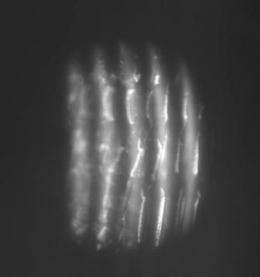
Two University of Arizona researchers have formed a research team to design, build and evaluate two versions of an ovarian cancer medical imaging and screening instrument that will use holographic components in a new type of optical microscope.
Raymond Kostuk and Jennifer Barton have secured a five-year, $2.4 million grant from the National Institutes of Health to build the instrument that they hope will one day be used to monitor women at high risk for ovarian cancer. Kostuk is the Kenneth Von Behren Professor of Electrical and Computer Engineering and professor of optical sciences. Barton heads the UA department of biomedical engineering and is assistant director of the BIO5 Institute.
The system is unique in that it will for the first time project multiple spatial images from different depths within a tissue sample and simultaneously provide spectral information from optical markers in order to better identify cancerous cells.
This combined spectral spatial imaging technique shows potential to be much more effective in identifying cancerous tissue sites than by separately using spatial or spectral information.
The grant was issued following the successful two-year development of a prototype system the team built. It tests the validity of using holographic technology for subsurface imaging without having to perform surgery and take tissue samples.
According to the National Institutes of Health, there is, to date, no single effective screening test for ovarian cancer, so ovarian cancer is rarely diagnosed in its early stages. The result is that in more than 50 percent of women with ovarian cancer are diagnosed in the late stages of the disease when the cancer has already advanced.
• About 76 percent percent of women with ovarian cancer survive one year after diagnosis.
• About 45 percent live longer than 5 years after diagnosis.
Barton said ovarian cancer provides a compelling case to test holographic imaging and its efficacy in detecting cancers. At the present time the preferred treatment is surgery, which is also often needed to diagnose ovarian cancer. The procedure includes taking tissue samples, which may threaten the woman's ability to have children in the future.
"Ovarian cancer has no symptoms until it is highly advanced making the five-year prognosis extremely poor. Those at high risk - with a family history of ovarian cancer or those who carry genetic mutations in the BRCA1 and BRCA2 genes, which normally help protect against both breast and ovarian cancer - may be counseled to have their ovaries removed through laparoscopic surgery," Barton said. "Now imagine if you are an 18-year-old woman who has this history - ovaries are an important part of your overall health. They produce hormones you need over and above the notion that you would need your ovaries should you want to have children in the future."
Thus, new technology capable of reliably diagnosing ovarian cancer in earlier stages could reduce the morbidity, high mortality and economic impact of this disease.
The system will work like a high-powered microscope that can be used to study tissue samples already removed. In addition, an endoscopic version is in the design stage to safely scan the ovaries for cancer during laparoscopic screenings in high-risk women, or as an adjunct to other laparoscopic procedures in all women.
The team will work with Dr. Kenneth D. Hatch, president of the Society of Pelvic Surgeons, and a professor of obstetrics and gynecology and director of female pelvic medicine and reconstructive surgery at the UA College of Medicine.
Through Hatch and a partnership with his patients who consent, Barton and Kostuk will be able to identify abnormal spatial and spectral markers of cancerous ovarian tissue.
The new imaging system will be tested on high-risk patients who are willing to participate and provide some future benefit to other patients who find themselves in a similar situation, Barton said.
Kostuk and Barton's aim is to design the imaging system so that it is easy to use, requiring very little training, and also be cost effective.
"The system will image like an MRI or a CT scan but with much higher resolution than an ultrasounic image and will be a lot less expensive than an MRI. As an additional benefit no radiation will be used or exposed to sensitive ovary areas during the cancer screenings," Kostuk said.
During the past 25 years Kostuk has researched different aspects of holography and holographic materials for use as optical elements.
The holographic imaging system being designed combines an optical technique that creates images capable of detecting subtle tissue microstructure changes. Together with fluorescence spectroscopy methods, the system has demonstrated capability for early cancer detection.
Another member of the team, UA research professor Marek Romanowski, with the UA department of biomedical engineering and the BIO5 Institute, is working on the development of targeted fluorescent dyes that will be used on tissue samples to identify or confirm suspected cancerous areas shown in the spatial image.
The multidisciplinary approach to the design of the hologram-based imaging system is a testament to the complexity of treating cancers.
"One of the advantages of being part of the UA is the ability to interact collaboratively with people in other disciplines," Kotuk said. "Jennifer is a wonderful colleague who can identify important medical applications for new techniques and is able to bridge the gap between traditional engineering and medicine. Her skill and knowledge is critical to the success of the program," he said.
"To solve the really interesting problems of today, no one person has all the expertise needed," Barton added.
Provided by University of Arizona (news : web)


