Traffic jam in brain causes schizophrenia symptoms
August 10, 2009
Traffic jam in brain causes schizophrenia symptoms

Enlarge

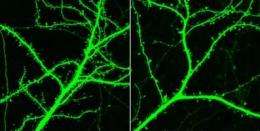
There are fewer pathways (green strands) for information to flow between neurons in the brain of a mouse bred to exhibit symptoms of schizophrenia compared to a normal mouse. Fewer pathways make it hard for information to flow between neurons and results in the symptoms of schizophrenia Credit: Peter Penzes, Northwestern University Feinberg School of Medicine

Schizophrenia waits silently until a seemingly normal child becomes a teenager or young adult. Then it swoops down and derails a young life.

Scientists have not understood what causes the severe mental disorder, which affects up to 1 percent of the population and results in hallucinations, memory loss and social withdrawal.

But new research from the Northwestern University Feinberg School of Medicine has revealed how schizophrenia works in the brain and provided a fresh opportunity for treatment. In a new, genetically engineered , scientists have discovered the disease symptoms are triggered by a low level of a brain protein necessary for neurons to talk to one another.

A Traffic Jam in Brain

In human and mouse brains, kalirin is the brain protein needed to build the dense network of highways, called dendritic spines, which allow information to flow from one neuron to another. Northwestern scientists have found that without adequate kalirin, the frontal cortex of the brain of a person with schizophrenia only has a few narrow roads. The information from neurons gets jammed up like rush hour traffic on an interstate highway squeezed to a single lane.

"Without enough pathways, the information takes much longer to travel between neurons and much of it will never arrive," said Peter Penzes, assistant professor of physiology at the Feinberg School. He is senior author of a paper reporting the findings published in a recent issue of the Proceedings of the National Academy of Science. Michael Cahill, a Feinberg doctoral student in neuroscience, is the lead author.

First Mouse Model to Develop Disease as a Teenager

Penzes discovered the kalirin effect after he created the mouse model, which was the first to have a low level of kalirin and the first to develop symptoms of schizophrenia as an adolescent (two months old in mouse time). This mimics the delayed onset of the disease in humans. In normal development, the brain ramps up the production of kalirin as it begins to mature in adolescence.

New Direction for Treatment

"This discovery opens a new direction for treating the devastating cognitive symptoms of schizophrenia," Penzes said. "There is currently no treatment for that. It suggests that if you can stimulate and amplify the activity of the protein kalirin that remains in the brain, perhaps we can help the symptoms."

Currently the only drug treatment for schizophrenia is an antipsychotic. "The drugs address the hallucinations and calm down the patient, but they don't improve their working memory (the ability of the brain to temporarily store and manage information required for complex mental tasks such as learning and reasoning) or their ability to think or their social behavior," Penzes said. "So you end up with patients who still can't integrate into society. Many attempt suicide."

Similarities Between Human and Mouse Brains

A few years ago in postmortem examinations of schizophrenic human brains, other scientists had found fewer connections between the brain cells in the frontal cortex and lower levels of kalirin. But the scientists couldn't show whether one condition led to the other.

With the new mouse model, Penzes was able to demonstrate that the low level of kalirin resulted in fewer dendritic spines in the of the brain, the part of the brain responsible for problem solving, planning and reasoning. Other areas of the brain had a normal number of the dendritic spines. Human brains and mouse brains share many similarities in the way they function, Penzes said.

The new schizophrenic mouse model also exhibits more schizophrenic symptoms than other models, making these mice especially good for drug testing and development, Penzes said. The mice with low amounts of kalirin had a poor working memory, were antisocial and hyperactive.

Penzes said future studies would aim at enhancing the function of kalirin in the in an effort to correct the cognitive symptoms of schizophrenia.

Source: Northwestern University (news : web)

4.8 /5 (9 votes)  

Filter


Move the slider to adjust rank threshold, so that you can hide some of the comments.


Display comments: newest first

NeilFarbstein
Aug 11, 2009

Rank: 1 / 5 (1)
when did you first have this delusion traffic jams are out to get you?
noahwilliamgray
Aug 11, 2009

Rank: not rated yet
The analogy of dendritic spines as "highways" is a little misleading. Obviously, the axons are the highways. Dendritic spines receive the information carried along the "highway." Another problem here is that there are many mental disorders which manifest morphologically as a disruption or loss of dendritic spines (Fragile-X, Trisomy-21, Rett Syndrome, etc...). All of these are very distinct from one another and schizophrenia. So the speculation as to the disruption of information flow is reasonable, but does not necessarily differentiate schizophrenia from any other disorder without additional knowledge.
Rank 4.8 /5 (9 votes)
Relevant PhysicsForums posts
  • Is Everyday Technology Killing Us?
    createdFeb 08, 2012
  • Exercise and weight loss
    createdFeb 08, 2012
  • Why do we have head aches? Our brains can't feel anything.
    createdFeb 07, 2012
  • "The end of diseases" by David Agus, interview from Daily Show with Jon Stewart
    createdFeb 04, 2012
  • Oncolytic adenovirus
    createdFeb 04, 2012
  • Nutrition label stuffs and diets
    createdFeb 02, 2012
  • More from Physics Forums - Medical Sciences

More news stories

Tenofovir, leading HIV medication, linked with risk of kidney damage

(Medical Xpress) -- Tenofovir, one of the most effective and commonly prescribed antiretroviral medications for HIV/AIDS, is associated with a significant risk of kidney damage and chronic kidney disease that increases over ...

Medicine & Health / Medications

created 43 minutes ago | popularity not rated yet | comments 0 | with audio podcast

New tumor suppressor gene identified

A recent study published in Clinical Cancer Research suggests that the protein hVps37A suppresses tumor growth in ovarian cancer. The work, which was funded by the Austrian Science Fund FWF, shows, for th ...

Medicine & Health / Cancer

created 13 minutes ago | popularity not rated yet | comments 0

Don't ignore kids' snores

(Medical Xpress) -- Your ears aren’t playing tricks on you – that is the sound of snoring you hear from the bedroom of your preschooler. Snoring is common in children, but in some cases it can be a symptom of a ...

Medicine & Health / Diseases

created 1 hour ago | popularity 5 / 5 (1) | comments 0

WHO calls for stepped-up fight against leprosy

The World Health Organization called Monday for greater efforts to fight leprosy, warning the disfiguring disease was defying efforts to wipe it out across many countries in the Asia-Pacific region.

Medicine & Health / Diseases

created 1 hour ago | popularity not rated yet | comments 0

Social psychologist: Lust makes you smarter and evidence that seven deadly sins are good for you

(Medical Xpress) -- Good news for lovers on Valentine’s Day - the seven deadly sins, including Lust, are good for you. University of Melbourne social psychologist Dr Simon Laham uses modern research to make a compelling ...

Medicine & Health / Psychology & Psychiatry

created 2 hours ago | popularity 4.5 / 5 (2) | comments 0


Researchers make better heat sensor based on butterfly wings

(PhysOrg.com) -- Scientists have long known that butterfly wings produce their iridescent colors by bouncing light around and between tiny ridges in structures made of chitin. More recently they’ve discovered ...

Manipulating genes with hidden TALENs

(PhysOrg.com) -- A better understanding of gene function in model plant and animal systems could be used to develop useful traits in livestock and crop plants, and might someday lead to developments in stem ...

Alien matter in the solar system: A galactic mismatch

This just in: The Solar System is different from the space just outside it.

Transforming galaxies

(PhysOrg.com) -- Many of the Universe's galaxies are like our own, displaying beautiful spiral arms wrapping around a bright nucleus. Examples in this stunning image, taken with the Wide Field Camera 3 on ...

'Smart' microcapsules in a single step

(PhysOrg.com) -- A new, single-step method of fabricating microcapsules, which have potential commercial applications in industries including medicine, agriculture and diagnostics, has been developed by researchers ...

China's pollution puts a dent in its economy

Although China has made substantial progress in cleaning up its air pollution,a new MIT study shows that the economic impact from ozone and particulates in its air has increased dramatically. ...