Physicians bust myths about insulin
August 11, 2009 Physicians bust myths about insulin

Enlarge

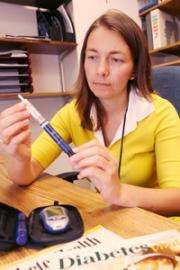
This is Dr. Ildiko Lingvay from UT Southwestern Medical Center. Credit: UT Southwestern Medical Center

People diagnosed with type 2 diabetes often resist taking insulin because they fear gaining weight, developing low blood sugar and seeing their quality of life decline.

A study recently completed at UT Southwestern Medical Center suggests that those fears are largely unfounded and that patients and physicians should consider as a front-line defense, as opposed to a treatment of last resort for non-insulin-dependent diabetes.

"We found that those patients who received insulin initially did just as well, if not better, than those who didn't receive insulin," said Dr. Ildiko Lingvay, assistant professor of internal medicine at UT Southwestern and lead author of the study appearing online and in a future issue of . "This reinforces the idea that insulin treatment is a viable and safe option for patients, even in the very initial stages of their diagnoses.

"There is a myth out in the community, especially among certain ethnicities, that insulin is the last resort, and that somebody started on insulin is going to die," Dr. Lingvay added. "We as physicians are responsible for teaching the patient that that's not the case."

More than 20 million Americans have . Obesity, age and lack of exercise all increase the risk for the disease, which is characterized by a progressive loss of insulin-producing beta cells. Diabetes is the single greatest independent risk factor for heart disease, as well as a contributor to a number of other medical problems, including blindness and kidney disease.

The standard initial treatment for type 2 diabetes is a single drug, often metformin, followed by the addition of more oral hypoglycemic agents as needed.

For this study, researchers evaluated the effectiveness of offering insulin-based therapy as an initial treatment option to newly diagnosed type 2 diabetes patients. They compared rates of compliance, satisfaction, effectiveness, safety and quality of life among the patients, who were randomized to receive either the standard triple oral therapy or insulin plus metformin, an oral drug that helps regulate blood sugar levels.

The patients, ranging in age from 21 to 70 years old, had been diagnosed with type 2 diabetes within the past two months. Researchers recruited study participants from Parkland Memorial Hospital or by self-referral to the Clinical Research Clinic at UT Southwestern between November 2003 and June 2005.

After enrollment, every participant followed an insulin and metformin regimen for three months. The patients were then randomized to continue taking insulin and metformin or begin the triple oral therapy regimen. All participants were checked monthly for the first four months, at six months after randomization, and every three months thereafter for three years. Of the 58 patients randomized, 24 of the insulin-treated group and 21 of the triple oral therapy group completed the study.

The researchers found that the patients taking insulin plus metformin had fewer low-blood-sugar, or hypoglycemic, events, gained less weight and reported high satisfaction with the insulin.

Dr. Lingvay said she hopes physicians use these findings as the rationale to offer insulin-metformin as the first, rather than last, line of defense.

"Modern medicine uses insulin as a very effective and safe treatment tool," she said. "With the new devices that we're using, giving yourself an insulin shot is not much harder than taking pills."

The data represent the first three years of a six-year study still under way at UT Southwestern. The next step, Dr. Lingvay said, is to begin analyzing how the insulin plus metformin and oral triple therapy regimens affect insulin production in .

Source: UT Southwestern Medical Center (news : web)


print this article email this article download pdf blog this article bookmark this article     Stumble it Digg this share on Facebook retweet share on Reddit add to delicious
Rate this story - not rated yet

Rank Filter

Move the slider to adjust rank threshold, so that you can hide some of the comments.


Display comments: newest first

  • mikehevans - Aug 11, 2009
    • Rank: not rated yet
    As an insulin user I have to say that nothing could be easier and more effective in treating the disease. I have been able to keep my blood sugars within the normal range, as well as my A1c. 15 years after my initial diagnosis I suffer from none of the deleterious effects of the disease. I have noticed, though, in talking with others who have been diagnosed with Type 2 Diabetes, that many are afraid of using insulin to control their blood sugar. I get the impression that they are convinced that it means they have failed in the treatment regimen, and fear criticism from their doctor or family. The handful of times I have suffered from low blood sugar since I began the treatment have been less of an inconvenience than a normal head cold and have made me more sensitive to my body's needs. Take the insulin, you won't regret it and you'll live longer.
  • PPihkala - Aug 11, 2009
    • Rank: not rated yet
    Yeah, keep taking insulin to keep insulin makers wealthy. I would suggest treating the underlying causes of diabetes 2 than to treat the symptoms with insulin. Diabetes is not caused by lack of insulin, but by resistance to it's effects. Search net for cures, do not accept eternal medication to be the only solution.
  • Jimster - Aug 12, 2009
    • Rank: not rated yet
    HA! Never ever, it seems, do these "studies" reveal which company is paying for the "research". I would wager $1000 vs. a donut that the funding outfit is a manufacturer/supplier of insulin. Why? Because the market for insulin is being threatened by superior meds (like GLP-1 analogues) that have demonstrated even neogenesis of pancreatic beta cells in Type 2 diabetics. Of course, type 1 diabetics will always need insulin but the use of insulin in newly diagnosed Type 2 diabetics only demonstrates that the GPs that prescribe it are too lazy to read the literature on incretin mimetics. Too sad for their patients.

August 11, 2009 all stories

Comments: 3

not rated yet
  • Stumble this up

  • Digg this

  • share this

  • hide
  • Related Stories

  • Weight loss more effective than intensive insulin therapy for type 2 diabetics
    created Mar 12, 2008 | popularity not rated yet | comments 0
  • Some patients may not need insulin for long-term control of type 2 diabetes
    created Jun 15, 2008 | popularity not rated yet | comments 0
  • FDA approves new diabetes treatment
    created Oct 17, 2006 | popularity not rated yet | comments 0
  • Insulin pill may mean end to daily shots
    created Jun 22, 2007 | popularity not rated yet | comments 0
  • Diabetes drug slows early-onset puberty in girls
    created Jun 16, 2008 | popularity not rated yet | comments 0


  • hide
  • Relevant PhysicsForums posts

  • Multiple Sclerosis & CCSVI
    created 14 hours ago
  • 23 Years in a Vegetative State....or not?
    created Nov 25, 2009
  • Has the H1N1 vaccine been scientifically proven to work?
    created Nov 24, 2009
  • nesfatin
    created Nov 22, 2009
  • Obsessive Compulsive Disorder
    created Nov 20, 2009
  • West's zone 2 starling resistor respiratory physiology
    created Nov 18, 2009
  • More from Physics Forums - Medical Sciences

Other News

Overeating can set stage for obesity, researchers say

Medicine & Health / Health

created 3 minutes ago | popularity not rated yet | comments 0

It doesn't seem like a fair fight. In one corner loomed the Thanksgiving table, groaning with poultry, pie and mashed potatoes.


New tools for prediction of disease progression in acute childhood leukemia

Medicine & Health / Cancer

created 1hour ago | popularity not rated yet | comments 0

(PhysOrg.com) -- Researchers at Uppsala University and University Children’s Hospital in Uppsala have devised powerful new tools for typing cells from children with acute lymphatic leukemia and for prediction of how children ...


Nuclear science to fight sleeping sickness

Medicine & Health / Diseases

created 3 hours ago | popularity not rated yet | comments 0

The International Atomic Energy Agency on Friday announced an agreement to help African nations battle the tsetse fly, the main carrier of parasites that causes sleeping sickness with its bites.


eye

Over-the-counter eye drops raise concern over antibiotic resistance

Medicine & Health / Medications

created 6 hours ago | popularity not rated yet | comments 0

(PhysOrg.com) -- The use of antibiotic eye drops for conjunctivitis has increased by almost half since they became available over the counter at chemists in 2005, data obtained by Oxford University researchers ...


A costly diagnosis: Alzheimer's disease takes toll on memories, and money too

Medicine & Health / Health

created 4 hours ago | popularity not rated yet | comments 0

Alzheimer's disease takes a devastating emotional toll on families but it also is one of the most expensive conditions to treat because of its progressive nature, requiring increasing assistance with eating, bathing and other ...