Physicists make crystal/liquid interface visible for first time
August 11, 2009 Physicists make crystal/liquid interface visible for first time

Enlarge

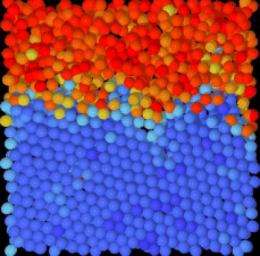
This is an image of what's actually happening in the fuzzy area of the crystal/liquid interface. Credit: Eric Weeks Lab/Emory University

"Imagine you're a water molecule in a glass of ice water, and you're floating right on the boundary of the ice and the water," proposes Emory University physicist Eric Weeks. "So how do you know if you're a solid or a liquid?"

Weeks' lab recently captured the first images of what's actually happening in this fuzzy area of the crystal/liquid interface. The lab's data, published this week in the (PNAS), make the waves between the two states of matter visible for the first time.

"The theory that surface waves move along the crystal/liquid boundary - the intrinsic interface - dates back to 1965 and is well established," says Weeks, associate professor of physics. "What we've done is found a way to take a picture of the intrinsic interface, measure it, and show how it fluctuates over time."

The visual evidence shows that the fuzzy region between the two states is extremely narrow, Weeks says. "The transition from completely organized to completely disorganized goes very quickly, spatially."

Modeling states of matter

Weeks' lab uses tiny plastic balls, each about the size of a , to model states of matter. Samples of these colloids can be fine-tuned into liquid or crystal states by changing the concentrations of the particles suspended in a solution.

" are too small too study while they are fluctuating," Weeks explains. "We used the plastic spheres to resize an experiment to a scale that we could observe. You lose some of the detail when you do this, but you hope it's not the critical detail."

The experiment took a great deal of trial and error, says Jessica Hernández-Guzmán, a graduate student in physics and the lead author of the PNAS article. "I was looking for that transition," she says. "I knew what the colloids looked like in a crystal state, and I knew what they looked like as a liquid, but I didn't know what they looked like in-between. When I finally saw (the transition), I felt like I had won the lottery."

The samples of plastic spheres were confined in wedge-shaped glass slides and loaded onto a confocal microscope turned sideways, so that gravity gradually changed the concentration gradient. Rapid, three-dimensional digital scans were made to record the Brownian motion of the particles over one hour. Algorithms were applied to the images to classify the degree of organization of each of the particles. The particles were then digitally colored: from dark blue for the most crystalline, to dark red for the most liquid. The series of images were stitched together and speeded up, becoming microscopy movies that reveal the action along the crystal/liquid interface.

'The zone of confusion'

"You can watch as the boundary fluctuates," Weeks says. "The yellow area along the bumpy line is liquid, but almost crystal. The light blue area is crystal, but almost liquid. The zone of confusion is less than two particles thick. By looking at the tiniest scale possible, we can see that the fuzzy region between the two areas is much smaller than we previously thought."

The research was funded by the National Science Foundation Faculty Early Career Development (CAREER) Program. Better understanding of the crystal/liquid interface could have industrial applications, such as investigating the use of colloidal crystals as optical switches, Weeks says.

Weeks is used to working in fuzzy territory. He has devoted most of his career to probing the mysteries of substances that cannot be pinned down as a solid, liquid or gas. Referred to as "soft condensed materials," they include everyday substances such as toothpaste, peanut butter, shaving cream, plastic and glass.

Source: Emory University (news : web)


Rate this story - 4.2 /5 (11 votes)

Rank Filter

Move the slider to adjust rank threshold, so that you can hide some of the comments.


Display comments: newest first

  • aroven - Aug 11, 2009
    • Rank: 4 / 5 (1)
    If I was a water molecule I wouldn't have the capacity for thought. Pathetic fallacy!
  • Sean_W - Aug 11, 2009
    • Rank: 3 / 5 (1)
    "Pathetic fallacy!"


    Or a simple figure of speech?
  • Sean_W - Aug 11, 2009
    • Rank: 2.5 / 5 (2)
    By the way, what does aether wave theory have to say about ice water?
  • mhouck - Aug 11, 2009
    • Rank: 1 / 5 (5)
    what a bunch of losers...use your brains, the earth is cooling because the greenhouse gases are melting the polar ice. It's like a glass of ice water, but once most all the ice is melted what will keep the glass/earth cool? Yea that's right NOTHING.
  • DGBEACH - Aug 11, 2009
    • Rank: 4.2 / 5 (5)
    what a bunch of losers...use your brains, the earth is cooling because the greenhouse gases are melting the polar ice. It's like a glass of ice water, but once most all the ice is melted what will keep the glass/earth cool? Yea that's right NOTHING.

    What will keep the earth cool; increased cloud cover due to the increase in evaporation of water at higher temperatures. Then as things cool down (because more sunlight is blocked by the clouds), the water falls back down as snow/rain...and the whole cycle starts over again...just like it did a couple of hundred thousand years ago...get with the program...millions of years worth of core-samples don't lie!
  • SincerelyTwo - Aug 11, 2009
    • Rank: 3.7 / 5 (3)
    mhouck; i suppose 'using your brain' doesn't matter much if your brain is shit to begin with.
  • googleplex - Aug 11, 2009
    • Rank: 5 / 5 (1)
    what a bunch of losers...use your brains, the earth is cooling because the greenhouse gases are melting the polar ice. It's like a glass of ice water, but once most all the ice is melted what will keep the glass/earth cool? Yea that's right NOTHING.


    What will keep the earth cool; increased cloud cover due to the increase in evaporation of water at higher temperatures. Then as things cool down (because more sunlight is blocked by the clouds), the water falls back down as snow/rain...and the whole cycle starts over again...just like it did a couple of hundred thousand years ago...get with the program...millions of years worth of core-samples don't lie!

    Except that there are different variables. Green house gases are being man made and at a rate that is magnitudes faster than the changes recorded in ice samples. So perhaps the damping effect of increased cloud formation responds very slowly. In which case the variations in temperature could be dramatically worse! Hopefully this hypothesis is wrong.
  • Alexa - Aug 11, 2009
    • Rank: 2 / 5 (4)
    what does aether wave theory have to say about ice water
    Well, for example, here's idea, inside of deeply frozen ice at the center of comets the water exists in supercooled state, in which it behaves like thick foamy polymer of nested water clusters. The complexity of this system would enable the evolution of primitive life forms, which would take many billions of years. On the other hand, there's lotta time for comets with compare to common planets.
  • poi - Aug 12, 2009
    • Rank: not rated yet
    I was tricked! I clicked the link, not reading the whole link first (since links are automatically cut by the admin - no offense meant to the admin.. peace... and this is just my sorry excuse since one can still read it from the status bar upon hovering) and i clicked it! I disown my being counted in the counter of that blog. Who the ____ cites a blog for reference or authority? Looks much like an account of the Farbs something guy.
  • Ricochet - Aug 12, 2009
    • Rank: not rated yet
    They have a video showing the interaction, and all we get is a still-frame? Common, physorg! You can do better than that!
  • Alexa - Aug 12, 2009
    • Rank: 3 / 5 (2)
    Anyway, I'd reccomend to visit lab pages, as they've many other vids and animations.

    http://www.physic...eks/lab/
  • Slotin - Aug 15, 2009
    • Rank: 3 / 5 (2)
  • Slotin - Aug 15, 2009
    • Rank: 3 / 5 (2)
    Miss Jessica is pretty, but the result is really valid for spherical particles without dipole momentum only. For polar molecules the surface layer becomes much more thicker.

August 11, 2009 all stories

Comments: 13

4.2 /5 (11 votes)

  • hide
  • Related Stories

  • Physicist opens new window on glass puzzle
    created Aug 09, 2007 | popularity not rated yet | comments 0
  • Colluding with colloids: Scientists make liquid crystal discovery
    created Dec 14, 2006 | popularity not rated yet | comments 0
  • Crystal to glass cooling model developed
    created Feb 22, 2006 | popularity not rated yet | comments 0
  • New type of liquid crystal identified; Holds promise of faster, lower priced liquid crystal displays
    created Jun 17, 2004 | popularity not rated yet | comments 0
  • Boomerang-shaped liquid crystals focus of new study
    created Jun 29, 2006 | popularity not rated yet | comments 0


  • hide
  • Relevant PhysicsForums posts

Other News

High-performance microring resonator developed by INRS researchers

Physics / Optics & Photonics

created 50 minutes ago | popularity not rated yet | comments 0

A new, more efficient low-cost microring resonator for high speed telecommunications systems has been developed and tested by Professor Roberto Morandotti's INRS team in collaboration with Canadian, American, and Australian ...


Extra large carbon

Extra large carbon

Physics / General Physics

created 2 hours ago | popularity 4.7 / 5 (6) | comments 0 | with audio podcast

An exotic form of carbon has been found to have an extra large nucleus, dwarfing even the nuclei of much heavier elements like copper and zinc, in experiments performed in a particle accelerator in Japan. ...


Leaf veins inspire a new model for distribution networks (w/ Video)

Physics / General Physics

created 5 hours ago | popularity 5 / 5 (2) | comments 0 | with audio podcast

(PhysOrg.com) -- Following the straight and narrow may be good moral advice, but it’s not a great design principle for a distribution network. In new research, a team of biophysicists describe a complex netting of interconnected ...


Scientist explore future of high-energy physics

Scientist explore future of high-energy physics

Physics / General Physics

created 8 hours ago | popularity 4.9 / 5 (10) | comments 4 | with audio podcast

In a 1954 speech to the American Physical Society, the University of Chicago's Enrico Fermi fancifully envisioned a particle accelerator that encircled the globe. Such would be the ultimate theoretical outcome, ...


New magnetic tuning method enhances data storage

New magnetic tuning method enhances data storage

Physics / General Physics

created 8 hours ago | popularity 4.3 / 5 (3) | comments 0 | with audio podcast

Researchers in Chicago and London have developed a method for controlling the properties of magnets that could be used to improve the storage capacity of next-generation computer hard drives.