Mysterious charge transport in self-assembled monolayer transistors unraveled
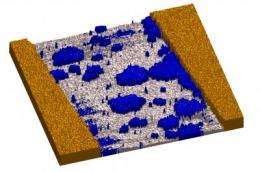
An international team of researchers from the Netherlands, Russia and Austria discovered that monolayer coverage and channel length set the mobility in self-assembled monolayer field-effect transistors (SAMFETs). This opens the door to extremely sensitive chemical sensors that can be produced in a cost-effective way. The research was done at Philips Research Eindhoven and Eindhoven University of Technology. The findings were published as an Advanced Online Publication in Nature Nanotechnology.
SAMFETs
The SAMFET is a recent example of the development of 'plastic micro-electronics'- i.e. electronics based on organic materials. Last year, Philips Research managed to build such a transistor by immersing a silicon substrate into solution containing liquid crystalline molecules that self-assemble onto this substrate, resulting in a semi-conductive layer of just a single molecule thick. The monolayer of the SAMFET consists of molecules that are standing upright. Conduction takes place by charges jumping from one molecule to the other.
However, in previous attempts to make a SAMFET, it was observed that as the length of the SAMFET increased, its level of conductivity counterintuitively decreased exponentially. In a joint project Philips Research, the Eindhoven University of Technology (TU/e), the University of Groningen, the Holst Centre, the Enikolopov Institute for Synthetical Polymer Materials in Moscow and the Technical University in Graz, Austria discovered that this decrease is determined by the monolayer coverage, which could be explained with a widely applicable two-dimensional percolation model.
The ultimate chemical sensor
One could compare this to crossing a river by jumping from rock to rock. The closer the rocks are to each other, the quicker one can jump or even walk to the other river bank. So if the monolayer displays more voids, the conductivity decreases dramatically. Up till now, this behavior was an uncharted area and inhibited the use of SAMFETs in applications such as sensors and plastic electronics. The SAMFET's extreme sensitivity could open doors to the development of the ultimate chemical sensor, the research team points out. "If we go back to that river again, another benefit of a SAMFET becomes clear", Martijn Kemerink, assistant professor at the TU/e indicates. "Imagine that there are just enough rocks to cross that river. When you remove just one rock, the effect is significant, for it is impossible to make it to the other side of the river. The SAMFET could be used to make sensors that give a large signal that is triggered by a small change", he continues.
Future steps
At present, SAMFETs are not widely used, for there are alternatives of which the production process is well-established. However, the production process of SAMFETs is extremely simple and material efficient. The transistor requires only a single layer of molecules that is applied by simple immersion into a chemical solution. The same solution can be used for many substrates, for the substrate only takes the necessary (small) amount of molecules. This makes future large-scale production of monolayer electronics efficient, simple and cost-effective.
More information: The publication "Monolayer coverage and channel length set the mobility in self-assembled monolayer field-effect transistors", by Matthijssen et al. can be found at www.nature.com/nnano/journal/v … /nnano.2009.201.html .
Source: Eindhoven University of Technology


