Multiple sclerosis successfully reversed in animals
August 11, 2009
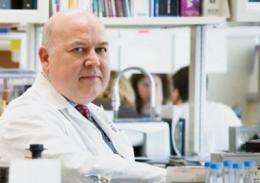
This is Dr. Jacques Galipeau of the Jewish General Hospital Lady Davis Institute for Medical Research and McGill University. Credit: Claudio Calligaries/McGill University
(PhysOrg.com) -- A new experimental treatment for multiple sclerosis (MS) completely reverses the devastating autoimmune disorder in mice, and might work exactly the same way in humans, say researchers at the Jewish General Hospital Lady Davis Institute for Medical Research and McGill University in Montreal.
MS is an autoimmune disease in which the body's own immune response attacks the central nervous system, almost as if the body had become allergic to itself, leading to progressive physical and cognitive disability.
The new treatment, appropriately named GIFT15, puts MS into remission by suppressing the immune response. This means it might also be effective against other autoimmune disorders like Crohn's disease, lupus and arthritis, the researchers said, and could theoretically also control immune responses in organ transplant patients. Moreover, unlike earlier immune-supppressing therapies which rely on chemical pharamaceuticals, this approach is a personalized form of cellular therapy which utilizes the body's own cells to suppress immunity in a much more targeted way.
GIFT15 was discovered by a team led by Dr. Jacques Galipeau of the JGH Lady Davis Institute and McGill's Faculty of Medicine. The results were published August 9 in the prestigious journal Nature Medicine.
GIFT15 is composed of two proteins, GSM-CSF and interleukin-15, fused together artificially in the lab. Under normal circumstances, the individual proteins usually act to stimulate the immune system, but in their fused form, the equation reverses itself.
"You know those mythical animals that have the head of an eagle and the body of a lion? They're called chimeras. In a lyrical sense, that's what we've created," said Galipeau, a world-renowned expert in cell regeneration affiliated with the Segal Cancer Centre at the Jewish General and McGill's Centre for Translational Research. "GIFT15 is a new protein hormone composed of two distinct proteins, and when they're stuck together they lead to a completely unexpected biological effect."
This effect, explained Galipeau, converts B-cells -- a common form of white blood cell normally involved in immune response -- into powerful immune-suppressive cells. Unlike their better-known cousins, T-cells, naturally-occurring immune-suppressing B-cells are almost unknown in nature and the notion of using them to control immunity is very new.
"GIFT15 can take your normal, run-of-the-mill B-cells and convert them -- in a Superman or Jekyll -Hyde sort of way -- into these super-powerful B-regulatory cells," Galipeau explained. "We can do that in a petri dish. We took normal B-cells from mice, and sprinkled GIFT15 on them, which led to this Jekyll and Hyde effect.
"And when we gave them back intravenously to mice ill with multiple sclerosis, the disease went away."
MS must be caught in its earliest stages, Galipeau cautioned, and clinical studies are needed to test the treatment's efficacy and safety in humans. No significant side-effects showed up in the mice, he said, and the treatment was fully effective with a single dose.
"It's easy to collect B-cells from a patient," he added. "It's just like donating blood. We purify them in the lab, treat them with GIFT15 in a petri dish, and give them back to the patient. That's what we did in mice, and that's what we believe we could do in people. It would be very easy to take the next step, it's just a question of finding the financial resources and partnerships to make this a reality."
-
Blocked signals to immune cells extend their life and contribute to progression of lupus
Feb 14, 2008 |
not rated yet |
0
-
Caffeine prevents multiple sclerosis-like disease in mice
Apr 07, 2008 |
not rated yet |
0
-
Stem cell transplant can grow new immune system in certain mice
Nov 22, 2007 |
not rated yet |
0
-
Interferon could be a key to preventing or treating multiple sclerosis
Oct 30, 2008 |
not rated yet |
0
-
Protection from the own immune system
Dec 01, 2008 |
not rated yet |
0
-
Engineers build first sub-10-nm carbon nanotube transistor
Feb 01, 2012 |
4.9 / 5 (29) |
30
-
Something old, something new: Evolution and the structural divergence of duplicate genes
Jan 31, 2012 |
4.6 / 5 (7) |
1
-
The hidden nanoworld of ice crystals: Revealing the dynamic behavior of quasi-liquid layers
Jan 30, 2012 |
5 / 5 (3) |
1
-
Stock market network reveals investor clustering
Jan 27, 2012 |
3.9 / 5 (23) |
8
-
Of microchemistry and molecules: Electronic microfluidic device synthesizes biocompatible probes
Jan 26, 2012 |
5 / 5 (1) |
0
-
Is Everyday Technology Killing Us?
14 hours ago
-
Exercise and weight loss
20 hours ago
-
Why do we have head aches? Our brains can't feel anything.
Feb 07, 2012
-
"The end of diseases" by David Agus, interview from Daily Show with Jon Stewart
Feb 04, 2012
-
Oncolytic adenovirus
Feb 04, 2012
-
Nutrition label stuffs and diets
Feb 02, 2012
- More from Physics Forums - Medical Sciences
More news stories
Scientists strengthen memory by stimulating key site in brain
Ever gone to the movies and forgotten where you parked the car? New UCLA research may one day help you improve your memory.
Medicine & Health / Neuroscience
6 hours ago |
5 / 5 (6) |
0
|
Short fasting cycles work as well as chemotherapy in mice
Man may not live by bread alone, but cancer in animals appears less resilient, judging by a study that found chemotherapy drugs work better when combined with cycles of short, severe fasting.
9 hours ago |
4.9 / 5 (11) |
2
|
Using the body's own immune system in the fight against cancer
DNA sequences from tumor cells can be used to direct the immune system to attack cancer, according to scientists at Washington University School of Medicine in St. Louis.
10 hours ago |
3 / 5 (2) |
1
|
'Explorers,' who embrace the uncertainty of choices, use specific part of cortex
Life shrouds most choices in mystery. Some people inch toward a comfortable enough spot and stick close to that rewarding status quo. Out to dinner, they order the usual. Others consider their options systematically ...
Medicine & Health / Neuroscience
11 hours ago |
4.3 / 5 (4) |
0
|
Scientists delve into the brain roots of hunger and eating
Synaptic plasticity the ability of the synaptic connections between the brain's neurons to change and modify over time -- has been shown to be a key to memory formation and the acquisition of new learning behaviors. ...
Medicine & Health / Neuroscience
11 hours ago |
5 / 5 (3) |
0
|
Astronomy team discovers nearby dwarf galaxy
(PhysOrg.com) -- A team led by UCLA research astronomer Michael Rich has used a unique telescope to discover a previously unknown companion to the nearby galaxy NGC 4449, which is some 12.5 million light years ...
Amasia: As next supercontinent forms, Arctic Ocean, Caribbean will vanish first
(PhysOrg.com) -- Geologists at Yale University have proposed a new theory to describe the formation of supercontinents, the epic process by which Earths major continental blocks combine into a single ...
Physicists build highly efficient 'no-waste' laser
A team of University of California, San Diego researchers has built the smallest room-temperature nanolaser to date, as well as an even more startling device: a highly efficient, "thresholdless" laser that ...
Why are there so few fish in the Earth's oceans?
(PhysOrg.com) -- A Stony Brook University researcher has found that, contrary to popular belief, there are not plenty of fish in the sea.
Transparent iron? For the first time, an experiment shows that atomic nuclei can become transparent
At the high-brilliance synchrotron light source PETRA III, a team of DESY scientists headed by Dr. Ralf Röhlsberger has succeeded in making atomic nuclei transparent with the help of X-ray light. At the ...
Study shows how DNA finds its match
It's been more than 50 years since James Watson and Francis Crick showed that DNA is a double helix of two strands that complement each other. But how does a short piece of DNA find its match, out of the millions ...
Aug 11, 2009
Rank: 3 / 5 (1)
http://www.thenat...916/1036
Aug 11, 2009
Rank: 4.4 / 5 (7)
Yes, for English speakers. The German meaning of "gift" is poison.
Aug 11, 2009
Rank: 5 / 5 (1)
Aug 11, 2009
Rank: 5 / 5 (1)
Aug 11, 2009
Rank: 4 / 5 (3)
You are both right. Chimera is the generic term for such mythological creatures. Gryphon is the specific term for the
eagle/lion combination.
Aug 12, 2009
Rank: 4 / 5 (1)
Aug 12, 2009
Rank: not rated yet
Aug 12, 2009
Rank: 1 / 5 (1)
It's a kind of manufactured AIDS, a lousy way to die!
Back to the drawing board...
Aug 12, 2009
Rank: not rated yet
I love advances in biology and chemistry with protien synthesis and us 'human' learning and naming everything we find but i guess i watched to many zombie movies as a kid and it scares the bejesus out of me to think we might one day accidentally introduce a material that kills us as a species 20 generations later, by accident.
----
PLEASE RESPOND TO THIS QUESTION IF YOU ARE KNOWLEGDABLE
I my old science courses we were told that women essentially were born with all the eggs they would produce in life already formed or staged ready for their bodies to develop and a hormone to push them out one at a time. Now after more courses I realize that no cell in the body lives for that long.... so is this true in some fashion?? or (hypothetical) if humans could stay in our twenties and thirties say 20 extra years could a woman still have eggs to reproduce??
i know the question is off topic but i figure people in biology would come to this article
Thanks in advance
Aug 12, 2009
Rank: 1 / 5 (1)
The term chimera has also come to mean, more generally, an impossible or foolish fantasy.
Maybe that is the best term?
Aug 12, 2009
Rank: 5 / 5 (1)
I think the immuno-suppression is only temporary while the disease is overcome. It does say no serious side-effects. A complete lack of immunities I would call a side-effect.
Aug 12, 2009
Rank: not rated yet
Perhaps the mice were not asked the right questions ..
tkjtkj@gmail.com
Aug 12, 2009
Rank: 5 / 5 (1)
Aug 12, 2009
Rank: not rated yet
Aug 12, 2009
Rank: not rated yet
Aug 12, 2009
Rank: not rated yet
Aug 18, 2009
Rank: not rated yet
http://en.wikiped..._therapy
-Restoring the symbiotes we evolved with (or less revolting facimiles)? Our overevolved immune systems are the inevitable result of overcrowding and living with our domesticated animals, which led to exposure to all manner of noxious infestation, and the bodys desperate attempts to compensate. Devolve the species by outsourcing the higher functions before it is too late!!