Pushing quantum mechanics to higher levels
August 11, 2009 Experiments at UCSB push quantum mechanics to higher levels

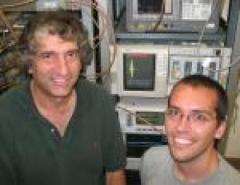
John Martinis and Matthew Neeley are researchers at University of California - Santa Barbara. Credit: George Foulsham, Office of Public Affairs, UCSB.

Scientists at UC Santa Barbara have devised a new type of superconducting circuit that behaves quantum mechanically -- but has up to five levels of energy instead of the usual two. The findings are published in the August 7 issue of Science.

These circuits act like in that they can only gain or lose energy in packets, or quanta, by jumping between discrete energy levels. "In our previous work, we focused on systems with just two energy levels, 'qubits,' because they are the quantum analog of 'bits,' which have two states, on and off," said Matthew Neeley, first author and a graduate student at UCSB.

He explained that in this work they operated a quantum circuit as a more complicated artificial atom with up to five energy levels. The generic term for such a system is "qudit," where 'd' refers to the number of energy levels -- in this case, 'd' equals five.

"This is the quantum analog of a switch that has several allowed positions, rather than just two," said Neeley. "Because it has more energy levels, the physics of a qudit is richer than for just a single qubit. This allows us to explore certain aspects of that go beyond what can be observed with a qubit."

Just as bits are used as the fundamental building blocks of computers, qubits could one day be used as building blocks of a quantum computer, a device that exploits the laws of quantum mechanics to perform certain computations faster than can be done with classical bits alone. "Qudits can be used in quantum computers as well, and there are even cases where qudits could be used to speed up certain operations with a quantum computer," said Neeley. "Most research to date has focused on qubit systems, but we hope our experimental demonstration will motivate more effort on qudits, as an addition to the processing toolbox."

Source: University of California - Santa Barbara (news : web)


print this article email this article download pdf blog this article bookmark this article     Stumble it Digg this share on Facebook retweet share on Reddit add to delicious
Rate this story - 3.8 /5 (8 votes)

Rank Filter

Move the slider to adjust rank threshold, so that you can hide some of the comments.


Display comments: newest first

  • Alexa - Aug 11, 2009
    • Rank: 1 / 5 (1)
    Or we can simulate the reality by real particles and we have quantum computer with billions of quantum states available. This is what the analogue computer is called.

August 11, 2009 all stories

Comments: 1

3.8 /5 (8 votes)
  • Stumble this up

  • Digg this

  • share this

  • hide
  • Related Stories

  • 2 qubits in action, new step towards the quantum computer
    created Jun 14, 2007 | popularity not rated yet | comments 0
  • Yale scientists bring quantum optics to a microchip
    created Sep 08, 2004 | popularity not rated yet | comments 0
  • Researchers make milestone discovery in quantum mechanics
    created Aug 05, 2008 | popularity not rated yet | comments 0
  • Scientists create first electronic quantum processor
    created Jun 28, 2009 | popularity not rated yet | comments 0
  • Quantum breakup is no heartbreaker
    created Feb 14, 2006 | popularity not rated yet | comments 0


Other News

Aquatic creatures mix ocean water

Physics / General Physics

created 1hour ago | popularity not rated yet | comments 0

Understanding mixing in the ocean is of fundamental importance to modeling climate change or predicting the effects of an El Niņo on our weather. Modern ocean models primarily incorporate the effects of winds and tides. However, ...


Nuclear weapons: Predicting the unthinkable

Physics / General Physics

created 4 hours ago | popularity 1 / 5 (1) | comments 0

If a nuclear weapon were detonated in a metropolitan area, how large would the affected area be? Where should first responders first go? According to physicist Fernando Grinstein, we have some initial understanding to address ...


Generating electricity from air flow

Physics / General Physics

created 4 hours ago | popularity 3.5 / 5 (4) | comments 1

A group of researchers at the City College of New York is developing a new way to generate power for planes and automobiles based on materials known as piezoelectrics, which convert the kinetic energy of motion into electricity. ...


Butterfly proboscis to sip cells

Physics / General Physics

created 2 hours ago | popularity not rated yet | comments 0

A butterfly's proboscis looks like a straw -- long, slender, and used for sipping -- but it works more like a paper towel, according to Konstantin Kornev of Clemson University. He hopes to borrow the tricks of this piece ...


Restored machine to explore mysteries of Big Bang (AP)

Restored machine to explore mysteries of Big Bang

Physics / General Physics

created Nov 21, 2009 | popularity 4.5 / 5 (16) | comments 14

(AP) -- Scientists are preparing the world's largest atom smasher to explore the depths of matter after successfully restarting the $10 billion machine following more than a year of repairs.