'Nanospears' could lead to better solar cells, lasers, lighting
August 11, 2009 'Nanospears' could lead to better solar cells, lasers, lighting

Enlarge

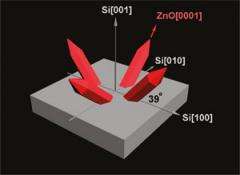
These red zinc oxide "nanospears" developed by Missouri S&T researchers grow on a surface of silicon. Illustration provided by Dr. Jay A. Switzer.

(PhysOrg.com) -- Growing - and precisely aligning - microscopic, spear-shaped zinc oxide crystals on a surface of single-crystal silicon, researchers at Missouri University of Science and Technology may have developed a method to make more efficient solar cells.

Dr. Jay A. Switzer and his colleagues at Missouri S&T report in the journal Chemistry of Materials that their simple, inexpensive process could also lead to new materials for ultraviolet lasers, solid-state lighting and piezoelectric devices.

"It's kind of like growing rock candy on a string," says Switzer, the Donald L. Castleman/Foundation for Chemical Research Professor of Discovery at Missouri S&T. But instead of using sugar water and string, Switzer's team grows the zinc oxide "nanospears" on the single-crystal placed in a beaker filled with an alkaline solution saturated with zinc ions. The process yields tilted, single-crystal, spear-shaped rods that grow out of the silicon surface, like tiny spikes.

The spears are about 100-200 nanometers in diameter - hundreds of times smaller than the width of a human hair - and about 1 micrometer in length. A nanometer - visible only with the aid of a high-power electron microscope - is one billionth of a meter, and some nanomaterials are only a few atoms in size.

The research is reported today (Tuesday, Aug. 11) in Chemistry of Materials' online ASAP ("as soon as publishable") section and will appear in an upcoming issue.

Zinc oxide is a semiconductor that possesses some unusual physical properties, Switzer says. The material both absorbs and emits light, so it could be used in to absorb sunshine as well as in lasers or solid-state lighting as an emitter of light.

Silicon is also a semiconductor, but it absorbs light at a different part of the spectrum than zinc oxide. By growing zinc oxide on top of the silicon, "you're putting two semiconductors on top of each other," thereby widening the spectrum from which a solar cell could draw light, Switzer says.

"You can absorb more light and possibly get more power out" with a zinc oxide-silicon solar cell, he says.

Previous efforts to grow zinc oxide on silicon have been limited to expensive ultra-high-vacuum methods, and because of silicon's high reactivity, it's been impossible to deposit the zinc oxide directly, without the use of a third material as a buffer. In addition, previous attempts to align the two materials epitaxially - or perfectly one on top of the other - have been unsuccessful until now. By tilting the nanospears 51 degrees, Switzer and his team have reduced the mismatch from 40 percent to just 0.2 percent, a near-perfect alignment.

Epitaxially aligning the and silicon is important to ensure higher efficiency, Switzer says.

More information: http://pubs.acs.org/doi/abs/10.1021/cm9010019

Provided by Missouri University of Science and Technology (news : web)


print this article email this article download pdf blog this article bookmark this article     Stumble it Digg this share on Facebook retweet share on Reddit add to delicious
Rate this story - 5 /5 (14 votes)

Rank Filter

Move the slider to adjust rank threshold, so that you can hide some of the comments.


Display comments: newest first

  • Mr_Frontier - Aug 12, 2009
    • Rank: 5 / 5 (1)
    They've created the ultimate back scratcher. I'm only speculating.
  • Ethelred - Aug 12, 2009
    • Rank: not rated yet
    Wow its the return of the SPAMMER. Yet again. Fourth time now. Back to single sentence posts. I guess that one two sentence post exhausted it.

    Go away, just go away.

    Words and lyrics by Blondie

    Ethelred

August 11, 2009 all stories

Comments: 2

5 /5 (14 votes)
  • Stumble this up

  • Digg this

  • share this

  • hide
  • Related Stories

  • Researchers think pink to produce 'green' solar energy
    created Jul 30, 2007 | popularity not rated yet | comments 0
  • Chemists measure copper levels in zinc oxide nanowires
    created Feb 19, 2008 | popularity not rated yet | comments 0
  • Zinc oxide gives green shine to new photoconductors
    created Mar 18, 2009 | popularity not rated yet | comments 0
  • Pigment formulated 225 years ago could be key in emerging technologies
    created Aug 02, 2006 | popularity not rated yet | comments 0
  • Method Safely Deposits Novel Metal Oxide Thin Films on Substrates
    created Sep 12, 2007 | popularity not rated yet | comments 0


  • hide
  • Relevant PhysicsForums posts

  • photoconductivity of polymers
    created 8 hours ago
  • Heat pipe for high temperature
    created 21 hours ago
  • Robot built out of acrylic
    created Nov 24, 2009
  • Thickness or Ga. of Stainless steel water tank?
    created Nov 24, 2009
  • More from Physics Forums - Materials & Chemical Engineering

Other News

Fast, easy, and highly sensitive arsenic detection with gold nanoparticles

Nanotechnology / Nanomaterials

created 15 hours ago | popularity 5 / 5 (1) | comments 0

(PhysOrg.com) -- Mention of arsenic poisoning usually brings to mind underhanded murder. However, the danger of arsenic poisoning from contaminated drinking water is far greater. Low concentrations of arsenic are found in ...


Water droplets direct self-assembly process in thin-film materials

Nanotechnology / Nanomaterials

created Nov 23, 2009 | popularity 5 / 5 (4) | comments 2

You can think of it as origami - very high-tech origami. Researchers at the University of Illinois have developed a technique for fabricating three-dimensional, single-crystalline silicon structures from thin films by coupling ...


Nanotube defects equal better energy and storage systems

Nanotube defects equal better energy and storage systems

Nanotechnology / Nanomaterials

created Nov 19, 2009 | popularity 4.4 / 5 (10) | comments 2

(PhysOrg.com) -- Most people would like to be able to charge their cell phones and other personal electronics quickly and not too often. A recent discovery made by UC San Diego engineers could lead to carbon ...


Nanotech in Space: Experiment To Weather the Trials of Orbit

Nanotech in Space: Experiment To Weather the Trials of Orbit

Nanotechnology / Nanomaterials

created Nov 24, 2009 | popularity 4 / 5 (2) | comments 0

Novel nanomaterials developed at Rensselaer were sent into orbit on Nov. 16 aboard Space Shuttle Atlantis.


Peptides control crystal growth with 'switches, throttles and brakes'

Peptides control crystal growth with 'switches, throttles and brakes'

Nanotechnology / Bio & Medicine

created Nov 23, 2009 | popularity 5 / 5 (3) | comments 0

(PhysOrg.com) -- By producing some of the highest resolution images of peptides attaching to mineral surfaces, scientists have a deeper understanding how biomolecules manipulate the growth crystals. This research ...