Discovery to aid study of biological structures, molecules
August 11, 2009 by Emil Venere
Discovery to aid study of biological structures, molecules

Enlarge

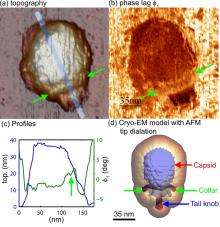
Researchers in the United States and Spain have discovered that an atomic force microscope - a tool widely used in nanoscale imaging - works differently in watery environments, a step toward better using the instrument to study biological molecules and structures. The researchers demonstrated their new understanding of how the instrument works in water to show details of the mechanical properties of a virus called Phi29. The images in "a" and "c" show the topography, and the image in "b" shows the different stiffness properties of the balloonlike head, stiff collar and hollow tail of the Phi29 virus, called a bacteriophage because it infects bacteria. (C. Carrasco-Pulido, P. J. de Pablo, J. Gomez-Herrero, Universidad Autonoma de Madrid, Spain)

(PhysOrg.com) -- Researchers in the United States and Spain have discovered that a tool widely used in nanoscale imaging works differently in watery environments, a step toward better using the instrument to study biological molecules and structures.

The researchers demonstrated their new understanding of how the instrument - the atomic force microscope - works in water to show detailed properties of a bacterial membrane and a virus called Phi29, said Arvind Raman, a Purdue professor of mechanical engineering.

"People using this kind of instrument to study biological structures need to know how it works in the natural watery environments of molecules and how to interpret images," he said.

An uses a tiny vibrating probe to yield information about materials and surfaces on the scale of , or billionths of a meter. Because the instrument enables scientists to "see" objects far smaller than possible using light microscopes, it could be ideal for studying molecules, cell membranes and other .

The best way to study such structures is in their wet, natural environments. However, the researchers have now discovered that in some respects the vibrating probe's tip behaves the opposite in water as it does in air, said Purdue mechanical engineering doctoral student John Melcher.

Purdue researchers collaborated with scientists at three institutions in Madrid, Spain: Universidad Autónoma de Madrid, Instituto de Ciencia de Materiales de Madrid and the Centro Nacional de Biotecnología.

Findings, which were detailed in a paper appearing online last week in the U.S. publication Proceedings of the National Academy of Sciences, are related to the subtle differences in how the instrument's probe vibrates. The probe is caused to oscillate by a vibrating source at its base. However, the tip of the probe oscillates slightly out of synch with the oscillations at the base. This difference in oscillation is referred to as a "phase contrast," and the tip is said to be out of phase with the base.

Although these differences in phase contrast reveal information about the composition of the material being studied, data can't be properly interpreted unless researchers understand precisely how the phase changes in water as well as in air, Raman said.

If the instrument is operating in air, the tip's phase lags slightly when interacting with a viscous material and advances slightly when scanning over a hard surface. Now researchers have learned the tip operates in the opposite manner when used in water: it lags while passing over a hard object and advances when scanning the gelatinous surface of a biological membrane.

Researchers deposited the membrane and viruses on a sheet of mica. Tests showed the differing properties of the inner and outer sides of the membrane and details about the latticelike protein structure of the membrane. Findings also showed the different properties of the balloonlike head, stiff collar and hollow tail of the Phi29 virus, called a bacteriophage because it infects bacteria.

"The findings suggest that phase contrast in liquids can be used to reveal rapidly the intrinsic variations in local stiffness with molecular resolution, for example, by showing that the head and the collar of an individual virus particle have different stiffness," Raman said.

Provided by Purdue University (news : web)

4.3 /5 (3 votes)  

Rank 4.3 /5 (3 votes)
Related Stories
Relevant PhysicsForums posts
  • Protease cleavage
    created6 hours ago
  • Pertubance in a model
    created12 hours ago
  • Cancer drugs and Alzheimer's, Oh my!
    created20 hours ago
  • Squishing cells
    created21 hours ago
  • Any books/articles for evolutionary stable strategy models in humans?
    createdFeb 09, 2012
  • Science behind the bore feeling?
    createdFeb 09, 2012
  • More from Physics Forums - Biology

More news stories

What lies beneath: Mapping hidden nanostructures

The ability to diagnose and predict the properties of materials is vital, particularly in the expanding field of nanotechnology. Electron and atom-probe microscopy can categorize atoms in thin sheets of material, ...

Nanotechnology / Nanophysics

created 10 hours ago | popularity 5 / 5 (1) | comments 1

New kind of solar cell could capture significantly more energy than current cells

New solar cells could increase the maximum efficiency of solar panels by over 25%, according to scientists from the University of Cambridge.

Nanotechnology / Nanophysics

created Feb 08, 2012 | popularity 4.5 / 5 (12) | comments 14 | with audio podcast

'Dark plasmons' transmit energy

Microscopic channels of gold nanoparticles have the ability to transmit electromagnetic energy that starts as light and propagates via "dark plasmons," according to researchers at Rice University.

Nanotechnology / Nanophysics

created Feb 09, 2012 | popularity 5 / 5 (6) | comments 1 | with audio podcast

Nanoshell whispering galleries improve thin solar panels

Visitors to Statuary Hall in the U.S. Capitol Building may have experienced a curious acoustic feature that allows a person to whisper softly at one side of the cavernous, half-domed room and for another on ...

Nanotechnology / Nanomaterials

created Feb 07, 2012 | popularity 4.3 / 5 (6) | comments 6 | with audio podcast

Revealing how a battery material works

Since its discovery 15 years ago, lithium iron phosphate (LiFePO4) has become one of the most promising materials for rechargeable batteries because of its stability, durability, safety and ability to deliver ...

Nanotechnology / Nanomaterials

created Feb 08, 2012 | popularity 5 / 5 (5) | comments 0 | with audio podcast


Google users warned of threat to smartphone wallets

Users of Google smartphone wallets were being warned on Friday that there is a way to crack pass codes intended to thwart thieves from going on illicit shopping sprees.

Anonymous knocks CIA website offline (Update)

The website of the Central Intelligence Agency was inaccessible on Friday after the hacker group Anonymous claimed to have knocked it offline.

Complex wiring of the nervous system may rely on a just a handful of genes and proteins

Researchers at the Salk Institute have discovered a startling feature of early brain development that helps to explain how complex neuron wiring patterns are programmed using just a handful of critical genes. ...

New error-correcting codes guarantee the fastest possible rate of data transmission

Error-correcting codes are one of the triumphs of the digital age. They’re a way of encoding information so that it can be transmitted across a communication channel — such as an optical fiber o ...

Putting the squeeze on planets outside our solar system

(PhysOrg.com) -- Using high-powered lasers, scientists at Lawrence Livermore National Laboratory and collaborators discovered that molten magnesium silicate undergoes a phase change in the liquid state, abruptly ...

The power of estrogen -- male snakes attract other males

A new study has shown that boosting the estrogen levels of male garter snakes causes them to secrete the same pheromones that females use to attract suitors, and turned the males into just about the sexiest ...