Magnetic microbe genome attracting attention for biotech research
August 11, 2009 Magnetic microbe genome attracting attention for biotech research

Enlarge

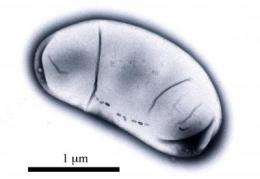
This is a transmission electron micrograph of magnetotactic bacterium, Desulfovibrio magneticus strain RS-1, showing a chain of bullet-shaped magnetosomes aligned along the Earth's magnetic field. Credit: Image courtesy of Tadashi Matsunaga (Tokyo University of Agriculture and Technology).

The smallest organisms to use a biological compass are magnetotactic bacteria, however mysteries remain about exactly how these bacteria create their cellular magnets. In a study published online in Genome Research, scientists have used genome sequencing to unlock new secrets about these magnetic microbes that could accelerate biotechnology and nanotechnology research.

Oxygen is essential for human life, but it is corrosive and poisonous to many . Magnetotactic bacteria evolved a clever method of using the Earth's to orient itself and swim downward - exactly the direction a microbe must move to locate low oxygen areas in lakes and oceans. To find the direction of the magnetic field, these bacteria synthesize nanoscale cellular structures called magnetosomes that contain crystals of naturally occurring magnetic minerals.

The shape and composition of magnetosomes are species- and strain-specific, suggesting that magnetosome synthesis is biologically controlled. Magnetosomes are currently difficult to harvest in large quantities or synthesize artificially, therefore deciphering how cells form magnetosomes is crucial if they are to be useful in new technologies.

Genetic analyses have been performed in closely related magnetotactic bacteria, but because magnetosomes are also found in other classes of bacteria, scientists do not yet have a clear picture of the genetic components necessary for magnetosome formation. Tadashi Matsunaga of the Tokyo University of Agriculture and Technology and colleagues recognized that by analyzing the of more distantly related magnetotactic bacteria, researchers may be able to clearly define the minimal gene set needed for magnetosome synthesis.

In this work, Matsunaga's group sequenced the genome of Desulfovibrio magneticus strain RS-1, a more distant relative of other magnetotactic bacteria previously studied, and is also known for the unique bullet-shape of its magnetosomes. "Understanding the genes that control the morphology of these magnetosomes would be a significant breakthrough," said Matsunaga, noting that RS-1 could be the key to opening up new applications for magnetosomes.

Comparing the RS-1 genome sequence to the genomes of other magnetotactic bacteria, the team determined that all magnetotactic bacteria contain three separate gene regions related to magnetosome synthesis. Surprisingly, they also found that magnetosome-related genes are very well conserved across different classes of bacteria. Matsunaga explained that this suggests that the core magentosome genes may have been established in these bacteria by several horizontal gene transfer events, rather than being passed down through a lineage.

In addition to illuminating core magnetosome genes, the group expects that their work on RS-1 will be a stepping-stone to manipulation of magnetosomes for new technologies. Matsunaga said that further research with RS-1 "could open doors to the synthesis of morphologically controlled magnetosomes, and provide opportunities to their applications in electromagnetic tapes, drug delivery, magnetic resonance imaging, and cell separation."

More information: Nakazawa H, Arakaki A, Narita-Yamada S, Yashiro I, Jinno K, Aoki N, Tsuruyama A, Okamura Y, Tanikawa S, Fujita N, Takeyama H, Matsunaga T. Whole genome sequence of Desulfovibrio magneticus strain RS-1 revealed common gene clusters in magnetotactic bacteria. Genome Res doi:10.1101/gr.088906.108

Source: Cold Spring Harbor Laboratory (news : web)


print this article email this article download pdf blog this article bookmark this article     Stumble it Digg this share on Facebook retweet share on Reddit add to delicious
Rate this story - 5 /5 (2 votes)


August 11, 2009 all stories

Comments: 0

5 /5 (2 votes)
  • Stumble this up

  • Digg this

  • share this

  • hide
  • Related Stories

  • Tiny magnetic crystals in bacteria are a compass, say researchers
    created Dec 17, 2008 | popularity not rated yet | comments 0
  • Bacteria which sense the Earth's magnetic field
    created Nov 21, 2005 | popularity not rated yet | comments 0
  • Bacterium found to have strange magnetic personality
    created Feb 17, 2006 | popularity not rated yet | comments 0
  • Magnetic Misfits: South Seeking Bacteria in the Northern Hemisphere
    created Jan 20, 2006 | popularity not rated yet | comments 0
  • Gene that magnetically labels cells shows potential as imaging tool
    created Jun 03, 2008 | popularity not rated yet | comments 0


  • hide
  • Relevant PhysicsForums posts

  • Selenocysteine in pH=7
    created 8 hours ago
  • What is the formula for calculating the speed of thought?
    created 13 hours ago
  • What does word "absorption" mean in the intestine?
    created 13 hours ago
  • What is transpulmonary pressure?
    created Nov 24, 2009
  • More from Physics Forums - Biology

Other News

First-ever blueprint of a minimal cell is more complex than expected

First-ever blueprint of a minimal cell is more complex than expected

Biology / Cell & Microbiology

created 5 hours ago | popularity 5 / 5 (8) | comments 0

What are the bare essentials of life, the indispensable ingredients required to produce a cell that can survive on its own? Can we describe the molecular anatomy of a cell, and understand how an entire organism ...


Ecological speciation by sexual selection on good genes: Is speciation adaptive?

Biology / Ecology

created 5 hours ago | popularity not rated yet | comments 0

Darwin suggested that the action of natural selection can produce new species, but 150 years after the publication of his famous book, 'On the Origin of Species', debate still continues on the mechanisms of speciation. New ...


The six elephants in Sierra Leone were shot and "crudely butchered"

S.Leone elephants 'wiped out' by poachers: official

Biology / Ecology

created 7 hours ago | popularity 5 / 5 (3) | comments 3

Poachers "wiped out" the entire elephant herd in Sierra Leone's only wildlife park, wildlife managers said Thursday after police said they had arrested a gang of 10 poachers.


Knockouts in human cells point to pathogenic targets

Knockouts in human cells point to pathogenic targets

Biology / Cell & Microbiology

created 8 hours ago | popularity not rated yet | comments 0

(PhysOrg.com) -- Whitehead researchers have developed a new approach for genetics in human cells and used this technique to identify specific genes and proteins required for pathogens.


Whiteflies sabotage alarm system of plant in distress

Whiteflies sabotage alarm system of plant in distress

Biology / Plants & Animals

created 9 hours ago | popularity 5 / 5 (1) | comments 0

(PhysOrg.com) -- When spider mites attack a bean plant, the plant responds by producing odours which attract predatory mites. These predatory mites then exterminate the spider mite population, thus acting ...