Human mind: Sound and vision wired through same 'black box'
August 12, 2009 Human mind: Sound and vision wired through same 'black box'

Enlarge

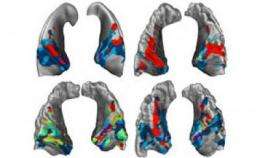
Participants were recruited to undergo functional magnetic resonance imaging, a non-invasive form of brain mapping used to determine how the brain recognizes different characteristics in musical instruments Credit: Marc Schönwiesner, Université de Montréal

Sounds and images share a similar neural code in the human brain, according to a new Canadian study. In the online edition of the Proceedings of the National Academy of Sciences (PNAS), scientists from the Université de Montréal and the Montreal Neurological Institute at McGill University explain how the same neural code in the brain allows people to distinguish between different types of sounds, such as speech and music, or different images.

Participants were recruited to undergo functional magnetic resonance imaging (FMRI), a non-invasive form of mapping used to determine how the brain recognizes different characteristics in musical instruments, words from conversations or environmental sounds. Subjects underwent an exhaustive three hours of FMRI exams to provide precise information about how the brain reacts when different sounds are played.

"It turns out that the brain uses the same strategy to encode sounds than it uses to encode different images," explains lead author Marc Schönwiesner, a Université de Montréal psychology professor. "This may make it easier for people to combine sounds and images that belong to the same object, such as the dribbling of a basketball."

The next step for the researchers is to determine exactly how the brain distinguishes between rock drum beats to the strings of a symphony or from a French conversation to an English one. "Our goal is to disentangle exactly how the brain extracts these different types of sounds. This is a step may eventually let us reconstruct a song that a person has heard from according to the activity pattern in their brain," explains Dr. Schönwiesner, who is also a member of the International Laboratory for Brain, Music and Research (BRAMS), a joint Université de Montréal and McGill University think-tank on music and the mind.

As scientists advance in decoding brain activation patterns, says Dr. Schönwiesner, mind-boggling applications can be envisaged. "If researchers can reconstruct a song a person has heard according to an fMRI reading, we're not far off to being able to record brain patterns during sleep and reconstruct dreams," he predicts. "That would be really cool, although this possibility is decades of research away."

Source: University of Montreal (news : web)


print this article email this article download pdf blog this article bookmark this article     Stumble it Digg this share on Facebook retweet share on Reddit add to delicious
Rate this story - 3.8 /5 (4 votes)

Rank Filter

Move the slider to adjust rank threshold, so that you can hide some of the comments.


Display comments: newest first

  • gmurphy - Aug 12, 2009
    • Rank: 5 / 5 (1)
    could do with more detail
  • zevkirsh - Aug 12, 2009
    • Rank: 5 / 5 (1)
    article says NOTHING.
  • Graeme - Aug 12, 2009
    • Rank: 5 / 5 (1)
    Are they talking about location of the sound? The article gives no idea.
  • GaryB - Aug 12, 2009
    • Rank: not rated yet
    Just to chime in:
    "same neural code" used for sound and images. And that neural code is??

August 12, 2009 all stories

Comments: 4

3.8 /5 (4 votes)
  • Stumble this up

  • Digg this

  • share this

  • hide
  • Related Stories

  • Researchers produce 'neural fingerprint' of speech recognition
    created Nov 10, 2008 | popularity not rated yet | comments 0
  • Study finds autistics better at problem-solving
    created Jun 16, 2009 | popularity not rated yet | comments 0
  • Scientists discover gene responsible for brain's aging
    created Jan 16, 2009 | popularity not rated yet | comments 0
  • Can mental training games help prevent Alzheimer's?
    created Mar 10, 2009 | popularity not rated yet | comments 0
  • Researchers identify new protein that triggers breast cancer
    created Jan 14, 2009 | popularity not rated yet | comments 0


  • hide
  • Relevant PhysicsForums posts

  • Obsessive Compulsive Disorder
    created Nov 20, 2009
  • West's zone 2 starling resistor respiratory physiology
    created Nov 18, 2009
  • 50-0-50 rule
    created Nov 18, 2009
  • What is the evidence in support of the anti-vaccine movement?
    created Nov 17, 2009
  • More from Physics Forums - Medical Sciences

Other News

Swine flu vaccine effective despite mutations: experts

Medicine & Health / Diseases

created 16 hours ago | popularity 1 / 5 (1) | comments 1

Swine flu vaccines are still effective despite reported cases of mutations in the A(H1N1) virus, health experts in Europe and North America said Saturday.


Study raises concerns about outdoor second-hand smoke

Medicine & Health / Health

created Nov 18, 2009 | popularity 2 / 5 (4) | comments 21

Indoor smoking bans have forced smokers at bars and restaurants onto outdoor patios, but a new University of Georgia study in collaboration with the Centers for Disease Control and Prevention suggests that these outdoor smoking ...


smoking, cigarette

Vaccine being developed to help smokers quit

Medicine & Health / Medications

created Nov 20, 2009 | popularity 4.5 / 5 (11) | comments 10

(PhysOrg.com) -- Glaxo-SmithKline has joined forces with Nabi Pharmaceuticals to produce a vaccine to help smokers give up their addiction permanently.


Pilot study relates phthalate exposure to less-masculine play by boys

Medicine & Health / Research

created Nov 16, 2009 | popularity 4.8 / 5 (9) | comments 9

A study of 145 preschool children reports, for the first time, that when the concentrations of two common phthalates in mothers' prenatal urine are elevated their sons are less likely to play with male-typical toys and games, ...


wine

Alcohol helps lower heart disease risk for men: study

Medicine & Health / Health

created Nov 19, 2009 | popularity 4.2 / 5 (6) | comments 7

Men who drink alcohol every day see a nearly one-third average reduction in the risk of coronary heart disease, according to a long-term study among Spanish men published on Thursday.