The mind's eye scans like a spotlight
August 12, 2009 The mind's eye scans like a spotlight

Enlarge

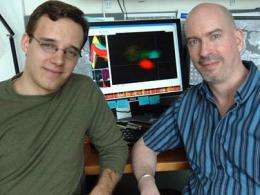
Picower Institute postdoctoral associate Timothy J. Buschman, left, and Picower Professor of Neuroscience Earl Miller. Photo / Donna Coveney

(PhysOrg.com) -- You're meeting a friend in a crowded cafeteria. Do your eyes scan the room like a roving spotlight, moving from face to face, or do you take in the whole scene, hoping that your friend's face will pop out at you? And what, for that matter, determines how fast you can scan the room?

Researchers at MIT's Picower Institute for and Memory say you are more likely to scan the room, jumping from face to face as you search for your friend. In addition, the timing of these jumps appears to be determined by waves of activity in the brain that act as a clock. The study, which appears in the Aug. 13 issue of the journal Neuron, sheds new light on a long-standing debate among neuroscientists over how the visual system picks out an object of interest in a complex scene.

In the study, monkeys were given the task of searching for one particular tilted, colored bar among a field of bars on a computer screen. By monitoring the activity of in three of the animals' brain regions, researchers found that the monkeys spontaneously shifted their attention in a sequence, like a moving spotlight that jumped from location to location.

What's more, the study showed that brain waves act as a kind of built-in clock that provides a framework for shifting attention from one location to the next. The work could have implications for understanding or treating attention deficit disorder or even potentially speeding up the rate of cognition in the brain.

"For many years, neuroscientists have been debating competing theories on whether humans and animals spontaneously search elements of a visual scene in a serial or parallel manner," said lead author Earl K. Miller, the Picower Professor of . "Ours is the first study based on direct evidence of neurophysiological activity."

Like clockwork

Activity in the brain comes and goes in waves, cycling between high and low activity states. Researchers have been recording brain waves for more than 100 years and although they think they play roles in working , decision-making and communication among brain regions, no one is sure of their exact role in brain function. This work suggests a new role for brain waves — one in which they are directly involved in the brain's processing.

Picower Institute postdoctoral associate and co-author Timothy J. Buschman found that the spotlight of the mind's eye shifted focus at 25 times a second and that this process of switching was regulated by brain waves. "This is one of the first examples of how brain waves play a specific role in computations," Buschman said.

"Attention regulates the flood of sensory information pouring into the brain into a manageable stream. In particular, a lot of different areas of the brain are involved in vision. If they all competed at once, it would be chaos," Miller said. "Brain waves may provide the clock that tells the brain when to shift its attention from one stimulus to another. Oscillating brain waves may provide a way for several regions across the brain to be on the same page at the same time — very similar to the way computers use an internal clock to synchronize the many different components inside."

The researchers' next step is to expand their search for brain wave function beyond the visual. They hope to discover whether brain waves are specific to visual function or act as a "general clock" for the brain.

The researchers have found that in the experiment with the , the speed at which the animals searched was related to the speed of their brain waves. When the clock ticked faster, the animals "thought" faster. This implies that it may be possible to change the speed of cognition if researchers can learn to artificially manipulate . In separate studies outside MIT, researchers are looking at the correlation between the brain waves' "clock speed" in humans and the speed at which subjects shift attention from one task to another.

Source: Massachusetts Institute of Technology (news : web)


print this article email this article download pdf blog this article bookmark this article     Stumble it Digg this share on Facebook retweet share on Reddit add to delicious
Rate this story - 4.3 /5 (3 votes)

Rank Filter

Move the slider to adjust rank threshold, so that you can hide some of the comments.


Display comments: newest first

  • CSharpner - Aug 12, 2009
    • Rank: 4 / 5 (1)
    Seems like they might be confusing cause and effect. As a software architect, this sounds an awfully lot like a programming loop that iterates. The loop isn't controlled by a clock, but since it's doing repetitive sequences, that by definition, take the same amount of time to run, to an outsider, it might look like the timing is the controlling factor, when in fact, the completion of each cycle triggers the next cycle (or wave). The timing of the loop is not planned and is not a controlling process, but just a side effect.

    Seems to me that the same is going on in the brain. I would imaging that if you interfered with the "timing", you'd disrupt the processes taking place.
  • gmurphy - Aug 12, 2009
    • Rank: not rated yet
    interesting point, I'm also a programmer but the cyclic process described here seem more similar to a clock cycle in a circuit, where each cycle is used to process the contents of the various logic gates
  • zevkirsh - Aug 12, 2009
    • Rank: not rated yet
    perhaps there is a feedback loop between attention, fight/flight response, and other stimuli-responses and the 'internal' network timing of neurons responsible for perception and memory as might explain the phenomeno of 'time slowing to a crawl' during a fight or a certain moment of trauma, or even a certain moment of sheer beauty. there would seem to be an underlying mechanism by which to explain the sensation of time slowing down during certain type of categorical experiences.
  • Caliban - Aug 12, 2009
    • Rank: not rated yet
    I think you are all getting at something important here- it seems that the brain's processing speed pretty much has to be related to the urgency assigned a particular task, which could be triggered by more than one sensory or cognitive input. Can we get there in first gear, or do we need overdrive?
    @Zevkirsh- it would be very interesting to look into just what it is that makes experiences that are apparently unrelated such as extreme fear, happiness, aesthetic bliss, et c- all produce this state of ultra hi-res attention- and why this is not typically the case with everyday information processing.

August 12, 2009 all stories

Comments: 4

4.3 /5 (3 votes)
  • Stumble this up

  • Digg this

  • share this

  • hide
  • Related Stories

  • Neuroscientists find different brain regions fuel attention
    created Mar 30, 2007 | popularity not rated yet | comments 0
  • For the first time, patterns of excitation waves found in brain's visual processing center
    created Jul 31, 2007 | popularity not rated yet | comments 0
  • Research explains how the brain finds Waldo
    created May 27, 2005 | popularity not rated yet | comments 0
  • Study: Meditators 'surprisingly' alert
    created Jul 06, 2007 | popularity not rated yet | comments 0
  • Long-distance brain waves focus attention (w/Video)
    created May 28, 2009 | popularity not rated yet | comments 0


  • hide
  • Relevant PhysicsForums posts

  • Obsessive Compulsive Disorder
    created Nov 20, 2009
  • West's zone 2 starling resistor respiratory physiology
    created Nov 18, 2009
  • 50-0-50 rule
    created Nov 18, 2009
  • What is the evidence in support of the anti-vaccine movement?
    created Nov 17, 2009
  • Chemical Burns
    created Nov 16, 2009
  • How to prevent another stroke?
    created Nov 11, 2009
  • More from Physics Forums - Medical Sciences

Other News

Swine flu vaccine effective despite mutations: experts

Medicine & Health / Diseases

created 11 hours ago | popularity 1 / 5 (1) | comments 1

Swine flu vaccines are still effective despite reported cases of mutations in the A(H1N1) virus, health experts in Europe and North America said Saturday.


Study raises concerns about outdoor second-hand smoke

Medicine & Health / Health

created Nov 18, 2009 | popularity 2 / 5 (4) | comments 21

Indoor smoking bans have forced smokers at bars and restaurants onto outdoor patios, but a new University of Georgia study in collaboration with the Centers for Disease Control and Prevention suggests that these outdoor smoking ...


smoking, cigarette

Vaccine being developed to help smokers quit

Medicine & Health / Medications

created Nov 20, 2009 | popularity 4.5 / 5 (11) | comments 10

(PhysOrg.com) -- Glaxo-SmithKline has joined forces with Nabi Pharmaceuticals to produce a vaccine to help smokers give up their addiction permanently.


Pilot study relates phthalate exposure to less-masculine play by boys

Medicine & Health / Research

created Nov 16, 2009 | popularity 4.8 / 5 (9) | comments 9

A study of 145 preschool children reports, for the first time, that when the concentrations of two common phthalates in mothers' prenatal urine are elevated their sons are less likely to play with male-typical toys and games, ...


wine

Alcohol helps lower heart disease risk for men: study

Medicine & Health / Health

created Nov 19, 2009 | popularity 4.2 / 5 (6) | comments 7

Men who drink alcohol every day see a nearly one-third average reduction in the risk of coronary heart disease, according to a long-term study among Spanish men published on Thursday.