Scientists deploy seismic network for study of Sierra Negra, Galapagos
August 12, 2009 Hiking, horses and helicopter: Scientists deploy seismic network for study of Sierra Negra, Galapagos

Enlarge

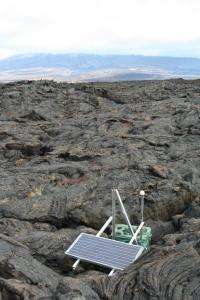
An interdisciplinary team of scientists from the University of Miami, University of Rochester, University of Idaho-Moscow and the Instituto Geofísico, Escuela Politécnica Nacional (Quito, Ecuador) joined forces to study one the world’s most active volcanoes, Sierra Negra in the Galápagos. Each site includes a seismometer, battery and solar panel, and electronics to continuously record ground vibrations from local and distant earthquakes. The broadband seismometers were provided by the PASSCAL instrument center and will record data for the next three years. Credit: Falk Amelung, University of Miami

An interdisciplinary team of scientists from the University of Miami (UM), University of Rochester, University of Idaho-Moscow and the Instituto Geofísico, Escuela Politécnica Nacional (Quito, Ecuador) have joined forces to study one the world's most active volcanoes, Sierra Negra in the Galápagos. The volcano's last eruption occurred in 2005, deepening its 8 km (~5 mile) wide caldera by 4 - 5 meters (~13 - 16 feet). The previous eruption in 1979 produced more than 1 km3 (~0.7 miles3) of lava and was one of the largest eruptions of the 20th century.

The team consists of Dr. Falk Amelung, associate professor of Marine Geology and Geophysics at UM's Rosenstiel School of Marine and Atmospheric Science; seismologists Dr. Cindy Ebinger of the University of Rochester and Dr. Mario Ruiz of the Instituto Geofísico, Escuela Politécnica Nacional de Quito; volcanologist Dr. Dennis Geist of the University of Idaho (Moscow); science teacher Lisa Hjelm from The Girls' Middle School in Mountain View, California; Escuela Politécnica Nacional undergraduate geology student Daniel Pacheco; and Program for Array Seismic Studies of the Continental Lithosphere (PASSCAL) engineer Eliana Arias-Dotson.

They returned from an adventure that lasted nearly three weeks, which included hiking, riding horses and navigating dangerous waters to deploy an experimental of 16 stations around Isla Isabela, Galápagos. The broadband seismometers provided by the PASSCAL instrument center will record data for the next three years.
Hiking, horses and helicopter: Scientists deploy seismic network for study of Sierra Negra, Galapagos
Enlarge

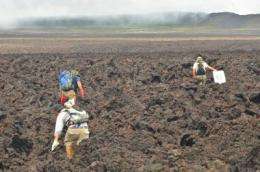
Funded through an NSF grant, an interdisciplinary team of scientists from the University of Miami, University of Rochester, University of Idaho and the Instituto Geofísico, Escuela Politécnica Nacional in Quito, Ecuador have joined forces to study one the world’s most active volcanoes, Sierra Negra in the Galápagos. Photo shows part of the team traveling to the caldera (L-R) Dr. Mario Ruiz and his student Daniel Pacheco from the Instituto Geofísico, Escuela Politécnica Nacional (Quito, Ecuador) and Dr. Dennis Geist of the University of Idaho (Moscow). Credit: Falk Amelung, University of Miami

"With the satellite data we regularly collect here at the University of Miami, using a technique called satellite radar interferometry, we are able to see the underground location of the magma chamber. The new seismic data will allow us to corroborate our information and obtain proof that the magma chamber is actually 2 km. (~1.2 miles) down and to what depth it extends," said Amelung. "Petrologists suggest that the chamber may extend to a depth of 10 km. (~6.2 miles), whereas geophysicists believe it might go only to a depth of 3 km. (1.8 miles) or so." These new seismic data will be analyzed to provide the first 3-D pictures of the volcanic plumbing system, completing the picture derived from satellite and rock studies.

The team conducted eight dry and wet landings from a boat, placing sites along the coastline. The Galápagos-based Charles Darwin Foundation and Parque Nacional de Galápagos, both celebrating their 50th anniversary in 2009, assisted in providing horses and other support to transport equipment to more remote regions of Isla Isabela. However, the most challenging deployment took place in the center of the caldera, where scientists had to hike over miles of sharp, jagged igneous rock from the last lava flow. Geist arranged for a helicopter to fly the heavy equipment to a central drop site so they could navigate the unforgiving terrain, which tore into their hiking boots and required heavy duty work gloves to traverse.

Once set up, each site included a seismometer that had to be precisely leveled, a battery and solar panel, and electronics to continuously record ground vibrations from local and distant earthquakes. A number of the sensitive instruments were buried, but in areas where hard volcanic rock was present, the stations were left above ground and protected by rocks and other natural features.

The integrated seismic-geodetic study of the active magmatic processes at Sierra Negra was funded by the National Science Foundation (NSF). An additional NSF grant was awarded to Hjelm for education and outreach. Her intent is to use data from this study to create a visualization of the interior of the volcano as an educational product for teens.

Source: University of Miami Rosenstiel School of Marine & Atmospheric Science


print this article email this article download pdf blog this article bookmark this article     Stumble it Digg this share on Facebook retweet share on Reddit add to delicious
Rate this story - 2 /5 (1 vote)


August 12, 2009 all stories

Comments: 0

2 /5 (1 vote)
  • Stumble this up

  • Digg this

  • share this

  • hide
  • Related Stories

  • Tracking a hot spot
    created May 17, 2007 | popularity not rated yet | comments 0
  • Slow slip and slide dynamics
    created Mar 05, 2008 | popularity not rated yet | comments 0
  • Crystals improve understanding of volcanic eruption triggers
    created Aug 28, 2008 | popularity not rated yet | comments 0
  • Wireless system to monitor volcanoes
    created Sep 23, 2004 | popularity not rated yet | comments 0
  • Volcanic eruption signals simulated in lab for first time
    created Oct 10, 2008 | popularity not rated yet | comments 0


  • hide
  • Relevant PhysicsForums posts

  • The IPCC and the term "most"
    created Nov 23, 2009
  • Is global warming a fact?
    created Nov 23, 2009
  • Random variability of wind patterns
    created Nov 23, 2009
  • Record precipitation in the UK
    created Nov 22, 2009
  • How to move cloud from one time to another..
    created Nov 22, 2009
  • Which countries around the world cause the most destruction to the rain forest
    created Nov 21, 2009
  • More from Physics Forums - Earth

Other News

Cassini Captures Ghostly Dance of Saturn's Northern Lights

Cassini Captures Ghostly Dance of Saturn's Northern Lights (w/ Video)

Space & Earth / Space Exploration

created 6 hours ago | popularity 5 / 5 (3) | comments 0

(PhysOrg.com) -- In the first video showing the auroras above the northern latitudes of Saturn, Cassini has spotted the tallest known "northern lights" in the solar system, flickering in shape and brightness ...


First black holes may have incubated in giant, starlike cocoons, says CU-Boulder study

First black holes may have incubated in giant, starlike cocoons

Space & Earth / Astronomy

created 9 hours ago | popularity 4.7 / 5 (9) | comments 7

(PhysOrg.com) -- The first large black holes in the universe likely formed and grew deep inside gigantic, starlike cocoons that smothered their powerful x-ray radiation and prevented surrounding gases from ...


ET: Check your voicemail

ET: Check your voicemail

Space & Earth / Space Exploration

created 6 hours ago | popularity 3.4 / 5 (5) | comments 4

(PhysOrg.com) -- Alien beings on faraway planets may not have noticed, but it’s been 35 years since human beings made the first deliberate effort to send them a message.


The drying shores of the Dead Sea

Dead Sea needs world help to stay alive

Space & Earth / Environment

created 8 hours ago | popularity 3.7 / 5 (3) | comments 0

The Dead Sea may soon shrink to a lifeless pond as Middle East political strife blocks vital measures needed to halt the decay of the world's lowest and saltiest body of water, experts say.


From Greenhouse to Icehouse

From Greenhouse to Icehouse

Space & Earth / Earth Sciences

created 15 hours ago | popularity 4.8 / 5 (8) | comments 7

A new study that reconstructed ocean temperatures from millions of years ago could provide new insight into how the Earth responds to climate change.