Satellite data explains vanishing India groundwater
August 12, 2009 Satellite data explains vanishing India groundwater

Enlarge

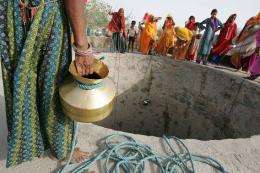
(PhysOrg.com) -- Using satellite data, UC Irvine and NASA hydrologists have found that groundwater beneath northern India has been receding by as much as 1 foot per year over the past decade - and they believe human consumption is almost entirely to blame.

More than 109 cubic kilometers (26 cubic miles) of groundwater disappeared from the region's aquifers between 2002 and 2008 - double the capacity of India's largest surface-water reservoir, the Upper Wainganga, and triple that of Lake Mead, the largest manmade reservoir in the U.S.

People are pumping northern India's underground water, mostly to irrigate cropland, faster than natural processes can replenish it, said Jay Famiglietti and Isabella Velicogna, UCI Earth system scientists, and Matt Rodell of NASA's Goddard Space Flight Center.

"If measures are not soon taken to ensure sustainable groundwater usage, consequences for the 114 million residents of the region may include a collapse of agricultural output, severe shortages of potable water, conflict and suffering," said Rodell, lead author of the study and former doctoral student of Famiglietti's at the University of Texas at Austin.

Study results will be published online Aug. 12 in the journal Nature.

Groundwater comes from the percolation of precipitation and other surface waters down through Earth's soil and rock, accumulating in aquifers - cavities and layers of porous rock, gravel, sand or clay. In some subterranean reservoirs, the water may be thousands to millions of years old; in others, water levels decline and rise again naturally each year.

Groundwater levels do not respond to changes in weather as rapidly as lakes, streams and do. So when groundwater is pumped for irrigation or other uses, restoration of original levels can take months or years.

"Groundwater mining - that is when withdrawals exceed replenishment rates - is a rapidly growing problem in many of the world's large aquifers," Famiglietti said. "Since groundwater provides nearly 80 percent of the water required for irrigated agriculture, diminishing groundwater reserves pose a serious threat to global food security."

Data provided by India's Ministry of Water Resources had suggested that groundwater use across the nation was exceeding natural replenishment, but the regional rate of depletion had been unknown.

In the new study, the hydrologists analyzed six years of monthly data for northern India from twin satellites called GRACE - NASA's Gravity Recovery and Climate Experiment - to produce a chronology of underground changes.

GRACE detects differences in gravity brought about by fluctuations in water mass, including water below the Earth's surface. As the satellites orbit 300 miles above Earth, their positions change - relative to each other - in response to variations in the pull of gravity. They fly about 137 miles apart, and microwave ranging systems measure every microscopic variance in the distance between the two.

"With GRACE, we can monitor water storage changes everywhere in the world from our desk," said Velicogna, also with NASA's Jet Propulsion Laboratory. "The satellites allow us to observe how water storage evolves from one month to the next in critical areas of the world."

Groundwater loss in northern is particularly alarming because there were no unusual trends in rainfall - in fact, it was slightly above normal during the study period. The researchers also examined data on soil moisture, lake and surface reservoir storage, vegetation and glaciers in the nearby Himalayas to confirm that the apparent groundwater trend was real. The only influence they couldn't rule out was human.

"For the first time, we can observe use on land with no additional ground-based data collection," Famiglietti said. "This is critical because in many developing countries, where hydrological data are both sparse and hard to access, space-based methods provide perhaps the only opportunity to assess changes in freshwater availability across large regions."

Source: University of California - Irvine


print this article email this article download pdf blog this article bookmark this article     Stumble it Digg this share on Facebook retweet share on Reddit add to delicious
Rate this story - 4.5 /5 (11 votes)

Rank Filter

Move the slider to adjust rank threshold, so that you can hide some of the comments.


Display comments: newest first

  • Mesafina - Aug 13, 2009
    • Rank: not rated yet
    India is going to encounter many serious problems in the not so distant future, and this is one of their big ones. I just returned from India last year and can say that overpopulation there is getting very bad. They have a higher population density even then China at the moment, and a faster population growth still.

    One of my main concerns is that India and China will butt heads in the future... they've already done so in the past once or twice. Dwindling resources in India could be a catalyst for instability or even national aggression.
  • Velanarris - Aug 13, 2009
    • Rank: not rated yet
    This is a crisis that will extend beyond India very quickly. We need to get our collective heads our of our rear ends and finish working on the freshwater problems the world faces.

August 12, 2009 all stories

Comments: 2

4.5 /5 (11 votes)
  • Stumble this up

  • Digg this

  • share this

  • hide
  • Related Stories

  • NASA Outlines Recent Changes in Earth's Freshwater Distribution
    created Dec 13, 2006 | popularity not rated yet | comments 0
  • Climate change goes underground
    created Aug 22, 2007 | popularity not rated yet | comments 0
  • Unseen Colorado Mountain Aquifers Throw Water on 'Teflon Basin' Myth
    created May 30, 2005 | popularity not rated yet | comments 0
  • Greenland ice sheet still losing mass
    created Sep 20, 2006 | popularity not rated yet | comments 0
  • Water table depth tied to droughts in Great Plains
    created Oct 01, 2008 | popularity not rated yet | comments 0


  • hide
  • Relevant PhysicsForums posts

  • The IPCC and the term "most"
    created Nov 23, 2009
  • Is global warming a fact?
    created Nov 23, 2009
  • Random variability of wind patterns
    created Nov 23, 2009
  • Record precipitation in the UK
    created Nov 22, 2009
  • How to move cloud from one time to another..
    created Nov 22, 2009
  • Which countries around the world cause the most destruction to the rain forest
    created Nov 21, 2009
  • More from Physics Forums - Earth

Other News

Cosmic 'dig' reveals vestiges of the Milky Way's building blocks

Cosmic 'Dig' Reveals Vestiges of the Milky Way's Building Blocks

Space & Earth / Astronomy

created 9 hours ago | popularity 4.9 / 5 (12) | comments 1

(PhysOrg.com) -- Peering through the thick dust clouds of our galaxy's "bulge" (the myriads of stars surrounding its center), a team of astronomers has unveiled an unusual mix of stars in the stellar grouping ...


No Wheel Stall in Diagnostic Drive

Spirit Mars Rover: No Wheel Stall in Diagnostic Drive

Space & Earth / Space Exploration

created 4 hours ago | popularity 5 / 5 (1) | comments 0

(PhysOrg.com) -- On Sol 2095 (Tuesday, Nov. 24), Spirit performed a set of diagnostic actions related to a stall of the right-rear wheel on the previous drive, three days earlier.


Monster Waves on the Sun are Real

Monster Waves on the Sun are Real (w/ Video)

Space & Earth / Astronomy

created 4 hours ago | popularity 5 / 5 (8) | comments 0

Sometimes you really can believe your eyes. That's what NASA's STEREO (Solar Terrestrial Relations Observatory) spacecraft are telling researchers about a controversial phenomenon on the sun known as the "solar ...


Oceanic crust formation is dynamic after all

Oceanic crust formation is dynamic after all

Space & Earth / Earth Sciences

created 8 hours ago | popularity 4.3 / 5 (3) | comments 0

Imagine the Earth's crust as the planet's skin: Some areas are old and wrinkled while others have a fresher, more youthful sheen, as if they had been regularly lathered with lotion.


Climate experts debate strategies for reducing atmospheric carbon and future warming

Climate experts debate strategies for reducing atmospheric carbon and future warming

Space & Earth / Environment

created 5 hours ago | popularity 3 / 5 (4) | comments 4

(PhysOrg.com) -- Reducing carbon dioxide to safe levels may require extracting carbon from the air, says Cornell climate researcher.