Highlight: Mechanical energy dissipation in ultrananocrystalline diamond microresonators
August 12, 2009
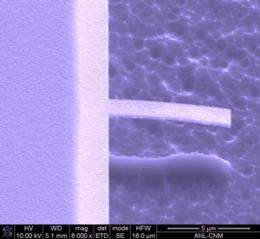
SEM micrograph of fabricated UNCD microresonator
Researchers in the Nanofabrication and Devices group at the Argonne National Laboratory, in collaboration with the University of Pennsylvania, Advanced Diamond Technologies Inc., and Innovative Micro Technology, have discovered that defects at the grain boundary in ultrananocrystalline diamond (UNCD) hold primary responsibility for the fundamental mechanism of energy dissipation.
Because of a high Young's modulus and high sound propagation velocity, UNCD materials hold potential for fabricating high-frequency microelectromechanical (MEMS) resonators.
However, their mechanical dissipation at high frequency, which is important for developing high-frequency resonator applications, is not well understood. Dissipation in UNCD cantilevers was determined by using ring-down measurement under ultrahigh-vacuum conditions, and the quality factor measured in the range of 5000-16000 at kHz resonance frequencies.
These studies reveal that dissipation in UNCD films is mainly due to the presence of defects such as nondiamond-carbon bonding at grain boundaries.
More information: V. P. Adiga, A. V. Sumant, S. Suresh, C, Gudeman, O. Auciello, J. A. Carlisle, R. W. Carpick, "Mechanical stiffness and dissipation in ultrananocrystalline diamond microresonators," Phys. Rev. B, 79, 245403 (2009)
-
Diamond technology to revolutionize mobile communications
Aug 07, 2006 |
not rated yet |
0
-
Ultrananocrystalline-diamond coating improves mechanical pump seals
Oct 07, 2008 |
not rated yet |
0
-
Argonne researchers create new diamond-nanotube composite material
Aug 30, 2005 |
not rated yet |
0
-
Diamonds are a Scientist's best Friend: Research into Building Better Small Machines
Jul 14, 2005 |
not rated yet |
0
-
Tough new probe developed for nanotechnologists
Aug 10, 2005 |
not rated yet |
0
-
Engineers build first sub-10-nm carbon nanotube transistor
Feb 01, 2012 |
4.9 / 5 (31) |
30
-
Something old, something new: Evolution and the structural divergence of duplicate genes
Jan 31, 2012 |
4.6 / 5 (7) |
1
-
The hidden nanoworld of ice crystals: Revealing the dynamic behavior of quasi-liquid layers
Jan 30, 2012 |
5 / 5 (3) |
1
-
Stock market network reveals investor clustering
Jan 27, 2012 |
3.9 / 5 (23) |
8
-
Of microchemistry and molecules: Electronic microfluidic device synthesizes biocompatible probes
Jan 26, 2012 |
5 / 5 (1) |
0
-
Weight required to balance a boom stand?
1 hour ago
-
Questions about Equivalence principle & Einstein Elevator?
2 hours ago
-
Kinetic energy of gas
4 hours ago
-
Understanding induced emfs
6 hours ago
-
What is the precise definition of a year?
7 hours ago
-
Universe as a cellular automaton
8 hours ago
- More from Physics Forums - General Physics
More news stories
New kind of solar cell could capture significantly more energy than current cells
New solar cells could increase the maximum efficiency of solar panels by over 25%, according to scientists from the University of Cambridge.
Feb 08, 2012 |
4.5 / 5 (12) |
14
|
Nanoshell whispering galleries improve thin solar panels
Visitors to Statuary Hall in the U.S. Capitol Building may have experienced a curious acoustic feature that allows a person to whisper softly at one side of the cavernous, half-domed room and for another on ...
Nanotechnology / Nanomaterials
Feb 07, 2012 |
4.3 / 5 (6) |
6
|
'Dark plasmons' transmit energy
Microscopic channels of gold nanoparticles have the ability to transmit electromagnetic energy that starts as light and propagates via "dark plasmons," according to researchers at Rice University.
Feb 09, 2012 |
4.8 / 5 (9) |
1
|
Revealing how a battery material works
Since its discovery 15 years ago, lithium iron phosphate (LiFePO4) has become one of the most promising materials for rechargeable batteries because of its stability, durability, safety and ability to deliver ...
Nanotechnology / Nanomaterials
Feb 08, 2012 |
5 / 5 (5) |
0
|
Nanotube therapy takes aim at breast cancer stem cells
Wake Forest Baptist Medical Center researchers have again proven that injecting multiwalled carbon nanotubes (MWCNTs) into tumors and heating them with a quick, 30-second laser treatment can kill them.
Nanotechnology / Bio & Medicine
Feb 09, 2012 |
5 / 5 (1) |
0
|
Walney offshore wind farm is world's biggest (for now)
(PhysOrg.com) -- The Walney wind farm on the Irish Sea--characterized by high tides, waves and windy weather--officially opened this week. The farm is treated in the press as a very big deal as the Walney ...
GPS court ruling leaves US phone tracking unclear
A US Supreme Court decision requiring a warrant to place a GPS device on the car of a criminal suspect leaves unresolved the bigger issue of police tracking using mobile phones, legal experts say.
Europeans protest controversial Internet pact
Tens of thousands of people marched in protests in more than a dozen European cities Saturday against a controversial anti-online piracy pact that critics say could curtail Internet freedom.
Europe stakes billion-dollar bet on new rocket
A pencil-slim rocket is scheduled to lift into space from South America on Monday, carrying a billion-dollar bet that Europe can grab a juicy slice of the market to place satellites in low orbit.
Study finds that anti-diabetic medication can prevent the long-term effects of maternal obesity
In a study to be presented today at the Society for Maternal-Fetal Medicine's annual meeting, The Pregnancy Meeting, in Dallas, Texas, researchers will report findings that show that short therapy with the anti-diabetic medication ...
Netflix settlement trims 14 pct off 4Q earnings
(AP) -- Netflix pressed the rewind button on its fourth-quarter earnings after settling allegations that the video subscription service violated a consumer-privacy law.