Huge new planet tells of game of planetary billiards
August 12, 2009
Huge new planet tells of game of planetary billiards

Enlarge

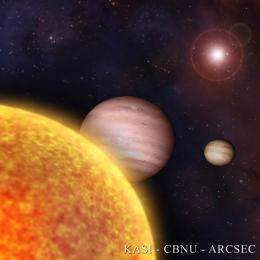
Artist's impression of two close extra-solar planets. Credit: KASI/CBNU/ARCSEC.

(PhysOrg.com) -- A team of scientists has found a new planet which orbits the wrong way around its host star. The planet, named WASP-17, and orbiting a star 1000 light years away, was found by the UK's WASP project in collaboration with Geneva Observatory. The discovery, which casts new light on how planetary systems form and evolve, is being announced today (12th August) in a paper submitted to Astrophysical Journal.

Since form out of the same swirling that creates a star, they are expected to orbit in the same direction that the star spins. Graduate students David Anderson, of Keele University, and Amaury Triaud, of Geneva Observatory, were surprised to find that WASP-17 is orbiting the wrong way, making it the first planet known to have a "retrograde" orbit. The likely explanation is that WASP-17 was involved in a near collision with another planet early in its history.

WASP-17 appears to have been the victim of a game of planetary billiards, flung into its unusual orbit by a close encounter with a "big brother" planet. Professor Coel Hellier, of Keele University, remarks: "Shakespeare said that two planets could no more occupy the same orbit than two kings could rule England; WASP-17 shows that he was right.”

David Anderson added “Newly formed solar systems can be violent places. Our own moon is thought to have been created when a Mars-sized planet collided with the recently formed Earth and threw up a cloud of debris that turned into the moon. A near collision during the early, violent stage of this planetary system could well have caused a gravitational slingshot, flinging WASP-17 into its backwards orbit.”

The first sign that WASP-17 was unusual was its large size. Though it is only half the mass of it is bloated to nearly twice Jupiter's size, making it the largest planet known.

Astronomers have long wondered why some extra-solar planets are far bigger than expected, and WASP-17 points to the explanation. Scattered into a highly elliptical, retrograde orbit, it would have been subjected to intense tides. Tidal compression and stretching would have heated the gas-giant planet to its current, hugely bloated extent. "This planet is only as dense as expanded polystyrene, seventy times less dense than the planet we're standing on", notes Prof. Hellier.

Professor Keith Mason, Chief Executive of the Science and Technology Facilities Council, which funded the research, said, “This is a fascinating new find and another triumph for the WASP team. Not only are they locating these far flung and mysterious planets but revealing more about how planetary systems, such as our own Solar System, formed and evolved. The WASP team has proved once again why this project is currently the World's most successful project searching for transiting exoplanets.”

WASP-17 is the 17th new exoplanet (planet outside our ) found by the Wide Area Search for Planets (WASP) consortium of UK universities. The WASP team detected the planet using an array of cameras that monitor hundreds of thousands of stars, searching for small dips in their light when a planet transits in front of them. Geneva Observatory then measured the mass of WASP-17, showing that it was the right mass to be a planet. The WASP-South camera array that led to the discovery of WASP-17 is hosted by the South African Astronomical Observatory.

More information: http://arxiv.org/abs/0908.1553

Provided by Science and Technology Facilities Council (news : web)

4.7 /5 (9 votes)  

Filter


Move the slider to adjust rank threshold, so that you can hide some of the comments.


Display comments: newest first

Nik_2213
Aug 13, 2009

Rank: not rated yet
Um, will it also be heated by hyper-velocity impacts as it continues to 'clear the orbit' ? 'Late Heavy Bombardment', writ larger ??
Rank 4.7 /5 (9 votes)
Related Stories
Relevant PhysicsForums posts
  • Never ending outer space.....
    createdFeb 11, 2012
  • Neutron Star fragments?
    createdFeb 11, 2012
  • stationary or not?
    createdFeb 11, 2012
  • Scale of the Universe
    createdFeb 10, 2012
  • Titan's lack of impact craters
    createdFeb 09, 2012
  • Real pictures of black hole eating a star?
    createdFeb 08, 2012
  • More from Physics Forums - General Astronomy

More news stories

With climate change, today's '100-year floods' may happen every three to 20 years: research

Last August, Hurricane Irene spun through the Caribbean and parts of the eastern United States, leaving widespread wreckage in its wake. The Category 3 storm whipped up water levels, generating storm surges ...

Space & Earth / Environment

created 4 minutes ago | popularity not rated yet | comments 0 | with audio podcast

New European rocket lifts off on maiden flight

A new lightweight rocket, Vega, lifted off from Europe's space base Monday carrying nine satellites on its inaugural flight, mission control said.

Space & Earth / Space Exploration

created 1 hour ago | popularity 5 / 5 (3) | comments 1

Climate change causes harmful algal blooms in North Atlantic: study

Warming oceans and increases in windiness could be causing of an abundance of harmful algal blooms in the North Atlantic Ocean and North Sea, according to new research.

Space & Earth / Environment

created 2 hours ago | popularity not rated yet | comments 0

Salvage workers begin pumping fuel from Italian shipwreck

Salvage workers Sunday began pumping fuel from the shipwrecked Italian cruise liner Costa Concordia, a day ahead of schedule, officials said.

Space & Earth / Environment

created 17 hours ago | popularity 5 / 5 (2) | comments 0

NASA budget will axe Mars deal with Europe: scientists

US President Barack Obama's budget proposal to be submitted next week for 2013 will cut NASA's budget by 20 percent and eliminate a major partnership with Europe on Mars exploration, scientists said Thursday.

Space & Earth / Space Exploration

created Feb 10, 2012 | popularity 5 / 5 (4) | comments 59


New molecule has potential to help treat genetic diseases and HIV

(PhysOrg.com) -- Chemists at The University of Texas at Austin have created a molecule that's so good at tangling itself inside the double helix of a DNA sequence that it can stay there for up to 16 days before ...

Social psychologist: Lust makes you smarter and evidence that seven deadly sins are good for you

(Medical Xpress) -- Good news for lovers on Valentine’s Day - the seven deadly sins, including Lust, are good for you. University of Melbourne social psychologist Dr Simon Laham uses modern research to make a compelling ...

The joy of cheques

An electronic cheque which eliminates the need for costly processing by banks but preserves the simplicity and ease of a traditional cheque book has been designed by a team of academics in the UK.

Research shows promise in converting camelina oil into jet fuel

(PhysOrg.com) -- Researchers at Montana State University-Northern have developed a process to convert camelina oil to jet fuel and other high-value chemicals. MSU has applied for a U.S. patent and research is ongoing.

Couples in the same place emotionally stay together, study says

(Medical Xpress) -- Despite life’s ups and downs, couples whose feelings are in sync consistently over time are more likely to stay together, says a University of California, Davis, study.

Researchers make breakthrough in stem cell research

(Medical Xpress) -- University of Queensland scientists have developed a world-first method for producing adult stem cells that will substantially impact patients who have a range of serious diseases.