Capping A Two-Faced Particle Gives Duke Engineers Complete Control (w/ Video)
August 12, 2009 By Richard Merritt Capping A Two-Faced Particle Gives Duke Engineers Complete Control

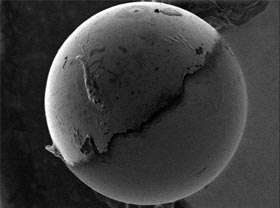
A dot-Janus particle less than 10 microns in diameter | Benjamin Yellin Lab, Pratt School of Engineering

(PhysOrg.com) -- Scientists drew fittingly from Roman mythology when they named a unique class of miniscule particles after the god Janus, who is usually depicted as having two faces looking in opposite directions.

For years, scientists have been fascinated by the tantalizing possibilities of these for their potential applications in electronic display devices, sensors and many other devices. However, realizing these applications requires precise control over the positions and orientation of the particles, something which has until now eluded scientists.

Duke University engineers say they can for the first time control all the degrees of the particle’s motion, opening up broad possibilities for nanotechnology and device applications. Their unique technology should make it more likely that Janus particles can be used as the building blocks for a myriad of applications, including such new technologies as and self-propelling micromachines.

Typical Janus particles consist of miniscule spherical beads that have one hemisphere coated with a magnetic or metallic material. External magnetic or electric fields can then be used to control the orientation of the particles. However, this coating interferes with optical beams, or traps, another tool scientists use to control positioning.

The breakthrough of Duke engineers was to devise a fabrication strategy to coat the particle with a much smaller fraction of material. This discovery allows these particles to be compatible with optical traps and external magnetic fields, allowing for total control over the particles’ positions and orientations.

“Past experiments have only been able to achieve four degrees of control using a combination of magnetic and optical techniques,” said Nathan Jenness, a graduate student who completed his studies this year from Duke’s Pratt School of Engineering. He and co-author Randall Erb, also a graduate student, were first authors of a paper appearing online in the journal Advanced Materials. “We have created a novel Janus particle that can be manipulated or constrained with six degrees of freedom.”

The researchers have dubbed the unique particles they created “dot-Janus” particles.

Using optical traps on dot-Janus particles, researchers controlled three degrees of movement - up and down, left and right, forward and backward, while constraining one degree of rotation - side-to-side tilting. Using magnetic fields, they controlled the remaining two degrees of rotation - forward and backward tilting, and left and right turning.

“The solution was to create a particle with a small cap of cobalt that covers about a quarter of the particle,” Erb said. He and Jenness conducted their research in the laboratory of Benjamin Yellen, Duke assistant professor of Mechanical Engineering and Materials Science. “This gave the particle just enough of a magnetic handle to allow it to be manipulated by magnetism without interfering with the optical tweezers.”

The researchers said that the fabrication of these unique dot-Janus particles combined with the ability to control their orientation will have important ramifications in the burgeoning field of nanoengineering.

“Being able to more completely control these particles affords us a greater ability to measure the mechanical properties of biomolecules, including DNA,” Yellen said. “It may also be possible to control the behavior of cells by manipulating dot-Janus particles attached to cell surfaces. These biological applications, as well as the ability to control the assembly of nanostructures, establish the broad scientific value of these findings.”

Provided by Duke University (news : web)


print this article email this article download pdf blog this article bookmark this article     Stumble it Digg this share on Facebook retweet share on Reddit add to delicious
Rate this story - 5 /5 (8 votes)

Rank Filter

Move the slider to adjust rank threshold, so that you can hide some of the comments.


Display comments: newest first

  • Birthmark - Aug 12, 2009
    • Rank: not rated yet
    This is very exciting, I can't wait to see the technology that comes for Janus particles. I just wish they gave an estimate for how many years until this technology is used.
  • kasen - Aug 13, 2009
    • Rank: not rated yet
    Well, they've proven it's feasible, now it just needs an adequate reason for mass production. As stated in the article, this will be quite a boon for medical research, so it won't be long till pharma companies will make it commonplace.

    I'm sure that if you couple all these small engineering breakthroughs, in a few years we'll have a working micro/nanobot prototype and that will be the beginning of a whole new era. Provided we survive till then, of course.
  • SmartK8 - Aug 13, 2009
    • Rank: not rated yet
    I hope the claytronics guys will get inspired.

August 12, 2009 all stories

Comments: 3

5 /5 (8 votes)
  • Stumble this up

  • Digg this

  • share this

  • hide
  • Related Stories

  • Sophisticated nano-structures assembled with magnets (Video)
    created Feb 18, 2009 | popularity not rated yet | comments 0
  • Janus particles offer new physics, new technology
    created Mar 13, 2006 | popularity not rated yet | comments 0
  • Polarized particles join toolbox for building unique structures
    created Oct 12, 2006 | popularity not rated yet | comments 0
  • Nano World: Two-faced Janus nanoparticles
    created Sep 27, 2005 | popularity not rated yet | comments 0
  • 'Two-Faced' Particles Act Like Tiny Submarines
    created Feb 21, 2008 | popularity not rated yet | comments 0


  • hide
  • Relevant PhysicsForums posts

  • photoconductivity of polymers
    created 3 hours ago
  • Heat pipe for high temperature
    created 16 hours ago
  • Robot built out of acrylic
    created Nov 24, 2009
  • Thickness or Ga. of Stainless steel water tank?
    created Nov 24, 2009
  • dynamic hardness measurements
    created Nov 21, 2009
  • May i know is structure such as bcc, fcc depends on how it process?
    created Nov 21, 2009
  • More from Physics Forums - Materials & Chemical Engineering

Other News

Fast, easy, and highly sensitive arsenic detection with gold nanoparticles

Nanotechnology / Nanomaterials

created 11 hours ago | popularity 5 / 5 (1) | comments 0

(PhysOrg.com) -- Mention of arsenic poisoning usually brings to mind underhanded murder. However, the danger of arsenic poisoning from contaminated drinking water is far greater. Low concentrations of arsenic are found in ...


Nanotech in Space: Experiment To Weather the Trials of Orbit

Nanotech in Space: Experiment To Weather the Trials of Orbit

Nanotechnology / Nanomaterials

created 23 hours ago | popularity 4 / 5 (2) | comments 0

Novel nanomaterials developed at Rensselaer were sent into orbit on Nov. 16 aboard Space Shuttle Atlantis.


Water droplets direct self-assembly process in thin-film materials

Nanotechnology / Nanomaterials

created Nov 23, 2009 | popularity 5 / 5 (4) | comments 2

You can think of it as origami - very high-tech origami. Researchers at the University of Illinois have developed a technique for fabricating three-dimensional, single-crystalline silicon structures from thin films by coupling ...


Nanotube defects equal better energy and storage systems

Nanotube defects equal better energy and storage systems

Nanotechnology / Nanomaterials

created Nov 19, 2009 | popularity 4.4 / 5 (10) | comments 2

(PhysOrg.com) -- Most people would like to be able to charge their cell phones and other personal electronics quickly and not too often. A recent discovery made by UC San Diego engineers could lead to carbon ...


Peptides control crystal growth with 'switches, throttles and brakes'

Peptides control crystal growth with 'switches, throttles and brakes'

Nanotechnology / Bio & Medicine

created Nov 23, 2009 | popularity 5 / 5 (3) | comments 0

(PhysOrg.com) -- By producing some of the highest resolution images of peptides attaching to mineral surfaces, scientists have a deeper understanding how biomolecules manipulate the growth crystals. This research ...