Uncovering the secrets of ulcer-causing bacteria
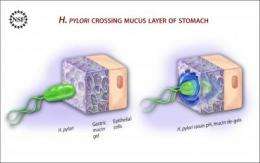
A team of researchers from Boston University, Harvard Medical School and Massachusetts Institute of Technology recently made a discovery that changes a long held paradigm about how bacteria move through soft gels. They showed that the bacterium that causes human stomach ulcers uses a clever biochemical strategy to alter the physical properties of its environment, allowing it to move and survive and further colonize its host.
The Proceedings of the National Academy of Sciences reports the findings in its most recent issue.
Helicobacter pylori is a bacterium that inhabits various areas of the stomach where it causes chronic, low-level inflammation and is linked to gastric ulcers and stomach cancer. In order to colonize the stomach, H. pylori must cope with highly acidic conditions in which other bacteria are unable to survive. It is well known however, that the bacterium accomplishes this by producing ammonia to neutralize the acid in its surroundings. In addition, newly published research shows it does something else; it changes its environment to enable freer movement.
Acidic conditions within the stomach also work against the bacteria's ability to move freely. This is due to a protein called "mucin," a crucial component of the protective mucus layer in the stomach. In the presence of acid mucin forms a protective gel, which acts as a physical barrier that stops harmful bacteria from reaching the cell wall.
But, H. pylori increases the pH of its surroundings and changes this "mucin" gel to a liquid, allowing the bacterium to swim across the mucus barrier, establish colonies, attack surface cells and form ulcers.
"Bacteria 'swim' through watery fluids using their tails to propel them," said Boston University physicist Rama Bansil, who is currently on leave from BU, working as a Division of Materials Research program manager at the National Science Foundation. "But it was not obvious how they move through a soft gel like mucus."
To answer the question Bansil, Shyam Erramilli and Jonathan Celli, also of Boston University, partnered with gastroenterologists Nezam Afdhal and Ciaran Kelly, and biochemists Sarah Keates, Bradley Turner and Ionita Ghiran at Harvard Medical School and mechanical and biomedical engineers Gareth McKinley, Peter So and Randy Ewoldt at MIT. The work began a few years ago as a feasibility study and was a part of Celli' Ph. D research.
Using video microscopes, the researchers found that when mucins extracted from mucus were in a liquid state, the bacteria could swim freely, but when mucins were in a gel state, the bacteria were stuck, even though their tails were rotating. More advanced imaging techniques revealed that pH changes directly correlated with the ability of the bacteria to move--the higher the pH, the greater the movement.
"This study indicates that the H. pylori, which is shaped very much like a screw, does not bore its way through the mucus gel like a screw through a cork as has previously been suggested," said Bansil. "Instead it achieves motility by using a clever biochemical strategy."
Researchers hope that the work will pave the way for future studies in native mucus and live animals to devise strategies for preventing H. pylori infection. Such studies could be important to the design of new therapeutic approaches that prevent the bacteria from colonizing in the first place, and also may be relevant to the broader question of bacterial infections in mucus linings in other organs.
Source: National Science Foundation (news : web)


