See no weevil: Researcher tracks rice bugs to help farmers, consumers (w/ Podcast)
August 12, 2009
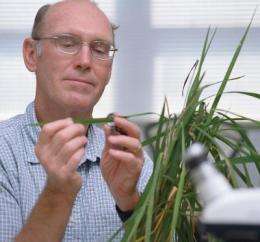
Dr. Michael "Mo" Way, Texas AgriLife Research entomologist at Beaumont, examines a rice plant in his lab. He's making gains on the water weevil which takes huge bites out of the rice crop globally every year. Credit: (Texas AgriLife Research photo)
When there's something bugging rice farmers, a large segment of the world's population is likely to find out.
Americans eat about 20.5 pounds of rice a year, while globally people annually eat about 126 pounds each, according to the United Nations Food and Agriculture Organization. Yet a big bite is also taken by insects in the field every year.
One of the worst, the rice water weevil, is a Southeast Texas native measuring in at less than one-fourth inch long. But its gray snout has chomped through much of the world making a sizable dent in the size and quality of global rice supplies.
A Texas researcher is making great strides - many of them splashing through rice paddies to scour grassy pinnacles and seed heads with his net - in controlling the rice-craving insect.
This video is not supported by your browser at this time.
Dr. Michael "Mo" Way, examines rice plants in his lab. His research on rice water weevil is helping find ways to cut losses to the insect worldwide. He talks about his work in this audio. Credit: Texas AgriLife Research news audio by Kathleen Phillips.
"I'm looking for ways to integrate a variety of treatments to manage pests efficiently and economically," said Dr. Michael "Mo" Way, Texas AgriLife Research entomologist at Beaumont, who has been working with rice and soybeans there since 1982.Rice water weevils are among the most serious pests in terms of causing lower yields and grain quality, Way said. And they don't just stop in Texas. Rice water weevils have become a global pest -- making it to California by the 1950s, to Japan in the 1970s, then China, Taiwan and more recently, Italy. In Texas, farmers can lose from 500-1,000 pounds per acre as this weevil swims, crawls and flies through the field, laying eggs underwater so the larvae can grow by gnawing on rice plant roots, the researcher explained.
Way was patient in his quest to see no weevil. He spent six years sweeping through fields, looking for water weevil damage to determine at what level it would make sense for a farmer to spend money controlling the pest.
Farmers had been referring to old data, he said, though many new rice varieties are being grown and with newer cultural methods, and it was not known whether these changes had made a difference on rice weevil control.
Armed with many seasons of field data from test areas grown as much like true farm situations as possible, Way and then-graduate student Luis Espino compared protected versus unprotected plots with those planted on a variety of dates. The protected plots were treated with various insecticides.
"What we found is that if farmers plant during the optimum planting window, then they can expect the greatest yield losses due to water weevil," he said. "And since we don't recommend planting outside that optimum time, it behooves them to control for the weevil.
"Usually, our highest management level farmers plant during that optimum time, from end of March to mid-April, and that enables them to produce a ratoon, or second crop as well," he added. "So, it makes good economic sense to control for the weevil."
To sample for water weevil in a field, Way and his team take a 4-inch by 4-inch plug that contains about three plants and the soil around the roots.
"For every one larvae per core, yield is reduced about 1 percent," he said. "So the economic injury levels (number of insects it takes to cause significant loss) are very low -- much lower than we thought."
Control usually means an insecticide, he noted, but researchers have also made strides in this area as well to develop products that are not as toxic to the environment as in the past.
"One of these is a seed treatment with rynaxypyr, a chemical that is far less toxic to mammals and wildlife than previous compounds," Way said. "Reports from the field this year where this product was used are very, very encouraging."
Way said because seed treatment is a preventive measure -- it has to be applied to the seed before planting and well beyond the time when larvae are found in the cores -- the researcher recommends that farmers go on their field history with weevils.
"Certain areas are more prone to water weevil damage," he said. Farmers should also make the decision to use seed treatment based on planting date, variety, seeding rate, typical plant stand and time of flood. "Based on these parameters, they can decide for themselves whether they will need the seed treatment," he added.
The study also noted a couple of secondary benefits from the seed treatment -- all of the chemical stays with the seed rather than drifts in the air, and it has shown ability to control other rice pests such as stalk borers, fall armyworm and South American rice miner.
"So this reduces the pesticide load in the environment," he said. "And farmers have another tool in their toolbox."
And people have more rice on their plates.
Source: Texas A&M AgriLife Communications
-
New canola strain takes the 'evil' out of 'weevil'
Jul 17, 2009 |
not rated yet |
0
-
Water-stingy agriculture reduces arsenic in rice markedly
Jul 28, 2008 |
not rated yet |
0
-
Research finds way to double rice crops in drought-stricken areas
Nov 20, 2008 |
not rated yet |
0
-
Arkansas rice farmers file a lawsuit
Aug 30, 2006 |
not rated yet |
0
-
Ag experts issue alfalfa weevil warming
Apr 11, 2007 |
not rated yet |
0
-
Engineers build first sub-10-nm carbon nanotube transistor
Feb 01, 2012 |
4.9 / 5 (33) |
30
-
Something old, something new: Evolution and the structural divergence of duplicate genes
Jan 31, 2012 |
4.6 / 5 (7) |
1
-
The hidden nanoworld of ice crystals: Revealing the dynamic behavior of quasi-liquid layers
Jan 30, 2012 |
5 / 5 (4) |
1
-
Stock market network reveals investor clustering
Jan 27, 2012 |
3.9 / 5 (23) |
8
-
Of microchemistry and molecules: Electronic microfluidic device synthesizes biocompatible probes
Jan 26, 2012 |
5 / 5 (2) |
0
-
Factors affecting beet root cell membrane
14 hours ago
-
Stem cell question.
Feb 10, 2012
-
Protease cleavage
Feb 10, 2012
-
Pertubance in a model
Feb 10, 2012
-
Cancer drugs and Alzheimer's, Oh my!
Feb 09, 2012
-
Squishing cells
Feb 09, 2012
- More from Physics Forums - Biology
More news stories
A mitosis mystery solved: How chromosomes align perfectly in a dividing cell
Although the process of mitotic cell division has been studied intensely for more than 50 years, Whitehead Institute researchers have only now solved the mystery of how cells correctly align their chromosomes during symmetric ...
10 hours ago |
4.3 / 5 (16) |
0
|
Researchers find extensive RNA editing in human transcriptome
In a new study published online in Nature Biotechnology, researchers from BGI, the world's largest genomics organization, reported the evidence of extensive RNA editing in a human cell line by analysis of RNA-seq data, demons ...
10 hours ago |
5 / 5 (4) |
0
|
The proteins ensuring genome protection
Researchers from the University of Geneva (UNIGE), Switzerland, have discovered the crucial role of two proteins in developing a cell 'anti-enzyme shield'. This protection system, which operates at the level of molecular ...
10 hours ago |
5 / 5 (3) |
0
|
Entire genome of extinct human decoded from fossil
(PhysOrg.com) -- In 2010, Svante Pääbo and his colleagues presented a draft version of the genome from a small fragment of a human finger bone discovered in Denisova Cave in southern Siberia. The ...
Feb 07, 2012 |
4.7 / 5 (60) |
51
|
Why are there so few fish in the Earth's oceans?
(PhysOrg.com) -- A Stony Brook University researcher has found that, contrary to popular belief, there are not plenty of fish in the sea.
Feb 08, 2012 |
4.2 / 5 (18) |
27
|
Scientists discover molecular secrets of 2,000-year-old Chinese herbal remedy
For roughly two thousand years, Chinese herbalists have treated Malaria using a root extract, commonly known as Chang Shan, from a type of hydrangea that grows in Tibet and Nepal. More recent studies suggest that halofuginone, ...
New method to examine batteries -- MRI from the inside
There is an ever-increasing need for advanced batteries for portable electronics, such as phones, cameras, and music players, but also to power electric vehicles and to facilitate the distribution and storage of energy derived ...
Google might launch Drive for cloud storage soon
(PhysOrg.com) -- Google's next big move, according to the Wall Street Journal, is a cloud storage service called Drive. Hardly first to the plate, Google is simply catching up to introducing its cloud reposi ...
Lab study raises questions over nano-particle impact
Tests involving chickens have raised questions about the impact on health from engineered nano-particles, the ultra-fine grains commonly used in drugs and processed foods, scientists said on Sunday.
Starve a virus, feed a cure? Findings show how some cells protect themselves against HIV
A protein that protects some of our immune cells from the most common and virulent form of HIV works by starving the virus of the molecular building blocks that it needs to replicate, according to research published online ...
Overeating may double risk of memory loss
New research suggests that consuming between 2,100 and 6,000 calories per day may double the risk of memory loss, or mild cognitive impairment (MCI), among people age 70 and older. The study was released today and will be ...