Researchers reveal the internal dance of water
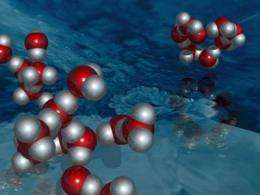
(PhysOrg.com) -- Water is familiar to everyone - it shapes our bodies and our planet. But despite this abundance, the molecular structure of water has remained a mystery, with the substance exhibiting many strange properties that are still poorly understood. Recent work at the SLAC National Accelerator Laboratory and several universities in Sweden and Japan, however, is shedding new light on water's molecular idiosyncrasies and offering insight into its strange bulk properties.
In all, water exhibits 66 known anomalies, including a strangely varying density, large heat capacity and high surface tension. Contrary to other "normal" liquids, which become increasingly denser as they get colder, water reaches its maximum density at about 4 degrees Celsius. Above and below this temperature, water is less dense; this is why, for example, lakes freeze from the surface down. Water also has an unusually large capacity to store heat, which stabilizes the temperature of the oceans, and a high surface tension, which allows insects to walk on water, droplets to form and trees to transport water to great heights.
"Understanding these anomalies is very important because water is the ultimate basis for our existence; no water, no life," said SLAC scientist Anders Nilsson, who is leading the experimental efforts. "Our work helps explain these anomalies on the molecular level at temperatures which are relevant to life."
How the molecules arrange themselves in water's solid form, ice, was long ago established: The molecules form a tight "tetrahedral" lattice, with each molecule binding to four others. Discovering the molecular arrangement in liquid water, however, is proving to be much more complex. For over 100 years, this structure has been the subject of intense debate. The current textbook model holds that since ice is made up of tetrahedral structures, liquid water should be similar, but less structured, given that heat creates disorder and breaks bonds. As ice melts, the story goes, the tetrahedral structures loosen their grip, breaking apart as the temperature rises, but all still striving to remain as tetrahedral as possible, resulting in a smooth distribution around distorted, partially broken tetrahedral structures.
Textbook model is incorrect
Recently, Nilsson and colleagues directed powerful X-rays, generated by the Stanford Synchrotron Radiation Lightsource at SLAC and the SPring-8 synchrotron facility in Japan, at samples of liquid water. These experiments suggested that the textbook model of water at ambient conditions is incorrect and that, unexpectedly, two distinct structures, either very disordered or very tetrahedral, exist no matter what the temperature.
In a paper scheduled for publication in the Proceedings of the National Academy of Sciences, the researchers reveal the additional discovery that the two types of structure are spatially separated, with the tetrahedral structures existing in "clumps" made of up to about 100 molecules surrounded by disordered regions; the liquid is a fluctuating mix of the two structures at temperatures ranging from ambient to all the way up near the boiling point. As the temperature of water increases, fewer and fewer of these clumps exist; but they are always there, in clumps of a similar size. The researchers also discovered that the disordered regions themselves become more disordered as the temperature rises.
"One can visualize this as a crowded dance restaurant, with some people sitting at large tables, taking up quite a bit of room - like the tetrahedral component in water - and other people on the dance floor, standing close together and moving slower or faster depending on the mood or 'temperature' of the restaurant; like the molecules in the disordered regions can be excited by heat, the dancers can be excited and move faster with the music," Nilsson said. "There's an exchange when people sitting decide to get up to dance and other dancers sit down to rest. When the dance floor really gets busy, tables can also be moved out of the way to allow for more dancers, and when things cool back off, more tables can be brought in."
This more detailed understanding of the molecular structure and dynamics of liquid water at ambient temperatures mirrors theoretical work on "supercooled" water: an unusual state in which water has not turned into ice even though it is far below the freezing point. In this state, theorists postulate, the liquid is made up of a continuously fluctuating mix of tetrahedral and more disordered structures, with the ratio of the two depending on temperature - just as Nilsson and his colleagues have found to be the case with water at the ambient temperatures important for life.
Popular notion dispelled
"Previously, hardly anyone thought that such fluctuations leading to distinct local structures existed at ambient temperatures," Nilsson said. "But that's precisely what we found."
This new work explains, in part, the liquid's strange properties. Water's density maximum at 4 degrees Celsius can be explained by the fact that the tetrahedral structures are of lower density that does not vary significantly with temperature, while the more disordered regions - which are of higher density - become more disordered and so less dense with increasing temperature. Likewise, as water heats, the percentage of molecules in the more disordered state increases, allowing this excitable structure to absorb significant amounts of heat, which leads to water's high heat capacity. Water's tendency to form strong hydrogen bonds explains the high surface tension that insects take advantage of when walking across water.
Connecting the molecular structure of water with its bulk properties in this way is important for fields ranging from medicine and biology to climate and energy research.
"If we don't understand this basic life material, how can we study the more complex life materials - like proteins - that are immersed in water?" asked postdoctoral researcher Congcong Huang, who conducted the X-ray scattering experiments. "We must understand the simple before we can understand the complex."
More information: www.pnas.org/content/early/200 … /0904743106.abstract
Provided by Stanford University (news : web)


