Worth the effort? Not if you're depressed
August 12, 2009 Worth the effort? Not if you're depressed

Enlarge

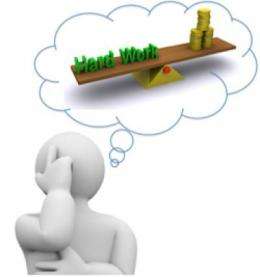
Individuals suffering from anhedonia, a key symptom of depression, are less likely to pursue rewards if effort is required to obtain the reward. Credit: Michael Treadway, Vanderbilt University

New research indicates that decreased cravings for pleasure may be at the root of a core symptom of major depressive disorder. The research is in contrast to the long-held notion that those suffering from depression lack the ability to enjoy rewards, rather than the desire to seek them.

The research, led by Vanderbilt psychologists Michael Treadway and David Zald, was published Aug. 12 by the online journal .

"This initial study shows that decreased reward processing, which is a core symptom of depression, is specifically related to a reduced willingness to work for a reward," Treadway, a graduate student in psychology, said.

Decreased motivation to seek and experience pleasurable experiences, known as anhedonia, is a primary symptom of . Anhedonia is less responsive to many and often persists after other symptoms of depression subside. However, understanding the different components of anhedonia - the desire to obtain something pleasurable versus experiencing pleasure - has been difficult for researchers to determine in humans.

"In the last decade and a half, animal models have found that the dopamine, long known to be involved in reward processing, is involved in craving or motivation, but not necessarily enjoyment," Treadway said. "To date, research into reward processing in individuals with anhedonia has focused on enjoyment of rewards, rather than assessing the drive to work for them. We think this task is one of the first to do that."

Treadway and his colleagues devised the Effort-Expenditure for Rewards Task, or EEfRT, to explore the role of reduced desire and motivation in individuals reporting symptoms of anhedonia. EEfRT involved having individuals play a simple video game that gave them a chance to choose between two different tasks, one hard, one difficult, to obtain monetary rewards. Participants were eligible but not guaranteed to receive money each time they completed a task successfully.

The "hard" task required pressing a button 100 times within 21 seconds using one's non-dominant little finger and carried a potentially higher reward than the easy task, which required pressing a button 30 times in seven seconds using one's dominant index finger. The subjects were told at the beginning of each trial whether they had a high, medium or low probability of winning a prize if they successfully completed the trial. The participants could choose which trials they completed and were given 20 minutes to perform as many tasks as possible.

The researchers found that subjects who reported symptoms consistent with anhedonia where less willing to make choices requiring greater effort in exchange for greater reward, particularly when the rewards were uncertain.

"Consistent with our hypotheses, we found that individuals with self-reported anhedonia made fewer hard-task choices," the authors wrote. "These findings are consistent with theoretical models linking anhedonia to decreased (dopamine levels)."

"By addressing the motivational dimension of anhedonia, our findings suggest a plausible theoretical connection between dopamine deficiency and reward processing in , which may eventually help us better understand how anhedonia responds to treatment," Treadway said.

Source: Vanderbilt University (news : web)


print this article email this article download pdf blog this article bookmark this article     Stumble it Digg this share on Facebook retweet share on Reddit add to delicious
Rate this story - 4.6 /5 (19 votes)

Rank Filter

Move the slider to adjust rank threshold, so that you can hide some of the comments.


Display comments: newest first

  • zevkirsh - Aug 13, 2009
    • Rank: 5 / 5 (1)
    i think i'll go smoke a ciggarette
  • david_42 - Aug 13, 2009
    • Rank: 5 / 5 (1)
    An interesting confirmation of my own experience with depression. Evaluation of depression always asks about enjoying activities. Why bother? prevents me from seeking out the activity in the first place.
  • Nik_2213 - Aug 13, 2009
    • Rank: not rated yet
    Yeah, like the other 'gotcha': Not Passive-Aggressive Condition, but old-fashioned 'Compliance Fatigue'...
  • finitesolutions - Aug 13, 2009
    • Rank: not rated yet
    Quitting is also a decision: a hard one.
  • fuzz54 - Aug 13, 2009
    • Rank: 5 / 5 (1)
    My experience with anhedonia agrees with this article. None of the antidepressants really cured it except for one which worked on serotonin AND dopamine. Just serotonin or dopamine alone didn't do it. And of course I went to therapy to figure out what goals I should be working towards to actually make me happy once I had the motivation to fix things.
  • paulthebassguy - Aug 13, 2009
    • Rank: not rated yet
    But in this test what was the most logical way to get the best reward? - Since you only had 20 minutes, wouldn't it be best to concentrate on the easier tasks where you had a more likely chance of getting a reward, in order to get the most amount of money at the end?
  • AMMBD - Aug 15, 2009
    • Rank: not rated yet
    @fuzz54 - what was the name of that drug that worked? i would like to suggest my father's doctor look into it.
  • fuzz54 - Oct 12, 2009
    • Rank: not rated yet
    The drug I took that had serotonin and dopamine was Effexor XR. There is now a generic version of this drug available. Effexor can have significant withdrawl symptoms though, so it can be hard to get off of and can be awful if you forget a dose and don't have access to it. I'm not having any problems though and am successfully dropping my dosage with no side effects.

August 12, 2009 all stories

Comments: 8

4.6 /5 (19 votes)
  • Stumble this up

  • Digg this

  • share this

  • hide
  • Related Stories

  • Brain response to information about the future suggests that ignorance isn't bliss
    created Jul 15, 2009 | popularity not rated yet | comments 0
  • The conflict of reward in depression
    created Mar 25, 2008 | popularity not rated yet | comments 0
  • Altered Perception of Reward in Human Cocaine Addiction
    created Oct 16, 2006 | popularity not rated yet | comments 0
  • Study shows how using mental strategies can alter the brain's reward circuitry
    created Jun 29, 2008 | popularity not rated yet | comments 0
  • Bikini-clad women make men impatient
    created May 30, 2008 | popularity not rated yet | comments 0


  • hide
  • Relevant PhysicsForums posts

  • Obsessive Compulsive Disorder
    created Nov 20, 2009
  • West's zone 2 starling resistor respiratory physiology
    created Nov 18, 2009
  • 50-0-50 rule
    created Nov 18, 2009
  • What is the evidence in support of the anti-vaccine movement?
    created Nov 17, 2009
  • More from Physics Forums - Medical Sciences

Other News

Swine flu vaccine effective despite mutations: experts

Medicine & Health / Diseases

created 15 hours ago | popularity 1 / 5 (1) | comments 1

Swine flu vaccines are still effective despite reported cases of mutations in the A(H1N1) virus, health experts in Europe and North America said Saturday.


Study raises concerns about outdoor second-hand smoke

Medicine & Health / Health

created Nov 18, 2009 | popularity 2 / 5 (4) | comments 21

Indoor smoking bans have forced smokers at bars and restaurants onto outdoor patios, but a new University of Georgia study in collaboration with the Centers for Disease Control and Prevention suggests that these outdoor smoking ...


smoking, cigarette

Vaccine being developed to help smokers quit

Medicine & Health / Medications

created Nov 20, 2009 | popularity 4.5 / 5 (11) | comments 10

(PhysOrg.com) -- Glaxo-SmithKline has joined forces with Nabi Pharmaceuticals to produce a vaccine to help smokers give up their addiction permanently.


Pilot study relates phthalate exposure to less-masculine play by boys

Medicine & Health / Research

created Nov 16, 2009 | popularity 4.8 / 5 (9) | comments 9

A study of 145 preschool children reports, for the first time, that when the concentrations of two common phthalates in mothers' prenatal urine are elevated their sons are less likely to play with male-typical toys and games, ...


wine

Alcohol helps lower heart disease risk for men: study

Medicine & Health / Health

created Nov 19, 2009 | popularity 4.2 / 5 (6) | comments 7

Men who drink alcohol every day see a nearly one-third average reduction in the risk of coronary heart disease, according to a long-term study among Spanish men published on Thursday.